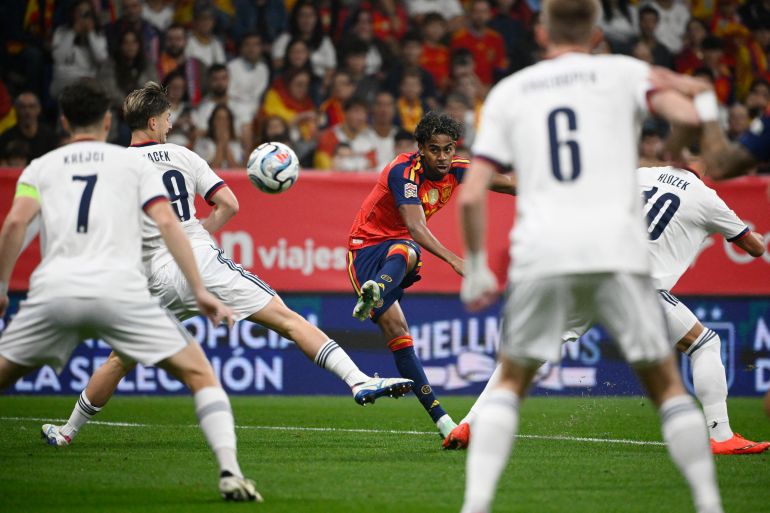
Lamine Yamal’s latest Spain goal lasted only six minutes before becoming another line in the record books.
The Barcelona winger opened the scoring in Spain’s 3-1 Nations League victory over Czechia, following early goals against England and Croatia in his previous two internationals. Reports highlighted that he became the first player in years to score so early in three consecutive international matches.
The statistic is eye-catching, but it also points towards something more important in Spain’s attack: Yamal is not waiting for matches to settle before influencing them.

Spain are using the opening phase as an attacking weapon
Many possession teams spend the first ten minutes measuring an opponent. Spain increasingly look prepared to attack immediately.
Against Czechia, Yamal’s early goal rewarded a start in which Luis de la Fuente’s team played with width, quick combinations and aggressive positioning around the penalty area. Rodri later added a second before Mikel Merino completed the scoring after the visitors briefly threatened a comeback.
Spain still controlled possession, but the purpose was not simply to move the opponent from side to side. The first objective was to create an isolation for Yamal or open the inside channel around him.
Once Spain score early, the geometry of the game changes. Opponents have to leave their defensive shell, creating more room for Rodri, the advanced midfielders and the opposite winger.

Yamal’s threat begins before he touches the ball
The teenager’s most important influence is not always the dribble itself. Defenders are already adjusting their starting positions because they expect him to receive wide on the right.
A full-back who gets too tight risks being beaten on the outside. A full-back who stays deeper creates space for Spain’s right-sided midfielder to receive between the lines. If a second defender moves across, central space becomes available.
That is why Yamal can dominate a match even when he is not constantly carrying the ball. His reputation changes the defensive shape before the pass arrives.
The Football Xtra examined that wider influence in its Ballon d’Or analysis of Lamine Yamal. His international performances are strengthening the same argument: elite attacking value is not only about goals and assists, but about how much an opponent has to alter its structure because one player is on the pitch.

Rodri gives Spain the freedom to attack early
Yamal’s fast starts are also connected to the security behind him. Spain can commit numbers forward because Rodri remains one of the best midfielders in the game at controlling transitions.
His goal against Czechia attracted attention, but his positioning is more important to the system. When an attack breaks down, Rodri’s first movement often prevents the opponent from turning the turnover into a counterattack.
That allows Spain’s full-backs and attacking midfielders to start higher. It also means Yamal can stay closer to the final third instead of constantly retreating to rebuild the team’s shape.
Merino gives the attack a different route
Mikel Merino’s late goal demonstrated another element of Spain’s attacking variety. If opponents overload the right side to contain Yamal, Spain still have runners who can attack central and left-sided spaces.
That balance is important because overdependence on one winger eventually becomes predictable. De la Fuente’s challenge is to use Yamal as the main source of imbalance without turning every possession into an attempt to find him.
The unbeaten run has created expectation
Spain’s 3-1 victory kept their perfect start to the Nations League group and extended a long unbeaten sequence. Results have created the expectation that they should control almost every opponent.
That creates a different problem from the one facing developing teams. Spain are no longer trying to prove they can dominate. They are trying to keep finding new ways to dominate once opponents arrive with a plan built specifically to stop them.
Yamal’s ability to score before that defensive plan settles is therefore particularly valuable.

The next stage is managing the dependence
Spain should not need Yamal to produce a decisive moment every time they play. The strongest version of this team uses his threat to create opportunities elsewhere.
That will matter against elite opponents. The Football Xtra’s preview of PSG against Barcelona showed how quickly top sides can target the space left behind aggressive attacking players. International football brings the same problem when Spain face teams capable of escaping the press.
For now, Yamal’s scoring sequence is evidence of an attack that starts with intent. Three consecutive early international goals are unlikely to become a permanent pattern, but the behaviour behind them can be repeated: isolate him quickly, attack before the block settles and use the attention he attracts to free the rest of the team.
Spain’s advantage is not simply that they possess one of the world’s most dangerous young forwards. It is that they increasingly understand how to make the first minutes of a match belong to him.
Read Here: GOAL — Lamine Yamal makes Spain history against Czechia