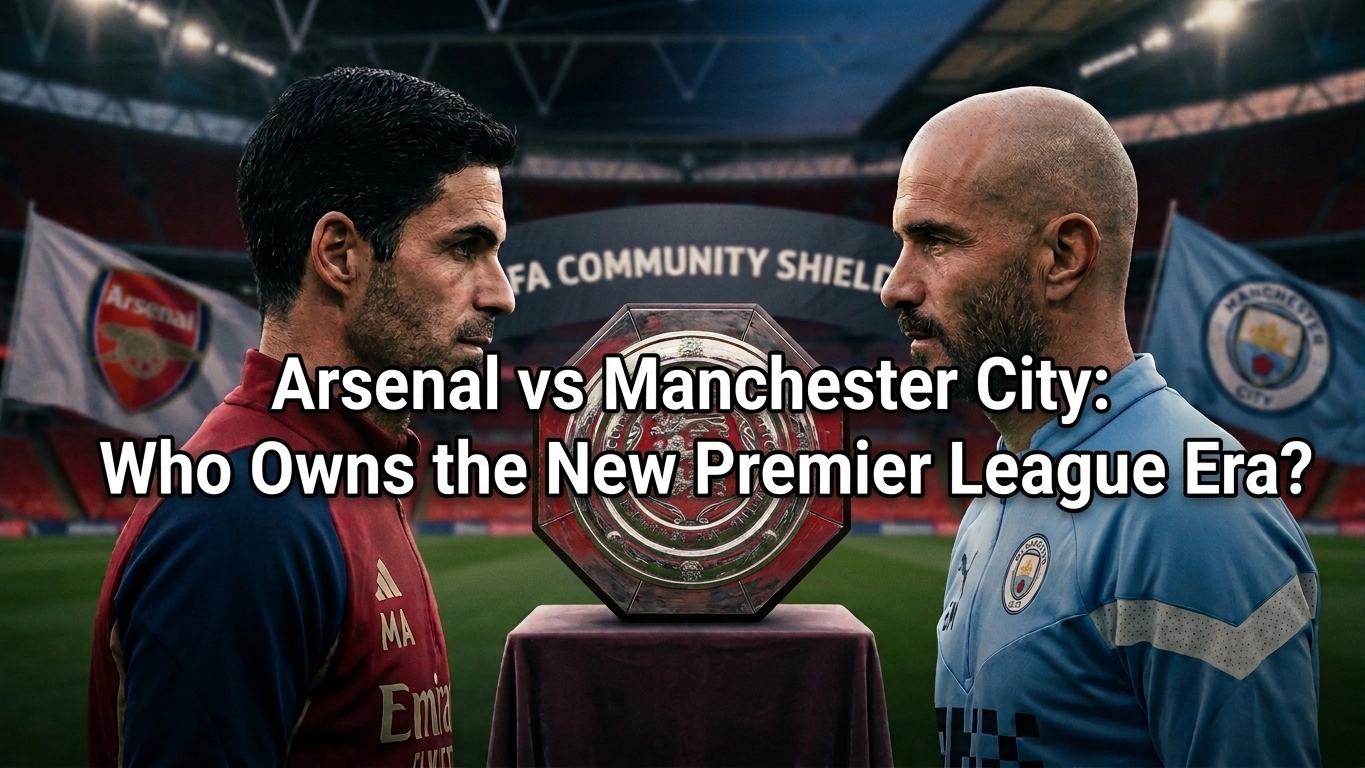
This is not just Arsenal vs Manchester City. It is the first serious test of whether the Premier League’s old power structure has actually changed.
For years, Manchester City set the standard. Under Pep Guardiola, they turned winning the Premier League into something approaching routine, collecting six league titles during his decade in charge and adding a first Champions League crown to the club’s history.
Then came the shift.
Arsenal finally broke through in 2025/26, ending a 22-year wait for the Premier League title and finishing seven points ahead of City.
Now Guardiola is gone.
Mikel Arteta remains.
And on Sunday, 16 August, the two clubs meet at Cardiff’s Principality Stadium in the 2026 FA Community Shield — Arsenal as Premier League champions and City as FA Cup holders.
The trophy itself will not decide the 2026/27 title race.
But the football might reveal something much more important.
Has Arsenal genuinely taken control of English football, or has Manchester City’s empire simply entered its next phase?
Why This Community Shield Matters More Than Usual
 The Community Shield is traditionally the curtain-raiser to the domestic season, bringing together the Premier League champions and FA Cup winners.
But the circumstances surrounding this particular meeting make it unusually significant.
Arsenal are no longer the ambitious challengers trying to close the gap.
They are the champions.
City are no longer defending a Guardiola-built dynasty.
They are beginning the Enzo Maresca era.
That changes the psychological equation completely.
The 2025/26 Premier League season ended with Arsenal on 85 points and City on 78. Arsenal were crowned champions after City’s draw at Bournemouth made them mathematically uncatchable.
It was not a symbolic changing of the guard.
It was a seven-point gap over 38 matches.
Yet football rarely allows one season to settle a long-term argument.
City have won eight Premier League titles in total. Arsenal have now won four.
The question is therefore not whether Arsenal deserved last season’s title.
They did.
The question is whether they can turn one championship into an era.
Arsenal Are No Longer the Hunters
One of the most interesting aspects of this match is the psychological transformation of Mikel Arteta’s team.
For several seasons, Arsenal were judged by how close they could get to Manchester City.
They finished second three consecutive times before finally going one step further in 2025/26. Arteta’s first Premier League Manager of the Season award arrived alongside the title that ended the club’s 22-year wait.
That history matters.
Because being the challenger allows you to play with freedom.
Being the champion creates a different burden.
Every opponent now wants to beat you.
Every tactical weakness is studied.
Every poor result becomes evidence that the title was a one-off.
And every transfer decision is judged against the standard of defending the crown.
Arteta therefore faces a completely different challenge.
He must make Arsenal better without allowing them to become predictable.
That distinction could define Sunday’s game.
Arsenal’s Next Evolution: From Control to Adaptability
The most important tactical question for Arsenal is not simply how much possession they will have.
It is what they do when Manchester City refuse to give them the game they want.
The 2025/26 meeting at the Emirates provides an interesting reference point.
City took the lead through Erling Haaland in the ninth minute and spent much of the match protecting that advantage. Arsenal dominated possession — 66.8% to City’s 33.2% — and produced 12 shots to City’s five.
Yet the match finished 1-1 after Gabriel Martinelli’s stoppage-time equaliser.
That game exposed an important tactical reality.
Arsenal can control territory without necessarily controlling the score.
Against a deep City block, possession can become circulation rather than penetration.
That is precisely where Arsenal’s evolution will be tested.
The arrival of Bruno Guimarães gives Arteta another elite midfield option and potentially greater physicality and ball progression through the middle. Arsenal also strengthened elsewhere during the summer, including the addition of Christos Tzolis and goalkeeper Illan Meslier.
The objective should not simply be to reproduce last season’s Arsenal.
It should be to create an Arsenal capable of winning matches in more than one way.
The Declan Rice Question
 One of Sunday’s most intriguing selection issues is Declan Rice.
Arteta confirmed that Rice, Bukayo Saka and Martin Zubimendi are available for the Community Shield despite their relatively recent return from extended post-World Cup breaks.
Rice’s importance goes beyond his defensive numbers.
His ability to carry the ball, cover large spaces and arrive around the penalty area gives Arsenal an important bridge between defensive stability and attacking aggression.
Against City’s positional game, that could become critical.
If Arsenal press high and City break the first line, Rice may be required to protect the spaces that open behind the midfield.
If Arsenal sit slightly deeper, his ball-carrying could become the mechanism for turning defensive recoveries into attacking transitions.
That versatility is precisely why Arsenal need him.
Then There Is Manchester City
If Arsenal represent continuity, Manchester City represent the biggest experiment of the afternoon.
Pep Guardiola is gone.
That sentence alone changes the context of everything City do.
Guardiola left after a decade at the Etihad, having won six Premier League titles and the Champions League.
Replacing that kind of manager is almost impossible.
Manchester City have therefore chosen something different from a revolution.
They have chosen continuity through Maresca.
The Italian is not an outsider arriving to dismantle Guardiola’s football.
He knows the club.
He previously worked within Guardiola’s coaching structure and later developed his own managerial career at Leicester and Chelsea before returning to Manchester as Guardiola’s successor.
Maresca has also made it clear that he does not intend to radically change the footballing blueprint inherited from Guardiola.
That makes Sunday’s match fascinating.
The tactical question is not:
“Can Maresca copy Guardiola?”
It is:
“How much can Maresca preserve before he needs to become his own manager?”
Maresca’s Biggest Challenge Is Not Tactics
City’s biggest problem may not be whether Maresca understands positional play.
He clearly does.
The bigger issue is whether he can maintain the competitive standards and psychological authority that Guardiola established.
A manager can inherit a tactical system.
He cannot inherit another manager’s aura.
That is why the Community Shield matters.
Maresca’s first opportunity to win silverware with Manchester City comes against the very team that ended Guardiola’s reign at the top of the Premier League.
And he has already described the game as a serious contest rather than treating it as a meaningless friendly.
For Maresca, this is the beginning of his credibility-building process.
For City, it is the beginning of discovering what their identity looks like without Guardiola standing on the touchline.
The Rodri Problem Could Change Everything
There is another subplot that could dominate City’s new era: Rodri’s future.
Maresca has refused to give certainty over the midfielder’s long-term future amid speculation linking him with Barcelona. He has also confirmed that Rodri is back in training after recovering from back surgery.
That uncertainty matters enormously because Rodri is not simply another midfielder.
He is structural.
He gives City control during possession.
He protects transitions.
He allows attacking players to move higher.
He gives the team’s positional structure a stable reference point.
If Rodri remains, Maresca has one of the world’s most important tactical anchors available to him.
If he leaves, City would not merely be replacing a player.
They would potentially have to redesign part of their midfield architecture.
That makes the Community Shield another opportunity to watch how Maresca intends to use him.
City’s New Attacking Formula
 There is already one intriguing development from City’s preseason.
During their Asian tour, Antoine Semenyo and Omar Marmoush developed an encouraging relationship. In the 3-1 win over Atlético Madrid, Semenyo provided two assists for Marmoush, while he finished the tour with four assists in three matches.
That is not enough evidence to declare a new attacking dynasty.
But it is enough to identify a tactical trend worth watching.
Maresca has several players capable of attacking from wide areas and then moving inside.
That creates a different type of threat from the classic City structure where width and positional occupation were meticulously controlled.
If Semenyo and Marmoush can attack spaces quickly rather than simply circulating possession, City could become more direct without abandoning their possession principles.
That would be one of Maresca’s most interesting possible contributions.
Guardiola’s City were masters of controlling the game. Maresca’s City may need to become masters of changing the game’s speed.
The Elliot Anderson Experiment
 Then there is Manchester City’s most expensive British signing.
Elliot Anderson joined from Nottingham Forest for a deal reportedly worth up to £116 million, making him the second-most expensive British player.
His arrival is particularly interesting because Anderson is not simply being bought for squad depth.
His profile gives City another midfielder capable of contributing both defensively and offensively.
He has described himself as a versatile box-to-box midfielder, and his first competitive test could come against the reigning champions.
That makes his potential role one of the key tactical stories of the match.
Can he provide the physicality required in a Premier League title race while still operating inside City’s positional framework?
If the answer is yes, City may have found an important piece of the post-Guardiola rebuild.
The Previous Battle Offers a Warning
There is another reason neither side should overreact to Sunday’s result.
Arsenal and City have already produced wildly different tactical battles in recent seasons.
In September 2025, their Premier League meeting finished 1-1 despite Arsenal having 66.8% possession and 11 corners. City were able to take the lead early, defend their advantage and ultimately concede only in the 93rd minute.
The lesson is important:
Possession does not automatically equal control.
And the opposite is also true.
City’s lower possession in that match did not mean they had abandoned their identity.
They adapted to the circumstances.
That is why Sunday’s match should be judged through the tactical details rather than simply the final score.
Three Tactical Battles That Could Decide the Shield
1. Arsenal’s Press vs City’s First Build-Up
The first question will be whether Arsenal aggressively press City’s centre-backs and goalkeeper or allow them to establish possession.
If Arsenal press too aggressively, City can potentially exploit the spaces behind the first line.
If Arsenal remain passive, City can gradually establish territorial control.
The balance will be crucial.
2. Rodri and City’s Midfield Control vs Arsenal’s Physicality
If Rodri starts, his positioning could determine how easily City escape Arsenal’s pressure.
Arsenal’s midfield, meanwhile, has greater physical and technical options than in previous seasons.
The battle will not simply be about who has more possession.
It will be about who controls the spaces between the lines.
3. Wide Attacks and Transition Speed
Saka remains Arsenal’s most obvious wide threat, while City have several players capable of creating overloads and attacking isolated defenders.
The team that transitions faster after winning possession could gain an advantage.
This is particularly important because both clubs possess enough technical quality to punish a defensive structure that takes even one wrong step.
Why the Result Could Be Misleading
There is a temptation to say:
If Arsenal win, the new era has begun.
Or:
If City win, Guardiola’s departure does not matter.
Both conclusions would be premature.
The Community Shield is one match.
It cannot measure a 38-game Premier League campaign.
It cannot measure Champions League fatigue.
It cannot predict injuries.
It cannot account for the final two weeks of the transfer window.
And it certainly cannot determine whether Arsenal can maintain their consistency over an entire season.
But it can reveal how both managers want their teams to behave.
That is what makes it valuable.
Arsenal vs Manchester City Is Now a Different Rivalry
For years, this fixture represented Arsenal’s attempt to dethrone City.
Now it represents something more complicated.
Arsenal have already done it.
They finished seven points clear, ended a 22-year title drought and reached their first Champions League final in two decades during the same campaign.
City, meanwhile, are rebuilding without Guardiola.
That means Sunday’s match has almost become a referendum on two competing futures.
Arsenal’s future is about defending what they finally achieved.
Manchester City‘s future is about proving that their dominance was bigger than one manager.
That is a far more interesting story than the Community Shield trophy itself.
What’s Next?
The 2026 FA Community Shield will be played at the Principality Stadium in Cardiff on Sunday, 16 August, with Sam Barrott appointed as referee. It is the first Community Shield appearance for Arsenal since 2023, when they beat Manchester City on penalties after a 0-0 draw.
But Sunday’s result should be treated as a clue, not a verdict.
Arsenal have already proven they can beat the Premier League’s established hierarchy.
Now they must prove they can stay there.
Manchester City have already proven they can dominate English football.
Now they must prove they can do it without Pep Guardiola.
And that is why this Community Shield matters.
The trophy will go into one cabinet. But the bigger prize is the narrative.
If Arsenal look tactically more flexible, physically stronger and mentally comfortable as champions, the rest of the Premier League will have reason to believe the power balance has genuinely shifted.
If Maresca’s City show they can maintain Guardiola’s control while adding greater verticality, physicality and unpredictability, the rest of England may discover that Manchester City’s era was never about one man alone.
Either way, Cardiff offers the first serious answer.
The old Premier League order is being tested. And Arsenal vs Manchester City is where the next chapter begins.
What do you think: have Arsenal genuinely taken Manchester City’s place at the top of English football, or will Maresca’s City reclaim the Premier League crown? Share your view in the comments.