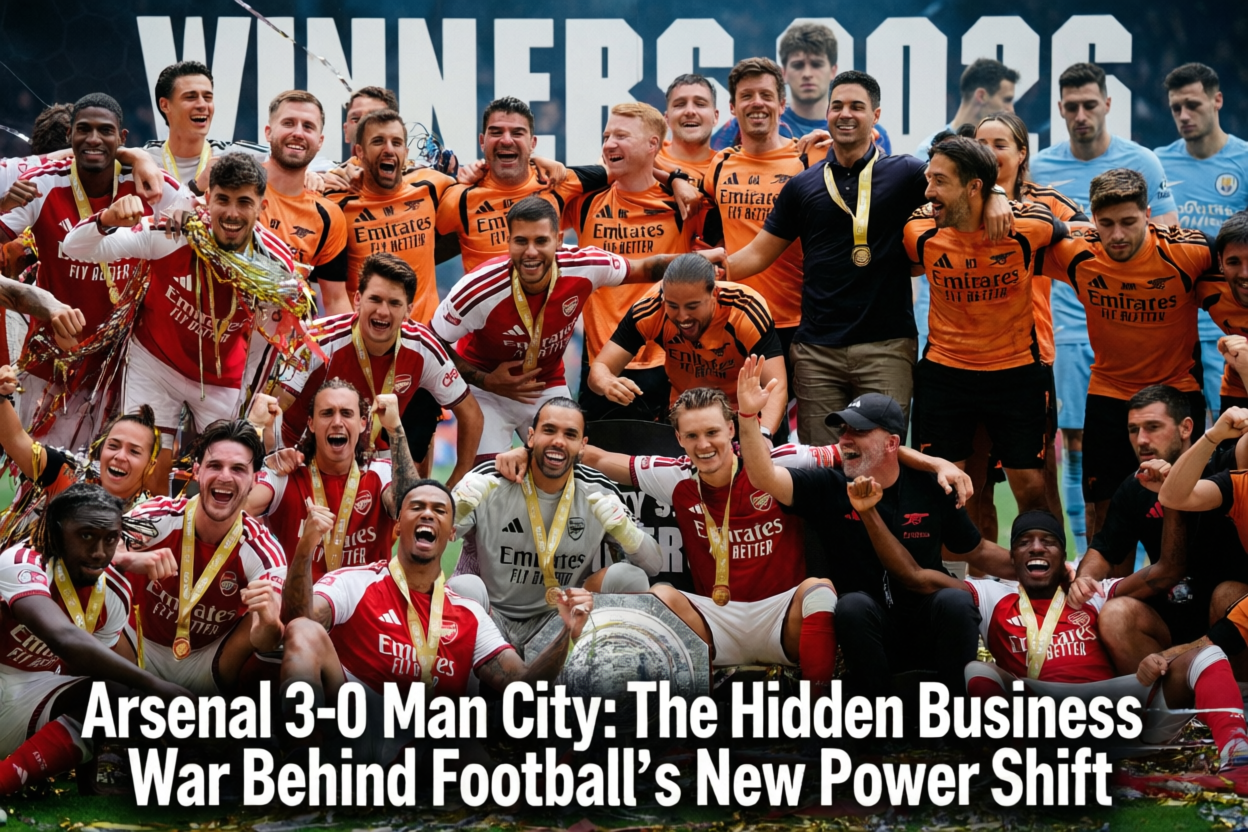
Arsenal 3-0 Man City Was More Than a Football Result
The most important thing Arsenal won in Cardiff may not have been the Community Shield. It was attention — and in modern football, attention can eventually become money.
At 23 seconds, Riccardo Calafiori put Arsenal ahead.
Kai Havertz doubled the advantage before half-time.
Martin Ødegaard completed the 3-0 victory after the break.
Manchester City, beginning life after Pep Guardiola under Enzo Maresca, never found a response. Arsenal did not merely lift the first trophy of the 2026/27 campaign; they produced the kind of high-profile performance that can shape the commercial narrative around a football club.
That is where the real story begins.
Because Arsenal vs Manchester City is no longer simply a competition between two football teams.
It is increasingly a competition between two football businesses.
Manchester City spent the Guardiola era building one of the most powerful commercial machines in world football.
Arsenal have spent the Arteta era rebuilding their sporting identity, reconnecting with supporters and pushing themselves into Europe’s financial elite.
Now the question is becoming much bigger:
Can Arsenal convert sporting success into a self-sustaining financial advantage — and eventually build an economic engine capable of challenging Manchester City’s?
The 3-0 scoreline does not answer that question.
But it may be an important piece of evidence.
The Trophy Is Not the Real Asset
It would be easy to overstate the financial importance of the Community Shield.
Winning it does not suddenly transform Arsenal’s balance sheet.
The competition cannot financially compare with the Premier League or a deep Champions League run.
But that misses the point.
The value of Sunday’s victory lies partly in what happened around the trophy.
Arsenal were already the reigning Premier League champions.
Manchester City were the FA Cup holders.
The match therefore brought together two clubs competing for more than silverware.
It brought together two brands competing for global attention.
And Arsenal won the attention battle as convincingly as they won the football match.
A 3-0 victory over Manchester City creates thousands of headlines, millions of social-media impressions, television coverage across international markets and another memorable chapter in Arsenal’s emerging modern identity.
That attention has an economic pathway.
Attention → engagement → audience growth → commercial value.
That is the first part of what could become Arsenal’s financial flywheel.
Arsenal Are Entering the Flywheel
The modern football superclub operates differently from the traditional football club.
A traditional club wins a trophy and celebrates.
A modern superclub asks:
What can we build from this trophy?
That distinction is crucial.
Arsenal’s own published strategy has previously described the objective as using funds generated by the business to invest back into the club, with greater on-field success intended to increase and further engage the club’s worldwide fanbase. In their 2024 accounts, Arsenal reported record revenue of £616.6 million, up from £466.7 million the previous year, with the club explicitly linking stronger football performance and commercial strategy to revenue growth.
That is essentially the flywheel.
It looks like this:
Success
↓
Global attention
↓
Commercial leverage
↓
Higher revenue
↓
More investment in football
↓
Better squad
↓
More success
The danger is that people often focus only on the first and last stages.
They see the trophy.
They see the next trophy.
They miss the machinery operating between them.
Manchester City Already Built That Machine
This is where Arsenal’s challenge becomes genuinely difficult.
Manchester City are not financially powerful simply because they spend large sums on players.
Their strength comes from a broader commercial ecosystem.
City’s official 2024/25 accounts reported £694.1 million in total revenue.
Of that:
- £340.4m came from commercial revenue
- £278.6m came from broadcasting
- £75.1m came from matchday revenue
The club also reported £95.2 million from player sales and a £9.9 million loss for the year.
The most important number is arguably not the £694.1 million.
It is the £340.4 million commercial figure.
Why?
Because commercial revenue is the part of the business that can potentially be expanded through sponsorships, retail, partnerships, technology, international markets and brand development.
City’s annual report says 11 new partners joined the men’s portfolio during 2024/25, while the club continued expanding its commercial activity in Asia.
That is what Arsenal are trying to challenge.
Not simply City’s starting XI.
City’s economic infrastructure.
Arsenal’s Advantage Is Not the Same as City’s
 This is where the story gets interesting.
Arsenal do not need to become another Manchester City.
In fact, copying City would probably be the wrong strategy.
Arsenal have a different economic foundation.
They have London.
They have the Emirates.
They have a globally recognised historic brand.
They have a large international supporter base.
They have one of the Premier League’s most recognisable young English stars in Bukayo Saka.
They now have a Premier League title.
They have reached a Champions League final.
And they have a football identity that is becoming increasingly associated with Mikel Arteta.
That creates a different business model.
City’s rise has been heavily connected to building a broad football ecosystem around the Etihad.
Arsenal’s opportunity is to maximise the commercial value of London + heritage + Emirates + global fanbase + sporting success.
That could become their own version of a superclub economic engine.
The Emirates Is More Than a Stadium
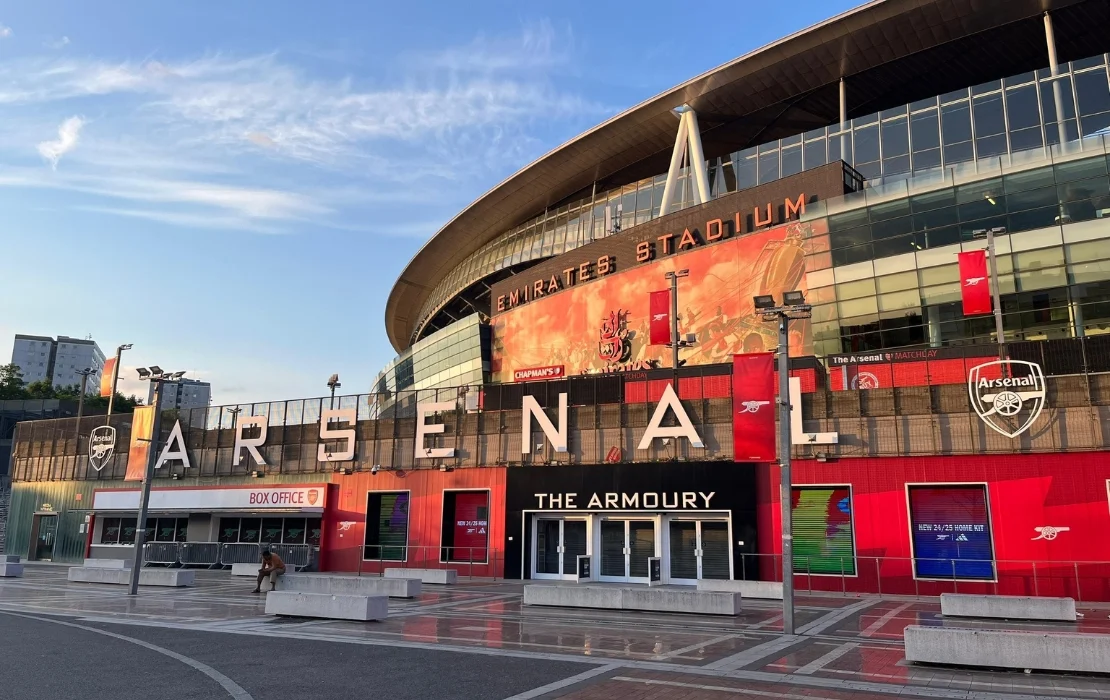 This is one of the areas where Arsenal’s commercial potential becomes particularly interesting.
A stadium is no longer simply a place where football is played.
It is an economic platform.
Every seat represents potential matchday revenue.
Every hospitality package represents premium revenue.
Every concert or non-football event represents additional utilisation.
Every visitor represents a potential customer.
Every shirt sold inside the stadium is another commercial transaction.
Arsenal’s current ticketing strategy shows how much attention the club pays to demand and stadium experience. For 2026/27, the club has introduced new match categories, maintained different premium products and expanded licensed standing areas, while continuing to develop the Emirates experience.
That matters because matchday revenue remains one of football’s most powerful controllable income streams.
And Arsenal have something City cannot replicate:
the London location.
London’s Economic Advantage
Manchester City have built an extraordinary global business from Manchester.
Arsenal have one of the world’s most commercially powerful cities sitting around their stadium.
London is a global centre for:
- Finance
- Tourism
- Technology
- Media
- Fashion
- Luxury brands
- International business
That gives Arsenal a natural commercial ecosystem.
A multinational company looking for a global football partnership is not simply buying an advertising board.
It is buying access to an audience.
And Arsenal’s location gives that audience additional value.
The Emirates can function simultaneously as:
stadium + hospitality venue + tourism destination + content environment + commercial platform.
That is why Arsenal’s future stadium strategy could become one of the most important pieces of their financial story.
The club does not necessarily need to copy the Etihad Campus.
It can monetise its own ecosystem.
The New Sponsorship Economy
Another important piece arrived before the Community Shield.
Arsenal recently extended their Emirates partnership, continuing one of the longest-running shirt sponsorship relationships in English football.
The significance is not merely the size of the deal.
It is the longevity.
Long-term partnerships give clubs something extremely valuable:
predictability.
A club can plan transfers, infrastructure and commercial investments more effectively when major revenue streams are secure over several seasons.
That matters because the modern superclub is essentially trying to create a predictable financial base around unpredictable football results.
You cannot guarantee that you will win the Champions League.
You can negotiate a long-term sponsorship agreement.
You cannot guarantee that Bukayo Saka will score 25 goals.
You can build a global merchandise strategy around him.
You cannot guarantee that Arsenal will reach another final.
You can build commercial partnerships that remain valuable regardless of the final score.
That is the difference between football success and football business.
And Then Came Tzolis
One of the most commercially interesting moments of the Community Shield was not one of the goals.
It was the performance of Christos Tzolis.
The new Arsenal signing produced two assists in his competitive debut as Arsenal defeated City 3-0. He was involved in the build-up to Havertz’s goal and then helped create Ødegaard’s second-half strike.
Of course, two assists do not make a player a commercial superstar.
That would be lazy analysis.
But they can start a process.
A new signing who performs immediately becomes:
- more recognisable;
- more discussed;
- more visible internationally;
- more attractive to media;
- more valuable for digital content;
- potentially more valuable for merchandise.
This is why elite clubs increasingly care about the story around players, not just their statistics.
Arsenal are building a squad containing sporting assets that can also become global brand assets.
Saka is already one.
Ødegaard is another.
Tzolis may or may not become one.
But the commercial model benefits when football success creates new personalities.
The Saka Economy
 This is where Arsenal have an advantage that financial spreadsheets cannot fully capture.
Bukayo Saka is not simply an asset on a football pitch.
He is part of Arsenal’s identity.
He represents the academy.
He represents London.
He represents England.
He represents Arsenal’s current generation.
That combination is commercially powerful.
A globally marketable player can amplify the value of:
shirt sales + social media + sponsorship campaigns + international tours + digital content + youth engagement.
The more successful Arsenal become, the larger the platform becomes for players like Saka.
And the larger the platform becomes, the more valuable the Arsenal brand becomes.
It is another flywheel.
Why the Champions League Is Arsenal’s Real Financial Battlefield
The Community Shield is the headline.
The Champions League is the financial battleground.
Deloitte’s 2026 Football Money League found that the world’s top 20 revenue-generating clubs collectively produced a record €12.4 billion, with commercial revenue reaching €5.3 billion and becoming the first revenue stream among the three major categories to exceed €5 billion.
That tells us something important.
The European elite are becoming increasingly commercialised.
Arsenal’s objective therefore cannot simply be:
Win England.
It has to become:
Remain commercially relevant in Europe.
Their run to the Champions League final in 2025/26 was therefore enormously important, even though Paris Saint-Germain ultimately won the final.
The longer Arsenal remain deep in the Champions League, the more global exposure they receive.
The more exposure they receive, the more valuable their commercial proposition can become.
The Champions League is therefore not merely another trophy competition.
It is part of Arsenal’s international growth strategy.
Manchester City’s Problem Is Not the 3-0 Defeat
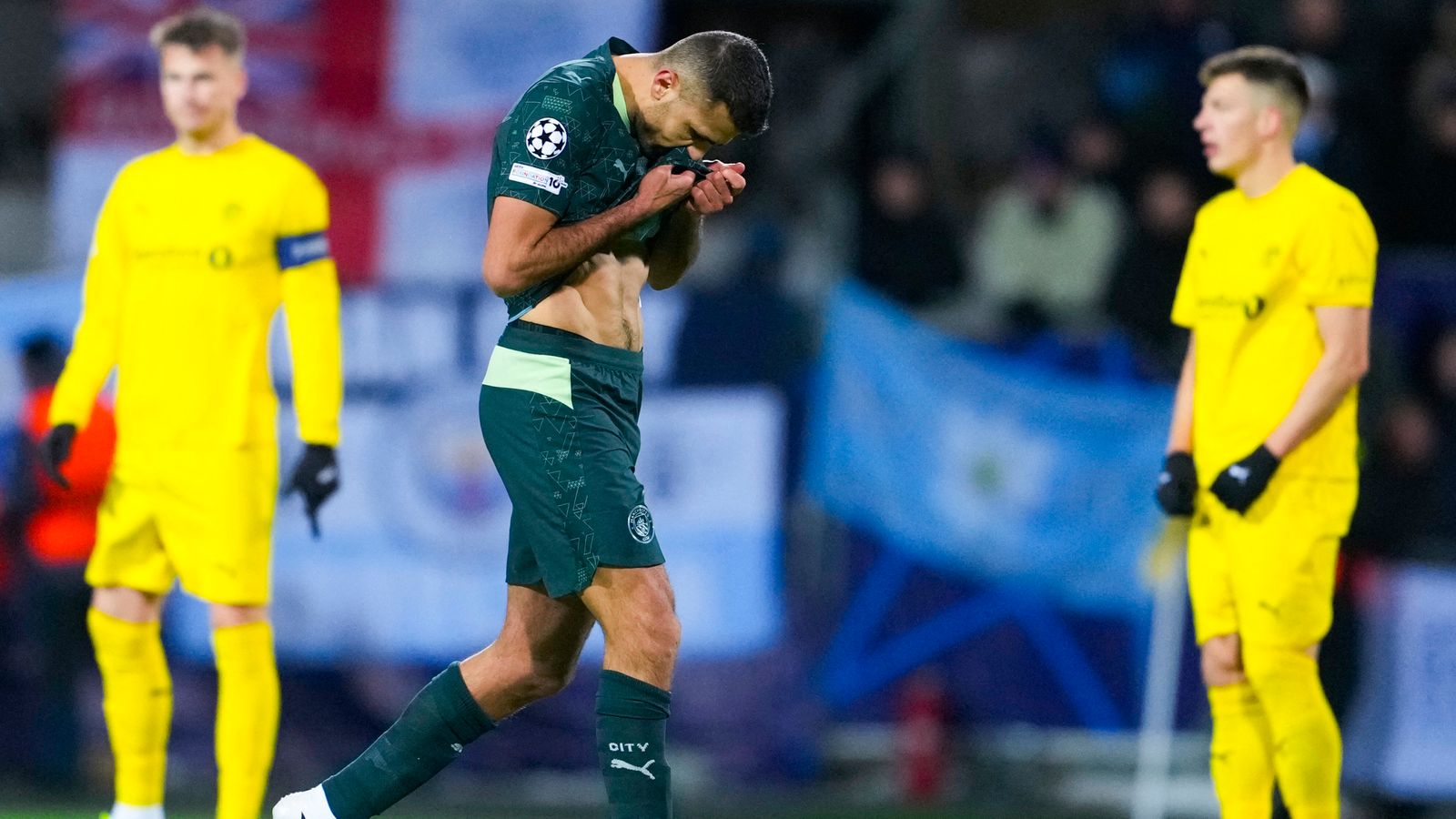 This is where we need to be careful.
It would be poor journalism to declare that Manchester City are suddenly financially weak because Arsenal beat them 3-0.
They are not.
Their £694.1 million revenue demonstrates the opposite.
The more interesting question is whether City can maintain their financial momentum while undergoing a sporting transition.
Pep Guardiola is gone.
Maresca is beginning a new era.
Rodri’s fitness and future remain important questions.
The squad is evolving.
And the club must continue investing while remaining competitive.
That creates a fascinating business challenge.
Can City rebuild the football machine without damaging the economic machine?
Because the two are connected.
A prolonged decline in European performance can affect broadcasting income.
A weaker sporting product can reduce global engagement.
Reduced engagement can make commercial growth harder.
That does not mean City are heading for financial trouble.
It means their next managerial era matters economically as well as tactically.
Arsenal’s Most Dangerous Opponent May Be Their Own Ambition
There is another side to this story.
Success is expensive.
Once Arsenal become accustomed to competing for Premier League titles and Champions League finals, the cost of remaining there increases.
Players demand higher wages.
Transfers become more expensive.
Squad depth becomes essential.
European competition creates more fixtures.
Every position requires elite-quality alternatives.
And every failure becomes more expensive.
That is the paradox of the football flywheel.
Winning creates revenue.
But winning also creates expectations.
And expectations create costs.
The objective is therefore not simply to increase revenue.
It is to make revenue grow faster than the cost of staying competitive.
That is the true test of Arsenal’s financial model.
The Number That Could Matter More Than Revenue
Football fans love talking about revenue.
But revenue alone does not determine who wins.
A club could generate £700 million and still make poor strategic decisions.
The more revealing question is:
How efficiently does a club convert financial resources into sporting advantage?
That means examining:
- Revenue growth
- Commercial growth
- Wage efficiency
- Transfer spending
- Player development
- European performance
- Stadium utilisation
- Sponsorship growth
- Squad value
- Academy output
This is where Arsenal’s current project becomes particularly interesting.
They are not simply spending their way to success.
The club has spent heavily, but it has also built around youth, recruitment, infrastructure and sporting culture.
That combination could make the model more sustainable.
Arsenal 3-0 Man City: The Arsenal Flywheel Is Now Turning
Consider the sequence.
Arsenal win the Premier League.
That increases global attention.
They reach the Champions League final.
That increases European visibility.
They strengthen the squad.
That raises expectations.
They enter the new season as champions.
Then they beat Manchester City 3-0.
That produces another global media moment.
That moment reinforces the idea that Arsenal are no longer simply a historic club returning to relevance.
They are becoming one of football’s current superclubs.
That perception itself has value.
It helps attract players.
It helps attract sponsors.
It helps sell merchandise.
It increases digital engagement.
It makes international commercial expansion easier.
And it creates the possibility of more sporting success.
The flywheel turns again.
Arsenal Don’t Need to Outspend City
This may ultimately be the most important lesson.
Arsenal do not need to become Manchester City financially.
They need to become more efficient than Manchester City in turning their unique advantages into sustained success.
City have the Etihad ecosystem.
Arsenal have London.
City have built enormous commercial reach.
Arsenal have a global historical brand.
City have Guardiola’s legacy.
Arsenal have Arteta’s project.
City have a huge established squad infrastructure.
Arsenal have a younger core entering its prime.
Different clubs.
Different economic models.
Same objective.
Control the future.
The 3-0 Was a Signal, Not a Verdict
There is a temptation to declare a new era after every major result.
Arsenal beat City 3-0.
Therefore Arsenal have replaced City.
That is too simplistic.
A Community Shield cannot determine a Premier League season.
One match cannot determine a club’s financial future.
But it can reveal momentum.
And momentum matters.
Arsenal entered Cardiff as Premier League champions.
They left as Community Shield winners.
They did it by beating the club that dominated English football for much of the previous decade.
And they did it convincingly.
For Arsenal, the challenge now is turning that sporting momentum into economic compounding.
Because if every trophy increases attention, every attention spike increases commercial power, and every increase in commercial power strengthens the squad, Arsenal could eventually create something much more powerful than a successful team.
They could create a self-reinforcing football business.
What’s Next: Can Arsenal Build the Next Superclub?
The biggest question after Arsenal 3-0 Man City is therefore not:
“Can Arsenal win the Premier League again?”
It is:
“Can Arsenal build a financial machine strong enough to keep them there?”
That is a much harder challenge.
Manchester City have spent years building theirs.
Real Madrid have spent decades building theirs.
Barcelona have built theirs around global identity.
Liverpool have built theirs around heritage, commercial reach and sporting success.
Arsenal now have an opportunity to build their own.
The ingredients are already visible:
Premier League success.
Champions League relevance.
A globally recognised brand.
London.
The Emirates.
Young stars.
Long-term commercial partnerships.
A growing international audience.
The 3-0 victory over Manchester City did not suddenly make Arsenal richer.
But it strengthened the story that Arsenal are becoming something much more valuable:
a club whose sporting success and commercial growth are beginning to feed each other.
And that is how football empires are actually built.
Not with one trophy.
Not with one transfer.
Not with one superstar.
But through a cycle in which winning creates money, money creates competitive strength, and competitive strength creates more winning.
Manchester City spent a decade perfecting that cycle.
Now Arsenal are trying to build their own.
The Community Shield may have been only one afternoon in Cardiff. But if Arsenal can turn Sunday’s 3-0 into another turn of their financial flywheel, the real battle between these two clubs may only just be beginning.
Do you believe Arsenal can build a financial model capable of challenging Manchester City’s long-term dominance — or will City’s commercial machine remain too powerful to displace? Share your view with The Football Xtra.