A player does not normally need a transfer fee to leave a club. He needs a legal route. And the Richarlison vs Tottenham dispute may now be testing exactly where that route begins and ends.
Richarlison has been excluded from Tottenham Hotspur’s 25-man Premier League squad after the striker expressed a desire to leave during pre-season. Tottenham manager Roberto De Zerbi has said the decision was connected to the player’s wishes, while reports now say Richarlison is exploring the possibility of taking the dispute to FIFA in an attempt to terminate his contract.
The case has suddenly become bigger than one unhappy striker.
It touches the fundamental question of modern football contracts:
Can a club keep a player contractually tied to it while effectively removing his route to first-team league football?
And on the other side:
Can a player use FIFA’s sporting-just-cause provisions to escape a contract simply because his sporting opportunities have disappeared?
The answer, at least under the existing framework, is far more complicated than either side would like.
Richarlison vs Tottenham: How Did the Crisis Start?
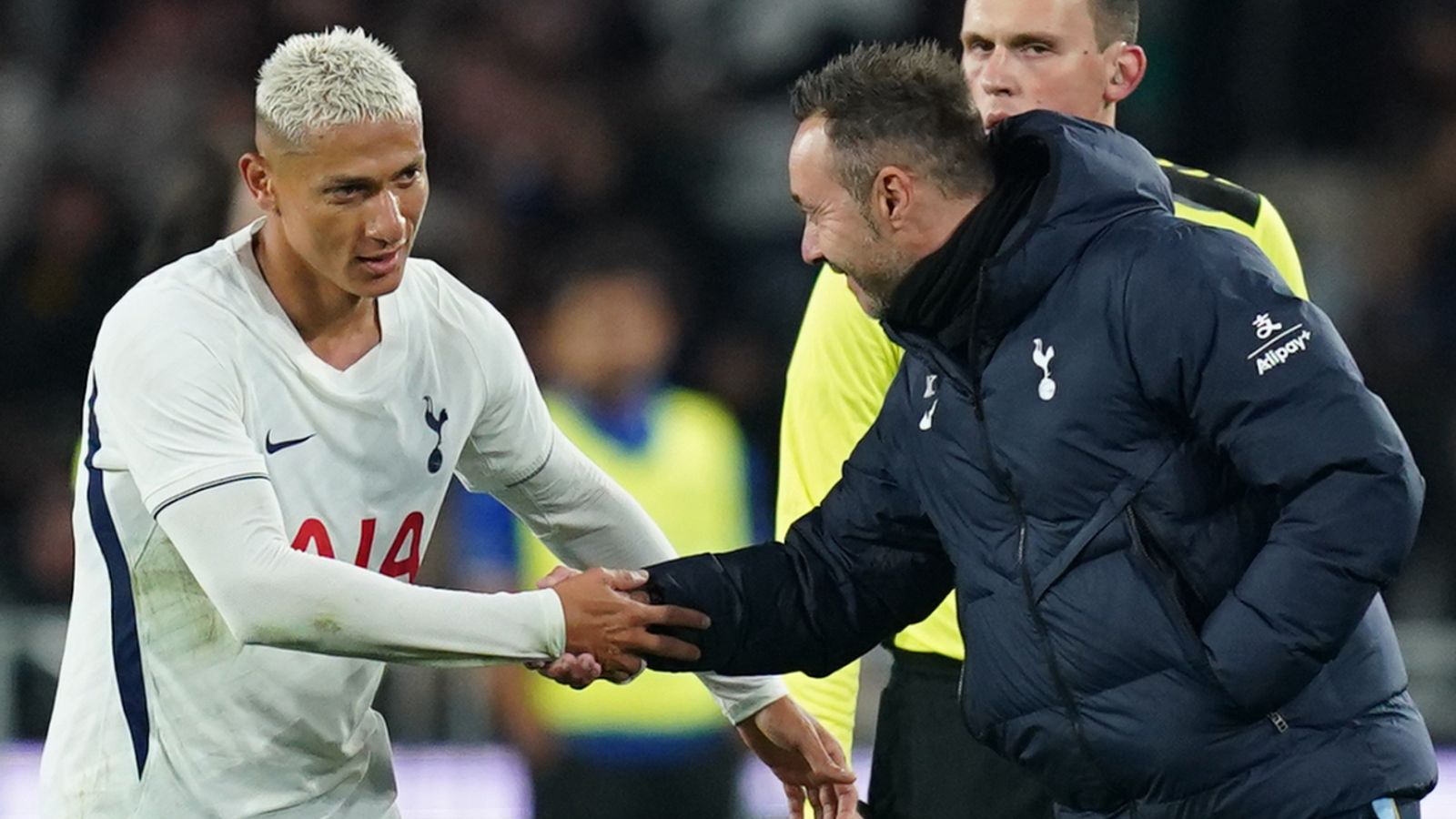 The background is important because this dispute did not appear out of nowhere.
Richarlison joined Tottenham from Everton in July 2022 in a deal reported at £60 million, signing a contract running until 2027.
The Brazilian arrived with a reputation as a versatile Premier League forward capable of playing both centrally and from wide positions. Tottenham had originally bought him to add goals, intensity and flexibility to the attack.
For much of his Tottenham career, however, injuries and inconsistency prevented him from becoming the unquestioned No.9 that the transfer fee implied.
Then came 2025/26.
Richarlison produced one of his most productive campaigns in a Tottenham shirt, featuring in 43 of the club’s 52 matches and scoring 12 goals, including 11 in the Premier League. Tottenham’s own records describe 2025/26 as his joint-best goalscoring campaign for the club in league terms and his most appearances in a season at Spurs.
His importance was particularly obvious in the fight for Premier League survival.
He scored crucial goals late in the season, including against Aston Villa and Chelsea, and finished as Tottenham’s top Premier League scorer with 11.
That makes what happened next even more striking.
Tottenham did not simply lose interest in a fringe player.
They moved away from a forward who had just been their leading league scorer.
Why Tottenham Left Richarlison Out of the Premier League Squad
 When the 2026 summer window closed, Tottenham submitted their Premier League squad without Richarlison.
That decision did not mean the Brazilian’s contract disappeared.
The Premier League’s squad rules allow clubs to register up to 25 senior players, with no more than 17 who do not satisfy the Home-Grown Player criteria. Under-21 players can be registered separately.
Tottenham’s official 2026/27 squad-number announcement had still listed Richarlison as the club’s No.9.
That distinction is crucial.
A shirt number is not the same thing as Premier League registration.
And a contract is not automatically cancelled because a player is omitted from a squad list.
That is the legal grey area at the heart of this story.
De Zerbi has been explicit about his version of events. Speaking before Tottenham’s match at Nottingham Forest, he said Richarlison had spoken to him at the beginning of pre-season and made clear that he wanted to leave.
The manager said he accepted that decision and that his preference was to keep players who wanted to stay and show the right commitment.
In other words, Tottenham’s argument is not simply that the club discarded Richarlison.
Their argument is that the player first made it clear he wanted out.
That changes the context substantially.
The Transfer Failed — But the Contract Did Not
 The obvious solution was a transfer.
Tottenham explored opportunities.
Everton were involved in discussions, while Trabzonspor showed serious interest late in the summer window. Richarlison was also reported to have agreed personal terms with Trabzonspor, but a full agreement did not materialise.
Another potential route emerged in Brazil.
Vasco da Gama have explored ways to bring Richarlison back, with a loan proposal reportedly accepted by the player. But the move encountered regulatory complications, including Tottenham’s loan quota position.
This is where the modern transfer system becomes fascinating.
A player can have:
- a willing destination,
- personal terms,
- a club that wants to move him,
and still remain stuck because the legal and registration machinery does not line up.
The summer transfer window then closes.
The player remains contracted.
And suddenly the contract itself becomes the battleground.
FIFA Article 15 Is Now the Most Important Detail
The most discussed part of the Richarlison case is Article 15 of FIFA’s Regulations on the Status and Transfer of Players, concerning “sporting just cause.”
Under the rule, an established professional who has appeared in fewer than 10% of his club’s official matches during the season may potentially terminate the contract prematurely on the grounds of sporting just cause.
But there is a critical catch.
The existence of sporting just cause is assessed case by case.
And the provision is not designed as an instant mechanism for a player who has been left out of a squad at the beginning of a campaign.
FIFA’s regulations state that this specific termination route may be exercised within 15 days following the player’s club’s final official match of the season. Compensation can also still be payable.
That makes the current Richarlison situation much more legally uncertain than some headlines suggest.
He has been excluded from Tottenham’s Premier League squad.
But the season has only just begun.
Therefore, the 10% threshold cannot simply be treated as if it has already been satisfied.
That is an important distinction for anyone covering this story.
So Could Richarlison Actually Walk Away for Free?
That is the million-pound question.
At this point, it would be inaccurate to say that Richarlison has already secured a legal right to terminate his Spurs contract.
He has not.
What exists is a potential legal argument.
The FIFA framework recognises sporting just cause, but it requires the facts and circumstances to be assessed. Academic analysis of Article 15 also stresses that the rule is an exceptional mechanism, not an automatic right, and that compensation may still arise even when sporting just cause is established.
That means Richarlison’s case would require more than:
“I am not in the squad.”
It would involve questions such as:
Was he genuinely being denied sporting participation?
What were the circumstances of his exclusion?
What did the club communicate to him?
Was the situation temporary or effectively permanent?
What were the player’s own actions in seeking a transfer?
And, ultimately, does the evidence satisfy FIFA’s standard for sporting just cause?
Those questions are why this story could become a major football-law case.
Richarlison vs Tottenham Is About More Than One Player
 There is a bigger principle behind this dispute.
Football has historically relied on contractual stability.
Clubs invest enormous amounts of money into players. They pay transfer fees, wages, signing bonuses and agent fees. They also build sporting plans around long-term contracts.
Allowing players to leave whenever they lose their place would create serious instability.
But the opposite problem is equally real.
A club could potentially sign a player to a long contract and then make him effectively unemployable within that sporting environment.
That is why FIFA has mechanisms dealing with sporting just cause.
The challenge is maintaining the balance.
Contracts must mean something — but so must a player’s professional career.
Richarlison sits directly in that tension.
Tottenham Also Have a Financial Problem
The football-law discussion cannot be separated from the economics.
Tottenham paid heavily for Richarlison in 2022 and still have a player under contract.
Ordinarily, excluding a player does not make the financial investment disappear.
The club’s ideal outcome would therefore be straightforward:
Find a buyer willing to pay an appropriate fee.
Recover part of the original investment.
Reduce the wage bill.
Reallocate the squad place.
Move forward.
But that became significantly harder after the market narrowed.
Everton discussions did not result in a completed transfer, while Trabzonspor’s reported offer was below Tottenham’s earlier valuation.
And when the deadline passed, Tottenham lost the easiest route out: the ordinary international transfer market.
Suddenly, both sides had less leverage.
Richarlison had fewer destinations.
Tottenham had fewer opportunities to generate a transfer fee.
That is how a transfer problem becomes a contract dispute.
Tottenham’s Striker Problem Makes This Even More Uncomfortable
The most ironic part of the saga may be what happened on the pitch after Richarlison’s omission.
Tottenham began the new Premier League campaign without a recognised striker solution that has immediately worked.
Reuters reported that Spurs had spent more than £300 million during the transfer window but failed to secure a recognised striker, while their goalless draw with Nottingham Forest left them with just one point from their opening three league matches and no shot on target in the match.
That produces a strange contradiction.
Tottenham have removed their top league scorer from the previous campaign.
They have failed to replace that production convincingly.
And now the player they omitted is at the centre of a potential FIFA dispute.
From a football-management perspective, that is difficult to defend purely on sporting grounds.
But again, Tottenham’s position is that Richarlison himself expressed a desire to leave before the club moved in another direction. De Zerbi has repeated that publicly.
So the story is not as simple as Spurs “throwing out” their best striker.
It is a breakdown in alignment between player, coach, club strategy and the transfer market.
The Diarra Case Changed the Background Music
 The timing of this dispute is especially interesting because FIFA’s transfer regulations are already undergoing significant reform following the landmark Diarra litigation.
FIFA approved a new regulatory framework in June 2026 after discussions involving player representatives, clubs, leagues, UEFA and other stakeholders. The new RSTP framework is scheduled to enter into force on 1 January 2027. FIFA says the revisions were designed to balance player and club interests while responding to the principles established by the Court of Justice of the European Union in the Diarra ruling.
This means the Richarlison dispute is emerging at a fascinating moment.
Football’s governing structures are already reconsidering how contractual stability, player mobility and transfer restrictions should work.
The Richarlison question therefore becomes part of a much larger debate:
How much control should a club have over a contracted player when the sporting relationship has effectively broken down?
That is a question football will continue wrestling with long after Richarlison’s Tottenham career is decided.
What Happens Next?
The immediate situation remains fluid.
Richarlison wants a route out.
Tottenham want to protect their contractual and financial position.
Potential destinations have been discussed, but the conventional transfer window has closed in England.
FIFA therefore becomes relevant not necessarily because the Brazilian can instantly walk away, but because it provides a legal framework through which disputes over contractual rights can ultimately be examined.
That distinction matters.
A FIFA case is not the same as a FIFA victory.
And an Article 15 argument is not an automatic free-transfer button.
The most credible reading of the current situation is that Richarlison is exploring whether there is a legal avenue to force a solution, while Tottenham maintain that the player wanted to leave and the club has acted accordingly.
Until a competent body rules on the facts, neither side can honestly claim the legal argument is settled.
Could This Really Change Premier League Transfers?
Perhaps.
But probably not because every unwanted player will suddenly become a free agent.
The bigger consequence would be if a FIFA decision establishes a clearer boundary around what clubs can and cannot do with contracted professionals who have been excluded from competitive football.
Imagine a future in which an expensive senior player is deliberately omitted from a club’s first-team plans for an extended period.
Could the player simply remain under contract for years?
Or should the law provide an increasingly effective exit?
The answer could affect how clubs structure contracts, how sporting directors manage squad sizes and how players negotiate guarantees over sporting participation.
And that is why Richarlison vs Tottenham deserves attention beyond the headlines.
This is not just a Brazilian striker looking for another club.
It is a clash between contractual stability and sporting freedom.
SEE ALSO: Premier League Transfer Deadline Spending Race: Why £2.7bn Has Created Football’s Biggest Arms Race
Tottenham are trying to control the consequences of a transfer that never happened.
Richarlison is trying to regain control of a career that he believes has become trapped by that failed transfer.
And FIFA may ultimately be asked to decide where that line should be drawn.
What’s Next for Richarlison vs Tottenham?
The coming months could determine whether this remains a messy transfer saga or develops into an important football-law test.
Tottenham’s best scenario is still a negotiated resolution that protects their financial interests.
Richarlison’s best scenario is a legitimate route to regular football without becoming contractually stranded.
But one thing is already clear:
The Richarlison vs Tottenham dispute is no longer just about where the striker will play. It is about how much power a football contract should actually give a club over a player’s career.
That is a question the Premier League, FIFA and the wider football industry cannot avoid forever.
And if FIFA is eventually asked to rule on this case, the decision could matter to far more players than Richarlison alone.
Do you think a club should be able to exclude a contracted senior player from its league squad without creating a realistic exit route — or should players have stronger protection?