Real Madrid 2-1 Inter looks like the perfect result on paper. Three points, a winning start to the Champions League campaign and two goals from Kylian Mbappé and Federico Valverde. But at the Santiago Bernabéu on Tuesday night, the scoreline concealed a much more complicated story.
José Mourinho got the result he wanted against his former club, but his Real Madrid side spent long periods without sufficient control, allowed Inter to create dangerous opportunities and relied heavily on Thibaut Courtois to protect a lead that could easily have disappeared.
Madrid ultimately survived.
But survival was not supposed to be the objective at home.
The biggest concern is that Real Madrid had enough chances to kill the game but failed to convert them, while simultaneously giving Inter too many opportunities to stay alive. Courtois made seven saves according to post-match player analysis, while Inter controlled more than 64% of possession.
That combination creates an uncomfortable question for Mourinho.
Did Real Madrid produce the blueprint for a Champions League-winning team — or did Courtois simply rescue them from a problem that elite European opponents will punish much more severely?
Real Madrid 2-1 Inter: The Scoreline Does Not Tell the Whole Story
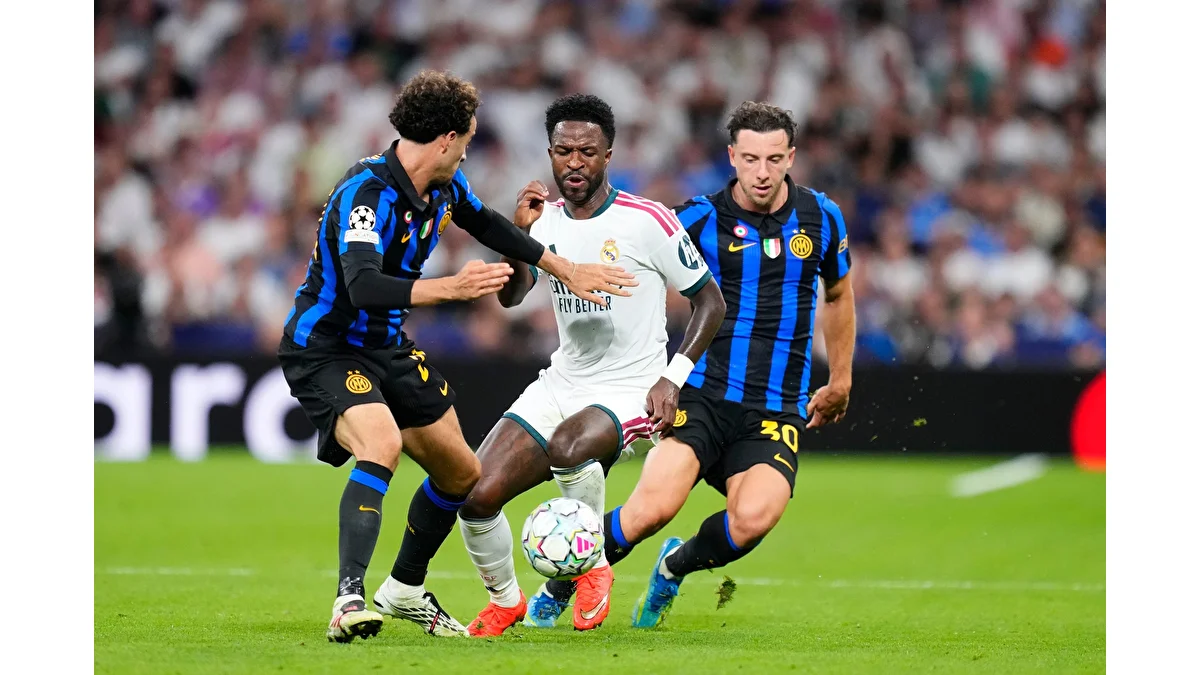 Madrid started the match at extraordinary intensity, but it was Inter who initially looked more comfortable in possession.
The Italian champions moved the ball with confidence and repeatedly tested the spaces around Madrid’s defensive structure. Thibaut Courtois was forced into an early intervention against Marcus Thuram before making another important save from Hakan Çalhanoğlu.
Then came the first major turning point.
Madrid’s pressure forced an Inter mistake, Brahim Díaz recovered the loose ball and Mbappé finished clinically to give the hosts the lead.
That goal changed the emotional balance of the game, but it did not completely change the underlying tactical picture.
Inter continued to have possession.
Madrid continued to defend space.
And then another Inter mistake gave Mourinho’s side a second goal.
This time, Federico Valverde punished goalkeeper Josep Martínez after the Inter goalkeeper attempted to play out under pressure.
Suddenly, Madrid were 2-0 ahead.
But they had not necessarily become the better team.
That distinction is crucial.
Mourinho’s Real Madrid Were Ruthless — But Not in Complete Control
 There is a positive interpretation of Madrid’s performance.
Mourinho’s team identified moments when Inter were vulnerable and punished them.
That is classic tournament football.
The first goal came from aggressive pressure.
The second also came from pressure and an opponent’s mistake.
Madrid therefore demonstrated something Mourinho has always valued: the ability to turn small moments into decisive advantages.
But there was another side to the performance.
Once Madrid were 2-0 ahead, they had opportunities to put the match beyond Inter’s reach.
They did not.
And that allowed the game to become increasingly chaotic.
Mourinho himself admitted after the match that he did not enjoy the chaos, saying the game could have ended 5-1 or 6-1 for Madrid, but could also have become 6-6. More importantly, he said he would prefer Madrid to score heavily with “absolute control” rather than needing an extraordinary performance from the goalkeeper.
That statement should not be ignored.
It was effectively Mourinho identifying his team’s biggest weakness himself.
Madrid won, but Mourinho knows they did not control the game well enough.
Thibaut Courtois Was the Difference
 If there was one player who transformed Madrid’s performance from potentially disappointing to successful, it was Courtois.
The Belgian goalkeeper produced a series of crucial saves, including interventions against Thuram, Çalhanoğlu and Inter’s late pressure.
Player-rating analysis credited him with seven saves, while Mourinho and Valverde both indicated that Courtois deserved the strongest individual recognition of the night.
And Courtois himself did not hide the problem.
After the match, he said Madrid should have closed the game earlier and admitted that the match became too chaotic towards the end. He also pointed out that the midfielders suffered most because of the constant end-to-end nature of the game.
That is an important observation.
A goalkeeper can save a team from defeat.
But a goalkeeper cannot permanently solve a team’s structural problems.
If Madrid repeatedly allow opponents to attack with space and volume, even Courtois will eventually face a night when one of those chances becomes unstoppable.
That is the danger Mourinho must address.
Madrid’s Defensive Problem Is Bigger Than Conceding One Goal
 It would be misleading to say Madrid’s defence was simply “bad.”
There were excellent individual performances.
Dean Huijsen, for example, produced a strong defensive display and was credited with 12 clearances, while Ibrahima Konaté also played an important role in limiting Inter’s attacks.
The problem was more structural.
Inter were able to sustain pressure for long periods.
Madrid’s midfield and defensive lines were sometimes stretched.
And when possession was lost, the team did not always regain control quickly enough.
That created an unusual situation.
Madrid could look dangerous whenever they recovered the ball and attacked space, but vulnerable whenever Inter established possession.
That is why the match became so open.
And open games can be dangerous for a team that is trying to control Champions League knockout football.
Real Madrid’s Defensive Transitions Need Work
One of Mourinho’s biggest challenges will be improving what happens immediately after Madrid lose possession.
Against Inter, the transition from attack to defence was not always clean.
Madrid had attacking players high up the pitch, while Inter were capable of finding space through midfield.
That created moments when the back line was exposed.
The solution is not necessarily to defend deeper.
It could instead involve improving the team’s counter-pressing structure.
When Madrid lose the ball, the nearest players must either win it back quickly or delay Inter’s first pass.
If neither happens, the defensive line is forced to retreat.
That is when opponents gain momentum.
Mourinho knows this.
His best teams have historically been built around defensive compactness, intelligent transitions and forcing opponents into low-quality attacking situations.
Against Inter, Madrid sometimes did the opposite.
They allowed the game to become a track meet.
And that is exactly what Mourinho said he did not want.
The Most Frustrating Part: Madrid Had Enough Chances to Win Comfortably
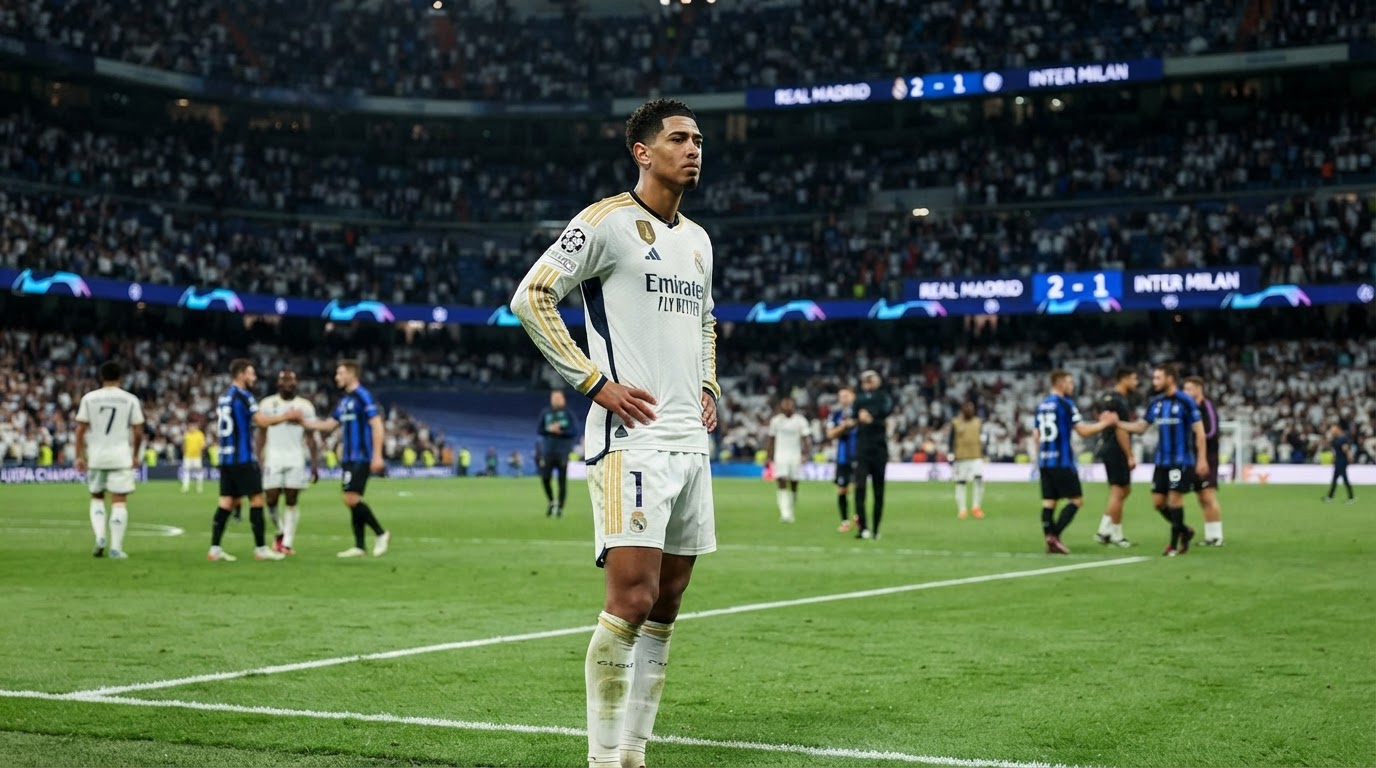 The defensive problems would have been less damaging if Madrid had converted their opportunities.
They did not.
This is perhaps the most fascinating contradiction of the match.
Madrid were dangerous enough to score four or five, but vulnerable enough to concede two or three.
The official Real Madrid match report records a series of excellent opportunities after the 2-0 lead.
Jude Bellingham had chances.
Mbappé went through on goal but was denied by Josep Martínez.
Brahim Díaz created another excellent opportunity.
Madrid repeatedly threatened to make it 3-0.
They simply could not finish the job.
Bellingham himself admitted afterwards that Madrid could have finished with a bigger scoreline and acknowledged that he was frustrated by his own missed opportunities.
This is where the conversation about Madrid’s attack becomes more complicated.
The team is not failing to create chances.
The problem is converting enough of those chances before the opponent finds a way back into the game.
Mbappé Has the Firepower — But Madrid Need More Efficiency
 Kylian Mbappé scored the opening goal and repeatedly threatened Inter’s defensive line.
His pace was particularly dangerous whenever Madrid recovered possession and attacked quickly.
But he also had opportunities that could have ended the contest.
That is not necessarily a criticism of Mbappé alone.
It is a team issue.
SEE ALSO: Mbappé Vinícius Partnership: Can Real Madrid’s Duo Become Legendary?
Madrid need their forwards to be more ruthless when the game opens up.
Against Inter, the opportunities were there.
Against a weaker opponent, Madrid might get away with missing them.
Against Manchester City, Bayern Munich, Liverpool or another elite Champions League side, they may not.
The margins become smaller as the competition progresses.
A missed one-on-one in September can become the difference between a semi-final victory and elimination in April.
Brahim Díaz Was One of Madrid’s Hidden Weapons
 One of the most encouraging aspects of the performance was Brahim Díaz.
He was directly involved in the opening goal and repeatedly created problems for Inter’s defence.
His ability to receive between lines, turn and attack defenders gave Madrid another route beyond simply playing directly toward Mbappé.
His contribution also demonstrated something important about Mourinho’s attacking model.
Madrid do not necessarily need to dominate possession to create danger.
They can allow opponents to have the ball and then attack aggressively when the opportunity appears.
That could become a genuine weapon in the Champions League.
But it must be balanced with better defensive control.
Otherwise, Madrid become too dependent on winning the transition battle every time.
Valverde Represents the Mourinho Football Madrid Could Become
 Federico Valverde’s performance may ultimately be more important to Mourinho’s project than his goal.
The Uruguayan offers intensity, athleticism, tactical flexibility and defensive commitment.
His goal came from aggressive pressure, exactly the type of action Mourinho wants his players to execute.
Valverde can contribute in midfield, support defensive transitions and still arrive in dangerous attacking positions.
That makes him almost ideal for this version of Real Madrid.
In a Champions League campaign where tactical adaptability becomes increasingly important, players like Valverde are invaluable.
He can help Mourinho change the team’s behaviour without necessarily changing personnel.
Real Madrid 2-1 Inter Revealed Both the Promise and the Danger
This is where the result becomes genuinely interesting.
There is a lot to like about Mourinho’s Madrid.
The positives:
- Three points against a major European opponent**
- Two goals from Mbappé and Valverde**
- Strong attacking transitions
- Effective high pressing for the goals
- Excellent goalkeeping from Courtois
- Strong individual performances from Huijsen and Brahim
- The ability to punish opponent mistakes
- Mental resilience after conceding late
But there are also clear concerns.
The warning signs:
- Too much possession conceded
- Too many dangerous Inter attacks
- Defensive transitions lacked consistency
- Courtois was required to make several major saves
- Madrid failed to convert enough clear chances
- The team lost control after taking a 2-0 lead
- The final stages became unnecessarily chaotic
That is a fascinating combination.
Mourinho has built a team capable of winning. But he has not yet built a team that consistently controls how it wins.
What Does This Mean for Madrid’s Champions League Ambitions?
The answer is neither “Madrid are favourites” nor “Madrid are in trouble.”
It is more nuanced.
The victory gives Mourinho three valuable points at the beginning of the league phase.
And defeating Inter — a team with strong recent domestic and European credentials — should not be dismissed.
But the performance also gives future opponents a blueprint.
If Inter can control possession and repeatedly create opportunities, other elite teams will study that.
They will ask:
Can we move Madrid’s defensive block from side to side?
Can we exploit the spaces after Madrid lose possession?
Can we force their midfield to defend for long periods?
Can we survive their transitions and stop Mbappé from attacking space?
Those questions will define Madrid’s European campaign.
The Mourinho Factor Could Still Change Everything
The most important reason for optimism is the coach.
Mourinho has won the Champions League twice and understands tournament football at the highest level.
He knows that September performances do not need to resemble April performances.
His job now is to improve the team’s control before the knockout stage.
The foundations are already visible.
Madrid can press.
They can counter.
They can defend deep when necessary.
They have elite attackers.
They have Courtois.
They have players capable of deciding matches individually.
The missing ingredient is consistency.
Mourinho himself has already identified the issue.
He wants Madrid to win without needing their goalkeeper to perform miracles.
That is exactly the evolution this team needs.
The Bright Light: Madrid Can Still Become Very Dangerous
Despite the concerns, there is one reason opponents should be worried.
Madrid created enough chances to destroy Inter even while failing to control the game.
Imagine what happens if Mourinho improves the defensive structure while maintaining the same attacking threat.
Imagine Madrid controlling midfield better.
Imagine the press becoming more coordinated.
Imagine Mbappé and Bellingham converting the opportunities they missed.
Imagine Courtois no longer needing to make seven saves every Champions League night.
That version of Real Madrid becomes extremely difficult to beat.
And that is why the Inter match should not be interpreted as a failure.
It should be interpreted as a warning.
What Mourinho Must Fix Before the Next Champions League Test
There are three priorities.
1. Control the midfield
Madrid cannot consistently allow opponents to dictate the rhythm.
Possession does not have to be dominant, but control must improve.
2. Improve defensive transitions
The moment Madrid lose the ball must become more organised.
The team needs to either recover possession quickly or delay the opponent’s counter.
3. Become more ruthless
The chances are coming.
The forwards must finish them.
A 3-0 lead is fundamentally different from a 2-1 lead in terms of game management.
Madrid had opportunities to create that separation against Inter.
They did not take them.
Verdict: Mourinho Won the Battle, But the Champions League War Has Just Started
Real Madrid 2-1 Inter is ultimately a victory Mourinho will happily accept.
Three points are three points.
The Champions League does not award extra points for aesthetic football.
But Mourinho will also know that his team cannot depend on Courtois producing another extraordinary performance every time the opposition discovers space.
The most encouraging aspect is that Madrid have the attacking quality to hurt Europe’s best teams.
The most worrying aspect is that they are still giving those teams too many opportunities to hurt them back.
That is the central contradiction of Mourinho’s new Real Madrid.
They look dangerous enough to beat anyone — but not yet controlled enough to feel unbeatable.
Inter exposed the problem.
Courtois covered it.
Mbappé and Valverde delivered the goals.
Mourinho collected the three points.
Now comes the difficult part: turning a chaotic victory into a repeatable Champions League formula.
Because if Mourinho can make this Madrid more compact without taking away its attacking explosiveness, the team could become one of the most dangerous sides in Europe.
But if Madrid continue to rely on Courtois to rescue them and fail to convert the chances that come their way, the Champions League’s elite will eventually punish them.
The result says Madrid are ready for Europe. The performance says Mourinho still has work to do.
And perhaps that is the most important lesson from their first Champions League night.
Madrid won the opener. But the real Mourinho project has only just begun.