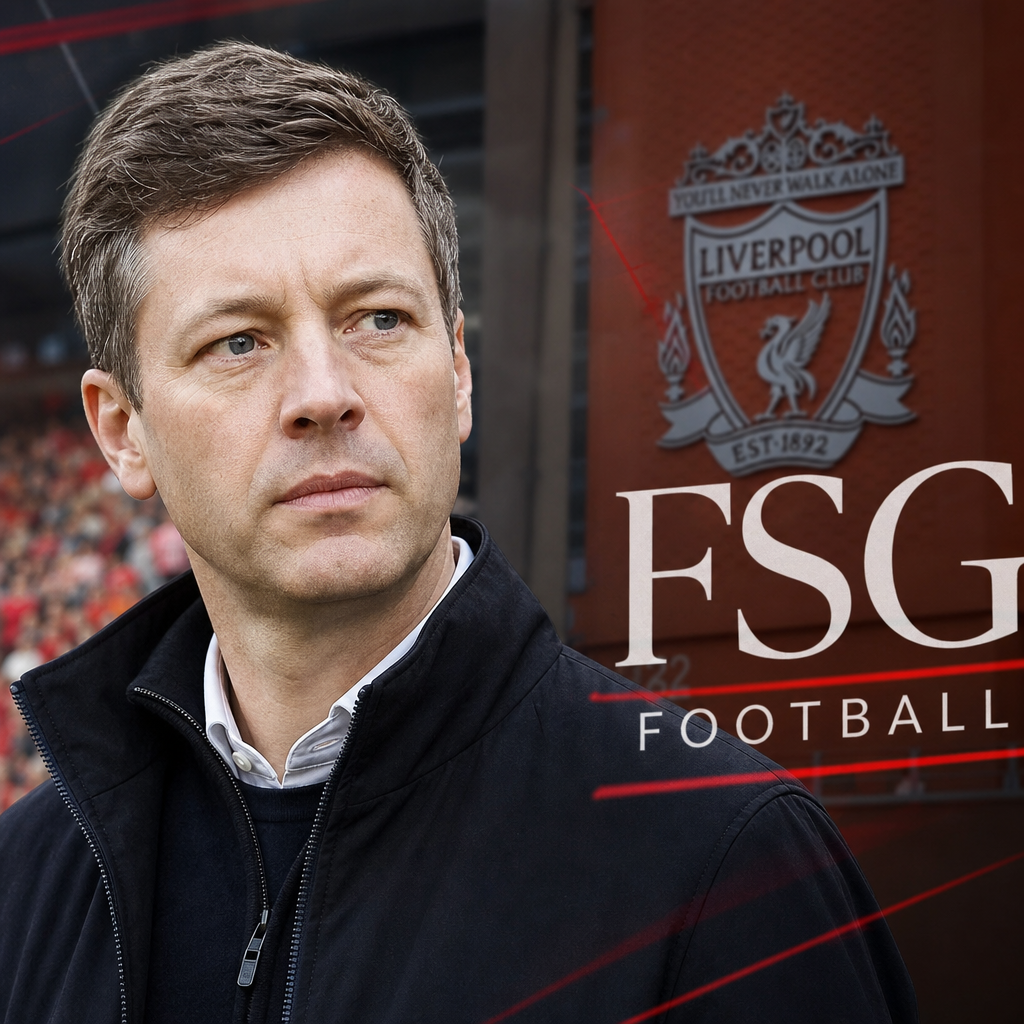
Michael Edwards leaves Liverpool and FSG at a pivotal moment for the club, with the long-serving football executive departing his role as chief executive officer of football at Fenway Sports Group ahead of the 2026/27 season. The move marks another major shift in Liverpool’s senior football structure and raises immediate questions about how the club’s long-term strategy will be shaped from here.
According to Sky Sports, Edwards has exited the position he held at FSG, the American ownership group that controls Liverpool. His departure comes at a significant moment for a club that has spent recent years balancing on-pitch ambition with a carefully managed off-field structure.
Table of Contents
What has happened

Michael Edwards leaves Liverpool and FSG after serving in a senior football leadership role at Fenway Sports Group. FSG are the owners of Liverpool, and Edwards’ exit means one of the most recognisable figures associated with the club’s modern football operations is no longer in place in that top-level role.
The timing is notable. The club is now being left ahead of the 2026/27 season, which places the decision in the context of future planning rather than an immediate matchday issue. Even so, a change at this level can have wide-reaching effects on recruitment, squad planning and the broader football hierarchy.
Edwards is widely known in football circles for his work in senior decision-making roles, and his presence has often been linked with the modernisation of Liverpool’s football structure. His departure therefore carries significance beyond a simple personnel change.
In practical terms, Michael Edwards leaves Liverpool and FSG with several areas potentially needing clarification, from reporting lines to longer-term responsibilities inside the club’s football department. Even when such transitions are planned well in advance, they tend to ripple through the entire structure.
Why this matters for Liverpool
For any elite club, the departure of a senior football executive is never routine.
At Liverpool, the chief executive officer of football role sits close to the centre of decision-making. That makes Edwards’ exit important not just as a name leaving the organisation, but as a potential reset in how the club approaches major football matters. When Michael Edwards leaves Liverpool and FSG, it naturally prompts questions about who carries forward the same level of strategic oversight.
At the highest level, these roles influence:
- recruitment planning
- squad succession
- managerial support structures
- long-term football governance
- communication between ownership and football departments
Liverpool have long been viewed as a club that values organisation, structure and planning. When a figure associated with those principles moves on, the effect is often felt across multiple departments, even if the change is made well in advance.
Edwards’ departure ahead of the 2026/27 season suggests this is part of a forward-looking transition rather than a crisis response. But regardless of the timeline, it remains a major development for a club of Liverpool’s size and profile.
Supporters will also wonder whether the exit changes the club’s internal rhythm. If Michael Edwards leaves Liverpool and FSG without a like-for-like replacement immediately in place, the club may need to redistribute responsibilities while keeping recruitment and planning on schedule.
The FSG angle
The fact that Edwards has left FSG, rather than simply a Liverpool-specific post, adds another layer to the story.
Fenway Sports Group’s football operation is built around more than one club-level decision-making process, and the CEO of football position sits within that wider framework. That means his exit is not just relevant to Liverpool supporters, but to the broader governance structure of FSG’s football interests.
Ownership groups in modern football increasingly rely on executives who understand both sporting and commercial demands. A person in Edwards’ position is typically central to ensuring that football operations remain aligned with financial discipline, strategic planning and competitive ambition.
That balance is especially important in elite European football, where clubs are expected to compete at the top while also making decisions that protect the long-term health of the business. In that sense, Michael Edwards leaves Liverpool and FSG at a time when football governance is under greater scrutiny than ever.
For readers looking at how elite clubs are structured, this is similar to the broader leadership questions discussed in our Premier League explained guide on why the league remains the world’s most-watched competition, where off-field planning and commercial strength are part of the story as much as results on the pitch.
A significant moment in governance
Football governance has become one of the defining themes of the modern game.
Clubs are no longer run solely by head coaches and sporting directors. Instead, senior football executives help shape the entire structure around them. That includes decisions on how a squad is built, how resources are allocated and how a club prepares for future cycles.
Edwards’ exit is therefore more than an internal staffing update. It reflects the broader reality that top clubs are increasingly dependent on highly specialised leadership at board level.
Liverpool’s challenge now is not simply finding a replacement, but ensuring continuity.
In a club of this scale, continuity matters because every major change can have ripple effects:
- transfer strategy may be adjusted
- internal reporting lines may shift
- long-term targets may be re-evaluated
- timing of key appointments can become critical
That is why departures of this kind often attract so much attention, even when they are announced without dramatic public statements.
Michael Edwards leaves Liverpool and FSG with a reputation that will inevitably be judged against the stability he helped build. Whether the next structure looks similar or moves in a different direction, the transition itself will be closely watched.
Business and financial implications
The financial side of football has become inseparable from sporting success.
A chief executive officer of football role at an ownership group such as FSG is likely to sit at the intersection of performance and economics. That means decisions are not only judged by results on the pitch, but by their impact on the wider structure of the club.
Liverpool, like other top clubs, operate in an environment where:
- player trading must be carefully managed
- wage structures remain under scrutiny
- long-term investment needs to be balanced against sustainability
- sporting departments must work within broader financial frameworks
Edwards’ departure could therefore influence how those priorities are handled in the years ahead.
It is also a reminder that modern football is increasingly shaped by executive continuity. Clubs often spend years building a system, and when a key executive leaves, the successor inherits not just a job title but an entire operational philosophy.
In practical terms, the decision could affect:
- the timing of future recruitment moves
- the degree of change within Liverpool’s hierarchy
- the club’s ability to maintain a consistent long-term football identity
None of that means a collapse in direction. But it does mean Liverpool will need to manage the transition carefully. Michael Edwards leaves Liverpool and FSG at a point where financial discipline and football ambition must stay aligned.
What this means for the football side
From a purely football perspective, the exit of a high-level executive can influence how a club plans for multiple seasons ahead.
Liverpool’s structure has historically been praised for creating clarity around decision-making. Edwards’ departure may prompt questions about how the next stage of that structure will look and who will take responsibility for key football decisions.
At elite level, that can matter just as much as what happens on the pitch. A club can have a strong squad and still be destabilised if its leadership model changes at the wrong time or without a clear succession plan.
For Liverpool, the priority will likely be ensuring that the pathway from ownership to football department remains stable.
That includes maintaining clarity around:
- who sets the recruitment agenda
- who approves long-term strategic plans
- how football priorities are communicated internally
- how the club positions itself for future seasons
Those are not headline-grabbing details in the way a transfer or managerial appointment might be, but they are essential to sustained success.
Michael Edwards leaves Liverpool and FSG with the club now facing a familiar elite-sport challenge: how to preserve the qualities that made the structure effective while adapting to a new leadership reality. That balance often defines whether a transition feels seamless or disruptive.
Why the timing stands out
The fact that Edwards has left ahead of the 2026/27 season gives the story additional weight.
Football decisions at this level are usually shaped long in advance. Clubs rarely want to be making major structural changes at the same time as they are preparing for a new campaign. For that reason, any senior departure before a season boundary naturally draws attention.
The timing suggests Liverpool and FSG now have a period in which to adjust, assess and potentially reshape responsibilities before the 2026/27 campaign begins.
That could prove important in several ways:
- it gives the club time to define the next leadership model
- it allows for internal restructuring without immediate competitive pressure
- it may enable a smoother handover if a successor is identified early
In the modern game, timing can be almost as important as the decision itself.
This is also why many supporters keep a close eye on executive changes alongside on-field stories. A club can look stable in the transfer market, but a leadership move can still signal a broader reset behind the scenes. That is especially true when Michael Edwards leaves Liverpool and FSG before a new cycle begins.
The broader Premier League context
Liverpool are not the only Premier League club to place heavy emphasis on executive football leadership.
Across the league, ownership groups now rely on senior football figures to manage increasingly complex organisations. The role is no longer limited to administrative coordination. It often extends into:
- strategic squad-building
- global football operations
- performance oversight
- financial planning
That means a move like Edwards’ departure will be seen by many observers as part of a broader trend rather than an isolated event.
Still, because it involves Liverpool, it will inevitably attract more scrutiny than a routine executive reshuffle.
The club’s global profile ensures that any change at the top of football operations becomes a talking point among supporters, analysts and rival clubs alike. The same level of attention is often seen around the competition itself, which is why many fans also follow long-form coverage such as our Premier League 2025/26 season analysis on defining stories, champions and fallen giants.
For Liverpool, that attention will now turn to how the club responds and whether its next step maintains the standards associated with the Edwards era.
Michael Edwards leaves Liverpool and FSG: the possible next steps
What comes next is the key question.
At this stage, the available information confirms Edwards has left his role, but not the full shape of the succession plan. That means attention will turn to whether FSG appoint a replacement, redistribute responsibilities or redesign the structure around the position altogether.
Whatever the answer, the next steps will matter.
Liverpool supporters will want reassurance that the club’s football project remains stable and that long-term planning is not derailed. In elite football, confidence in leadership can be just as important as confidence in the squad.
For FSG, this is a moment to demonstrate control and clarity.
For Liverpool, it is a reminder that success on the pitch is often linked to stability behind the scenes.
If the transition is handled well, the club can move forward without major disruption. If it is handled poorly, the effects could be felt across recruitment, planning and internal communication for some time. That is why Michael Edwards leaves Liverpool and FSG as more than a routine personnel update: it is a structural story with long-term implications.