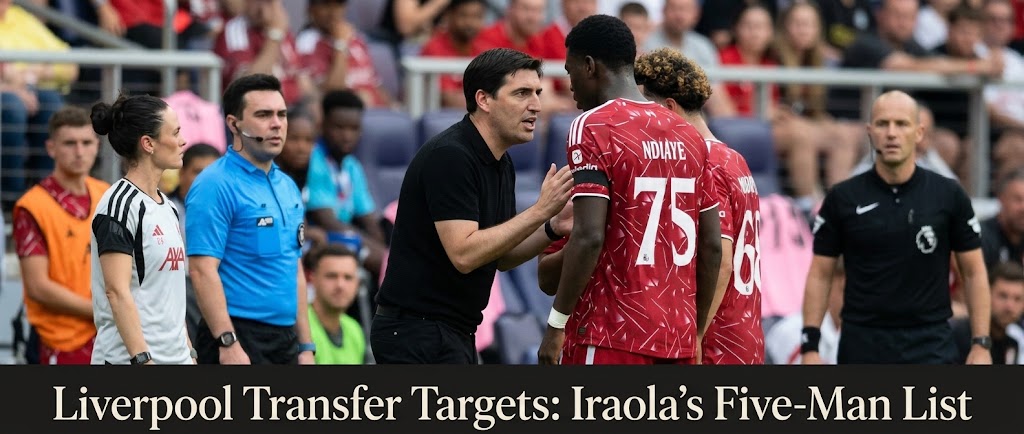
When the original list emerged in June, it provided an intriguing insight into how Iraola wanted to reshape Liverpool.
The five reported Liverpool transfer targets covered three key areas: attacking width, midfield control and defensive athleticism.
Bradley Barcola and Yan Diomande represented explosive attacking options. Jarrod Bowen offered Premier League experience, Adam Wharton provided a potential midfield solution, while Denzel Dumfries could have added power and attacking threat from right-back.
The recruitment strategy appeared logical.
Iraola’s football demands intensity, speed, aggressive pressing and players capable of operating in large spaces. The five names therefore represented more than a collection of talented footballers—they reflected the type of squad the new Liverpool manager wanted to build.
Liverpool Transfer Targets: Iraola’s Original Five-Man Blueprint
 When the original report emerged in June, Liverpool were entering a period of major transition.
Mohamed Salah and Andy Robertson had left, while Ibrahima Konaté was also heading out. Iraola therefore inherited a squad that needed more than a cosmetic adjustment.
The reported five targets reflected three obvious priorities.
Attack: Yan Diomande, Bradley Barcola and Jarrod Bowen.
Midfield: Adam Wharton.
Right-back: Denzel Dumfries.
The idea was clear: introduce players capable of handling a more aggressive, high-intensity system while also adding experience and athleticism.
ESPN’s reported list specifically described an elite winger as one of Liverpool’s major priorities, with Diomande, Barcola and Bowen representing different profiles. Wharton was identified as a midfield option, while Dumfries offered an experienced solution at right-back.
But the summer did not follow that script.
1. Bradley Barcola: The One Target Liverpool Are Actually Getting
 Of the original five, Bradley Barcola is the story that has survived the summer.
Liverpool have reached an agreement with Paris Saint-Germain worth up to £123 million, with £106m understood to be the initial payment and another £17m potentially arriving through add-ons. The France international is expected to sign a long-term contract after completing his medical.
That is significant for two reasons.
First, Barcola was not merely a random name connected with Liverpool. He was identified as one of the club’s principal attacking targets much earlier in the summer.
Second, his arrival directly addresses one of the biggest structural problems in the squad: Liverpool lost Salah but have struggled to find a natural replacement on the right side.
The irony is that Barcola is naturally more comfortable from the left.
That means Iraola will have to solve a tactical puzzle.
SEE ALSO: Liverpool Barcola Deal: New Era After Salah
Liverpool already have players such as Cody Gakpo and Rio Ngumoha who can operate from the left, while Víctor Muñoz has also arrived. Barcola therefore gives Iraola extraordinary attacking quality, but it does not automatically solve the positional imbalance created by Salah’s departure.
Why Barcola fits Iraola
Barcola’s acceleration and ability to attack defenders one-versus-one are especially attractive for a manager who wants his team to play aggressively.
Iraola’s Bournemouth sides were built around intensity, pressing and quick attacks. Liverpool need players who can turn recoveries into immediate attacking situations.
Barcola can potentially provide exactly that.
His ability to carry the ball at speed means Liverpool can transition from defence to attack without requiring every possession to become a long, slow build-up.
And that could be one of the biggest changes under Iraola.
2. Yan Diomande: From Liverpool Target to Real Madrid Player
 The Diomande story is the clearest example of how quickly transfer plans can become obsolete.
In June, the teenage RB Leipzig winger was one of Liverpool’s most attractive attacking targets. Liverpool reportedly made an offer and were prepared to invest heavily, but negotiations ultimately failed to produce a deal.
By August, the story had completely changed.
Diomande joined Real Madrid, with Liverpool deciding not to meet Leipzig’s eventual valuation.
That is important because Diomande was initially viewed as a potential long-term successor to Salah.
Liverpool therefore lost not just a transfer target, but a potential strategic solution to their post-Salah rebuild.
And it explains why the club became increasingly aggressive in its pursuit of Barcola.
3. Jarrod Bowen: The Experience Option That Never Materialised
 Bowen represented a completely different strategy.
While Diomande and Barcola offered youth and explosiveness, Bowen offered something Liverpool arguably lacked after Salah’s departure: Premier League experience.
When West Ham were relegated, there was speculation that the England international could leave. Reports in June even positioned him as an experienced attacker who could complement younger arrivals.
But Bowen ultimately stayed.
That decision changed the equation.
For Liverpool, Bowen would have been a relatively straightforward tactical fit because he already understands the physical and tactical demands of English football.
More importantly, he could have provided a natural right-sided option.
Instead, Liverpool have continued looking at alternatives, including Yankuba Minteh and other attacking players, while Barcola became the priority.
So the Bowen chapter illustrates another problem with Liverpool’s recruitment this summer: the club’s original shortlist and its final market opportunities have not always matched.
4. Adam Wharton: The Midfield Problem Is Still There
 Perhaps the most interesting name on the original list is Adam Wharton.
Liverpool’s midfield did not necessarily need another superstar. What it needed was balance.
Wharton offers qualities associated with a deeper midfield role: breaking up play, receiving possession under pressure and playing line-breaking passes.
Those qualities remain relevant to Iraola’s team.
Indeed, Liverpool’s midfield has continued to attract scrutiny during the opening weeks of the season, with Wharton still being suggested as a potential solution to some of the team’s structural problems.
But there is a major difference between interest and a deal.
Later reports indicated Liverpool’s move for Wharton would not happen.
That leaves Iraola with a fascinating problem.
His Liverpool side wants to press aggressively, but pressing successfully requires protection behind the press.
If the midfield cannot control transitions, Liverpool can become vulnerable when the first wave of pressure is beaten.
That was visible against Forest.
Liverpool had periods of attacking dominance, but the game repeatedly demonstrated the danger of losing control of the match.
The answer may not necessarily be Wharton—but the underlying midfield question remains.
5. Denzel Dumfries: Another Target Who Has Disappeared
 Dumfries was arguably the most obvious tactical fit among the five.
The Dutch full-back combines physical power, speed and attacking aggression. Those are exactly the attributes that can become valuable in an Iraola system.
The original report identified him as a Liverpool target and noted that his Inter contract contained a release clause.
But that possibility disappeared.
Dumfries moved to Real Madrid, with Inter subsequently looking for his replacement.
That is particularly relevant because Liverpool still have questions at right-back.
Jeremie Frimpong has attacking qualities but has faced criticism over his defensive consistency, while Conor Bradley’s availability has been affected by injury problems.
Liverpool therefore lost another potential solution before the end of the window.
What the Forest Draw Actually Tells Us About Iraola’s Rebuild
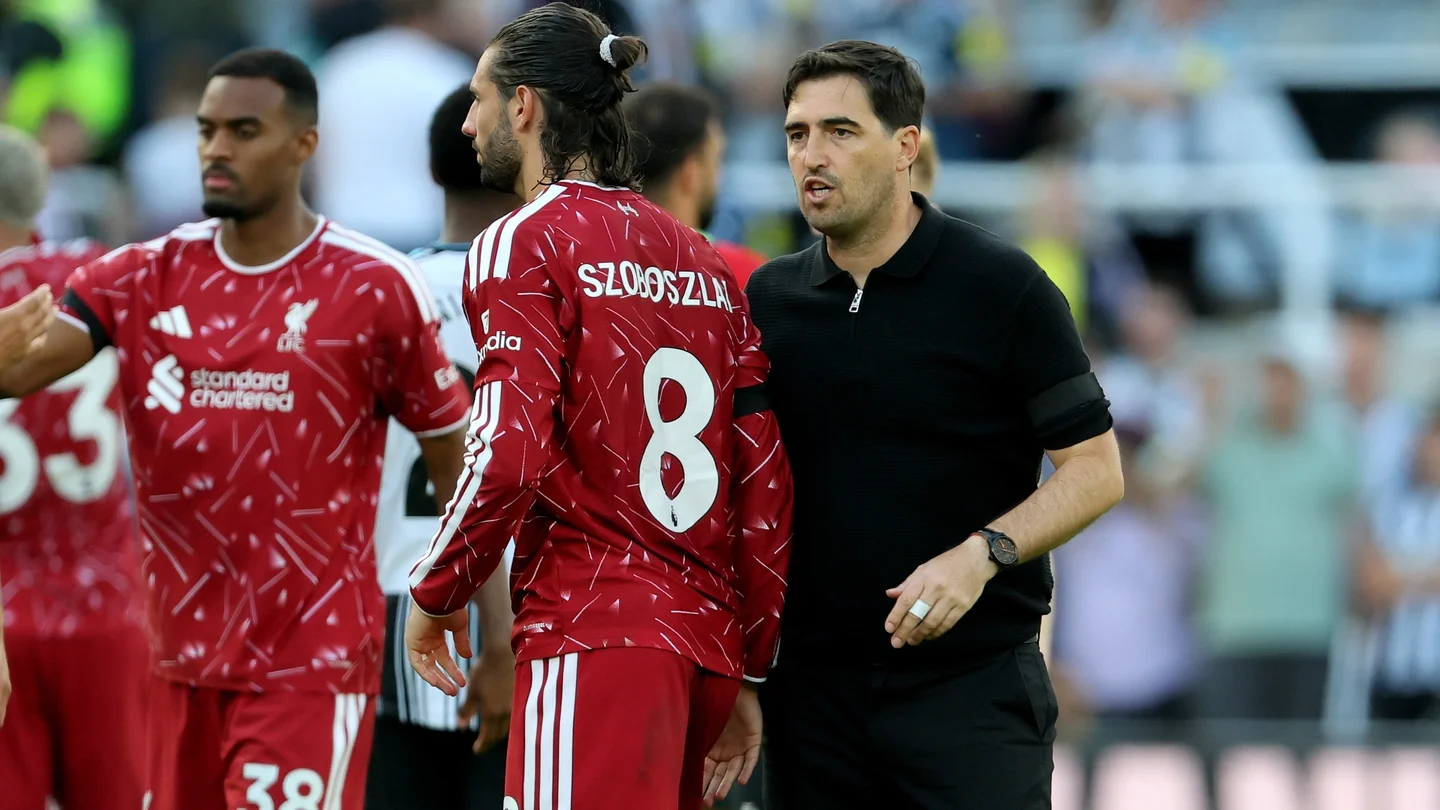 The most important conclusion from the Forest match is not simply that Liverpool need “more players.”
It is that they need the right profiles.
Iraola himself expressed frustration after the game about Liverpool’s slow first-half performance and the lack of urgency and control. He also explained that a malfunction with the substitution board prevented him from making a planned triple change before Forest’s second goal.
That matters tactically.
A high-intensity team cannot depend only on individual brilliance.
It needs:
- aggressive defensive pressure;
- quick reactions after losing possession;
- enough physicality to sustain the tempo;
- midfield control;
- wide players capable of stretching opponents;
- defenders comfortable defending large spaces.
The Forest game showed flashes of the attacking potential, but also highlighted how much work remains defensively and structurally.
And this is where the original five-man list becomes useful.
It was not simply a collection of famous names.
It represented five solutions to five different problems.
The problem is that football’s transfer market has already rewritten the list.
Liverpool’s Five Targets: Where Are They Now?
Player Original role Current situation
Bradley Barcola Elite winger Deal agreed, medical pending
Yan Diomande Explosive young winger Joined Real Madrid
Jarrod Bowen Experienced attacker Stayed at West Ham
Adam Wharton Midfield control Liverpool move ruled out
Denzel Dumfries Right-back Joined Real Madrid
The transformation is striking.
Five reported targets. One still realistically alive.
And that one player could cost up to £123 million.
The Bigger Issue: Is Barcola Enough?
This is where Liverpool’s recruitment strategy deserves serious scrutiny.
Barcola would be a major signing. There is little doubt about that.
But one elite winger cannot solve every problem exposed by the first matches of the Iraola era.
Liverpool have already added Jérémy Jacquet, Víctor Muñoz and Ronald Araújo on loan, while Barcola is now close to joining.
Yet the squad still has questions.
The biggest is defensive stability.
The second is right-sided attacking balance.
The third is midfield control.
And the fourth is simply squad depth.
Iraola has acknowledged that Liverpool have areas that need addressing and has indicated that more transfer activity could happen before the deadline. After the Forest game, he again suggested that work was continuing behind the scenes.
That makes the final days of the window extremely important.
Why This Rebuild Could Define Iraola’s Liverpool
Managers are often judged by tactics.
But at elite clubs, they are also judged by recruitment.
Iraola has inherited a Liverpool squad with enormous individual quality, but the balance of that squad is not necessarily perfect for his football.
That distinction matters.
A player can be world-class and still be a poor fit for a particular tactical structure.
The Forest draw demonstrated exactly that tension.
Liverpool can produce dangerous attacking moments, but Iraola wants more intensity, better defensive organisation and greater control.
The question now is whether the club’s recruitment department can provide the players to make that possible.
Barcola could become the first major piece.
But he cannot be the entire puzzle.
What’s Next for Liverpool?
The transfer window is approaching its conclusion, and Liverpool have already demonstrated that they are willing to spend heavily to get their priority targets.
The reported Barcola package of up to £123 million is evidence of that.
But the bigger story is what happens after Barcola.
Does Liverpool add another winger?
Do they strengthen midfield?
Do they find another defensive solution?
Or does Iraola decide that the existing squad can eventually adapt to his demands?
Those decisions could define the first season of his Liverpool project.
The original five-man list from June now looks almost unrecognisable. Diomande and Dumfries have moved to Real Madrid, Bowen stayed at West Ham, Wharton is no longer a realistic Liverpool move, while Barcola is finally approaching Anfield.
The bigger question, therefore, is no longer whether Iraola identified five players. It is whether Liverpool can give him enough of the right players before the window closes to turn his footballing vision into a team capable of winning games—not merely rescuing draws.
And after the 2-2 Forest draw at Anfield, that question has become impossible to ignore.
What do you think Liverpool need most before the transfer window closes: another winger, a midfielder, or defensive reinforcement?