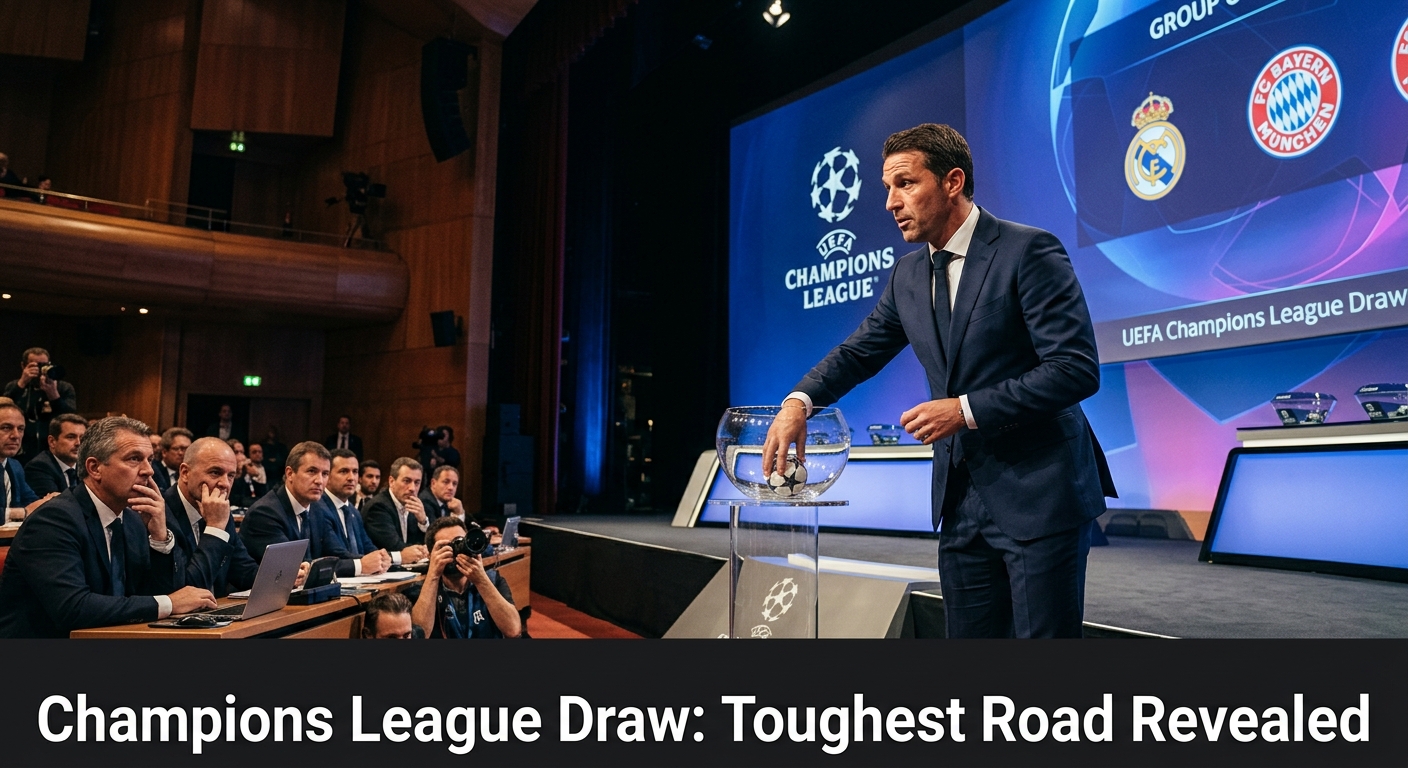
The Champions League Draw has done more than create blockbuster fixtures—it has already changed the difficulty of the road to Madrid for Europe’s biggest clubs.
Some contenders received a schedule that allows them to build confidence gradually. Others were handed a sequence of heavyweight tests that could expose every weakness before the knockout rounds even begin.
Manchester City must navigate Paris Saint-Germain and Barcelona, while Arsenal face both Real Madrid and Bayern Munich in addition to Napoli and Borussia Dortmund. Liverpool, meanwhile, will meet Atlético Madrid and Inter but avoid the concentration of elite opponents carried by some of their Premier League rivals.
That makes this draw about much more than glamorous fixtures.
In the new 36-team league phase, the quality of the route can influence league position, squad rotation, injury management and even the psychological momentum a club carries into the knockout stage.
So which teams have the toughest road—and which clubs may quietly feel that the draw has opened the door to Madrid?
This Draw Is About More Than Big Names
The first mistake would be judging the Champions League draw simply by counting famous clubs.
A difficult schedule is not necessarily the one with the most famous opponent.
The real test is the combination of elite opposition, away fixtures, squad depth and the number of difficult matches that arrive before a team can settle into the competition.
That matters even more under UEFA’s current format.
Each club has eight league-phase fixtures instead of a traditional six-game group stage. The top eight qualify directly for the Round of 16, while positions 9 to 24 must survive a playoff.
That creates a new strategic objective.
Finishing first is obviously attractive, but finishing inside the top eight is now extremely valuable because it removes one additional knockout hurdle.
In other words, a difficult draw can have consequences far beyond one or two difficult nights.
Manchester City Have The Most Brutal Heavyweight Combination
 If one team can make the strongest case for having the toughest road, it is Manchester City.
Their eight opponents are:
- Paris Saint-Germain
- Barcelona
- Napoli
- Porto
- RB Leipzig
- Sporting CP
- Lens
- AEK Athens.
On paper, that list immediately stands out.
Two of Europe’s biggest clubs—PSG and Barcelona—are joined by Napoli and Leipzig, both capable of making any European night uncomfortable.
The PSG–Barcelona problem
The biggest issue is not simply facing two giants.
It is the tactical variety they represent.
PSG can demand that City defend transitions and deal with fast combinations between the lines. Barcelona can create a different problem altogether, forcing opponents to defend long possession phases and repeated positional rotations.
A team may prepare perfectly for one style and still be exposed by the other.
That is what makes City’s draw dangerous.
Napoli adds another layer
Napoli are particularly important because they bring a different kind of test.
They can turn games into physical, emotionally intense contests where the margin for technical mistakes becomes smaller.
City therefore cannot rely on one tactical solution across their league phase.
They will need adaptability.
That is significant in the first Champions League campaign of the new Manchester City era under Enzo Maresca.
UEFA lists City as a Pot 1 side with Maresca as their new head coach, and identifies Erling Haaland as their key attacking figure while Elliot Anderson is their major summer signing.
The draw therefore arrives at the exact moment when City are still defining what their new identity looks like.
That makes their road difficult on paper and strategically dangerous in practice.
Arsenal May Have The Most Impressive “Big Match” Schedule
 If City have the deepest cluster of difficult opponents, Arsenal may have the most prestigious heavyweight draw.
Their opponents are:
- Real Madrid
- Bayern Munich
- Borussia Dortmund
- Napoli
- Real Betis
- Lille
- Slavia Praha
- Sabah.
Look at the names at the top.
Real Madrid. Bayern Munich. Borussia Dortmund. Napoli.
That is an extraordinary set of tests.
Arsenal reached the Champions League final last season before losing to Paris Saint-Germain on penalties, according to UEFA’s current team profile.
So this is not a club entering Europe hoping simply to survive.
This is a club expected to contend.
The Real Madrid factor
Real Madrid are the ultimate test of Arsenal’s European maturity.
Madrid bring Champions League experience, elite individual talent and the ability to turn apparently comfortable games into high-pressure contests.
But the timing also matters.
A match against Real Madrid can become an identity test.
If Arsenal dominate possession but struggle to penetrate, the question becomes whether their attacking structure is good enough at the elite level.
If they control the transition moments and create high-quality chances, their status as a genuine contender becomes much easier to defend.
Then comes Bayern
Bayern create a different challenge.
Their coach Vincent Kompany has built an aggressive attacking side, with UEFA highlighting both the team’s attacking approach and the risk that comes with it. Harry Kane remains their central attacking reference after scoring 33 Champions League goals in 38 appearances for Bayern entering the campaign.
For Arsenal, the Bayern match could become a test of defensive spacing and midfield protection.
And then there is Dortmund.
Suddenly, Arsenal are not dealing with one heavyweight.
They are dealing with a sequence.
That is why their route is so demanding.
Liverpool: The Draw That Could Quietly Become A Gift
 Liverpool’s schedule looks difficult until it is placed beside City’s and Arsenal’s.
Their eight opponents are:
- Atlético Madrid
- Inter
- Porto
- Villarreal
- Fenerbahçe
- Club Brugge
- Lens
- LASK.
Atlético and Inter are serious European opponents.
But there is a significant difference.
Liverpool do not have the same concentration of Pot 1 and elite-level opponents that City and Arsenal must absorb.
That could prove enormously important.
Atlético and Inter are still major tests
Atlético bring Diego Simeone’s experience and defensive discipline. UEFA notes that Simeone is now in his 16th season as Atlético coach and has guided the club through repeated Champions League campaigns.
Inter represent another tactical challenge, particularly in terms of structural discipline and their ability to manage matches without losing their shape.
Yet Liverpool also have several fixtures where they can realistically target maximum points.
That gives Andoni Iraola an opportunity that Arsenal and City may not have:
build rhythm without constantly playing at maximum intensity.
Liverpool’s situation is especially interesting because UEFA lists Iraola as the new coach after Arne Slot’s departure. The club also enters the campaign after finishing fifth in England last season.
A balanced Champions League route could therefore be exactly what a new manager needs.
Aston Villa Have The “Two Giants” Problem
 Aston Villa’s draw is fascinating.
They face:
- Paris Saint-Germain
- Barcelona
- Borussia Dortmund
- Fenerbahçe
- Viking
- Galatasaray
- Club Brugge
- Slavia Praha.
PSG and Barcelona immediately dominate the headlines.
But Villa’s situation is different from Arsenal or City.
There is less expectation that they must finish near the very top.
That could actually make their European campaign dangerous for opponents.
Unai Emery has enormous European experience and, according to UEFA, won the Europa League for a fifth time with Villa last season. The club qualified for the Champions League after that triumph.
Villa can therefore approach the league phase without carrying the same pressure as the traditional favourites.
Their matches against PSG and Barcelona could be opportunities rather than obligations.
Manchester United Face A Different Kind Of Pressure
 Manchester United’s opponents include:
- Bayern Munich
- Atlético Madrid
- Roma
- RB Leipzig
- Aston Villa
- Villarreal
- Sporting CP
- Como.
This is a substantial schedule.
Bayern and Atlético immediately stand out, while Leipzig, Roma and Villa can all create serious problems.
But United’s biggest challenge may not be the strength of the draw.
It may be expectation.
A club returning to the Champions League must immediately behave like a European contender, not a newcomer.
The draw offers enough difficult fixtures to make every dropped point significant.
So Who Actually Got The Toughest Road?
There is no official UEFA “difficulty ranking” attached to the draw.
But using opponent quality and the concentration of high-level fixtures as the measuring stick produces a compelling hierarchy.
1. Manchester City
PSG + Barcelona + Napoli + Leipzig creates perhaps the toughest overall combination.
2. Arsenal
Real Madrid + Bayern + Dortmund + Napoli gives them arguably the most intimidating heavyweight schedule.
3. Manchester United
Bayern + Atlético + Leipzig + Roma + Villa makes this a demanding return to Europe’s elite.
4. Aston Villa
PSG + Barcelona + Dortmund is brutal at the top end, even if the remaining fixtures provide opportunities.
5. Liverpool
Atlético + Inter are major tests, but the overall schedule is more balanced.
This is not a prediction of final league positions.
It is an assessment of route difficulty.
The Hidden Winner: Squad Depth
The most important consequence of this draw may not become visible until December.
Eight league-phase games stretch a squad.
Then add domestic football.
Then injuries.
Then suspensions.
Then travel.
The strongest clubs will not necessarily be those with the best starting XI.
SEE ALSO; Champions League 2026/27 Draw: Winners, Losers And Title Race Secrets
They will be the clubs capable of maintaining a high level when their second-choice and third-choice players are required.
That is particularly important for City and Arsenal.
If one of them suffers an injury crisis during a sequence involving Champions League heavyweights, the draw suddenly becomes much harder than the fixture list suggests.
Liverpool’s comparatively balanced schedule could therefore become a strategic advantage.
The New Format Makes Every Point More Valuable
 There is another reason this draw matters.
Under the current league phase, the goal is not simply to avoid elimination.
The goal is to finish as high as possible.
The top eight advance directly to the Round of 16.
Teams finishing 9th to 24th face a playoff.
That means a difficult draw can impose a double penalty:
harder matches in the league phase + greater risk of an extra knockout tie.
That is why clubs will care about the difference between finishing 7th and 13th even before the knockout stage begins.
What The Draw Tells Us About The 2027 Final
 The final is scheduled for 5 June 2027 at Madrid’s Metropolitano Stadium.
The road there has already begun to take shape.
City must prove their new era can handle elite European pressure.
Arsenal must prove last season’s final run was not an isolated peak.
Liverpool must show that a new manager can immediately compete in Europe.
Real Madrid must navigate a demanding schedule that includes Arsenal.
And PSG must defend their status as reigning champions after being drawn against both Barcelona and Manchester City.
The draw has not decided who reaches Madrid.
But it has changed the cost of getting there.
Conclusion: The Hardest Road May Shape The Champion
The Champions League Draw has created two very different realities for Europe’s contenders.
Manchester City and Arsenal received the kind of heavyweight schedules that can expose even elite squads. Liverpool, while facing Atlético Madrid and Inter, have a more balanced route that may allow them to accumulate points without constantly living on the tactical edge.
That does not mean Liverpool have an easy road.
Nor does it mean City or Arsenal will struggle.
It means the new Champions League is increasingly becoming a competition of route management.
The champion will need more than superstar quality.
It will need the ability to survive difficult nights, rotate intelligently, collect points consistently and arrive in March with its squad—and confidence—intact.
The draw has been made. Now the real European test begins.
Which club do you believe received the toughest Champions League road to Madrid: Manchester City, Arsenal, or another contender? Share your verdict with The Football Xtra.