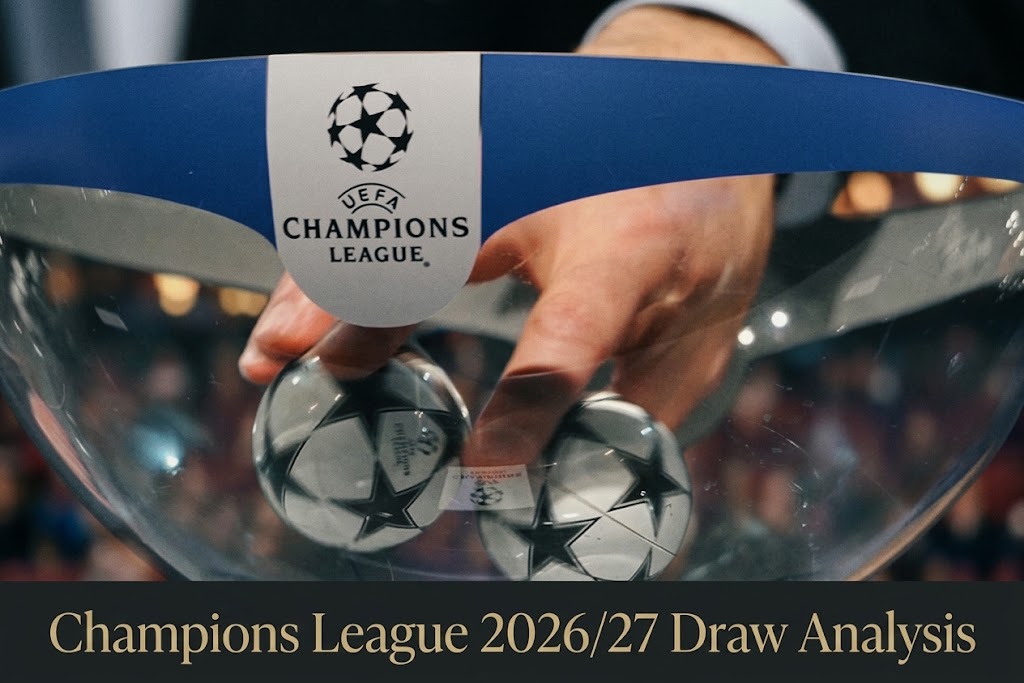
Champions League 2026/27 Draw has created a new European battlefield where one difficult fixture can completely change a club’s journey towards football’s biggest prize.
The Champions League is no longer only about having the strongest squad.
Under UEFA’s new league phase format, success now depends on something more complicated:
strategy, squad depth, rotation and surviving a demanding eight-game opening phase.
With 36 clubs competing and Europe’s giants already positioned across four pots, every draw decision carries tactical and financial consequences.
For Real Madrid, Manchester City, Arsenal, Liverpool, Barcelona and Bayern Munich, the mission remains the same:
Win Europe.
But the road to the final has become more unpredictable than ever.
Champions League 2026/27 Draw Analysis: The New Battle For European Supremacy
 The Champions League Has Entered A New Era
For decades, Champions League success followed a familiar formula:
- Strong squad.
- Elite manager.
- Big-match experience.
- Momentum in knockout rounds.
However, the new league phase format has changed the calculation.
Instead of six group matches, every club now faces eight different opponents.
That means:
- More high-level matches.
- Less room for mistakes.
- Greater importance of squad depth.
A poor start can create pressure immediately.
A strong start can give a team a psychological advantage before the knockout stage.
The Biggest Winners From The Draw
 1. Manchester City: Built For The New Champions League
Manchester City’s biggest advantage is not only talent.
It is squad structure.
The modern Champions League rewards teams that can handle:
- Injuries.
- Rotation.
- Tactical changes.
City have historically been among the strongest teams at controlling possession and dominating opponents.
However, their 2026/27 challenge is different.
With a new era beginning after Guardiola’s period, Europe will test whether City’s football structure is stronger than one manager.
Their advantage:
- Financial power.
- Elite recruitment.
- Champions League experience.
The question:
Can the new Manchester City survive the pressure of replacing a legendary era?
Real Madrid: The Champions League DNA Advantage
 Real Madrid remain the ultimate Champions League specialists.
Their advantage cannot always be measured by statistics.
It is mentality.
The club has repeatedly shown the ability to win difficult European matches because of:
- Experience.
- Individual brilliance.
- Calmness under pressure.
However, the new format creates a different challenge.
The league phase requires consistency.
Real Madrid cannot simply wait for knockout football.
They must perform from Matchday 1.
Arsenal: The Moment To Prove European Ambition
 Arsenal enter another Champions League campaign with growing expectations.
The question surrounding Mikel Arteta’s team:
Can they move from being Premier League contenders to European champions?
Their strengths:
- Tactical organisation.
- Defensive structure.
- Young elite talent.
Their challenge:
Champions League knockout football requires experience.
The 2026/27 campaign could define whether Arsenal have become a true European superpower.
Liverpool And The Importance Of Squad Management
Liverpool’s return among Europe’s elite creates another fascinating storyline.
The Champions League demands balance.
A team must compete domestically while managing European travel.
Liverpool’s biggest challenge:
Maintaining intensity across multiple competitions.
Their success may depend on:
- Rotation.
- Midfield control.
- Defensive consistency.
The New Format Creates New Tactical Problems
The league phase changes how managers think.
Previously:
A team could calculate six matches.
Now:
Eight different opponents create more complexity.
Managers must prepare for:
- Different tactical systems.
- Different styles.
- Different levels of opposition.
A club may face:
- A possession-based giant.
- A defensive specialist.
- A dangerous counter-attacking team.
Adaptability becomes a weapon.
The Financial Battle Behind The Champions League Draw
 The Champions League is not only about trophies.
It is also football’s biggest financial competition.
A strong European run brings:
- Broadcasting revenue.
- Sponsorship value.
- Global exposure.
- Increased player attraction.
For smaller clubs, one famous opponent can transform their season financially.
SEE ALSO; Champions League Explained: Format, Money and Why It Defines European Football
For giants, early elimination can represent a major financial disappointment.
Who Could Be The Surprise Team?
Every Champions League season creates unexpected stories.
The new format could benefit teams that:
- Have strong organisation.
- Defend well.
- Maximise home advantage.
History shows that European success is not always decided by the biggest budget.
Sometimes it belongs to the team that handles pressure better.
The Biggest Question: Does The New Format Help Or Hurt The Giants?
The traditional giants still have advantages.
Money.
Squad depth.
Experience.
But the new system introduces uncertainty.
More matches mean more opportunities for mistakes.
A single bad run can affect league position.
The Champions League has become less predictable.
And that may be exactly what UEFA wanted.
What’s Next Before The Trophy Race Begins?
 The next important phase will be:
- Final squad registrations.
- Tactical adjustments.
- Injury management.
- First eight league phase matches.
The teams that adapt fastest will have the advantage.
Conclusion: Champions League 2026/27 Will Reward Adaptability
Champions League 2026/27 Draw has created a competition where talent alone will not guarantee success.
The winners will likely be the team that combines:
- Elite quality.
- Tactical intelligence.
- Squad depth.
- Mental strength.
The new Champions League era is officially here.
The question is no longer only:
Who has the best players?
The bigger question is:
Who can survive Europe’s most demanding football marathon and lift the trophy in Madrid?
What team do you think received the best route to Champions League glory this season? Share your prediction.