Barcelona did not merely open their Champions League campaign with a 5-1 victory over Feyenoord. They announced that their attack may already have a new centre of gravity — and it is Raphinha.
The headlines will naturally belong to Lamine Yamal. The teenager scored, supplied two assists, finished the game wearing the captain’s armband and again looked like the kind of player who can bend a major European night around his talent.
But Barcelona 5-1 Feyenoord produced another, perhaps more important, conclusion.
Raphinha is no longer simply the experienced star operating alongside Barcelona’s young phenomenon. He is increasingly becoming the player who gives Hansi Flick’s attack structure, aggression and ruthless finishing.
The Brazilian scored twice, earned UEFA’s Player of the Match award and took his tally to eight goals in five matches this season. He has also scored in every one of those five games. Barcelona’s official statistics note that no Barça player had scored as many goals in the first five matches of a season since Sándor Kocsis in 1958/59.
That is why this five-goal demolition deserves to be read differently.
Yamal was spectacular.
Raphinha was decisive.
Barcelona 5-1 Feyenoord: The Scoreline Was Only Part of the Story
 The scoreline tells us Barcelona dominated. The underlying numbers explain how.
According to StatMuse, Barcelona finished with 72% possession, 24 shots, nine on target, 799 passes attempted and 45 touches in Feyenoord’s penalty area. The visitors managed only four shots and two on target. Barcelona also completed 94% of their passes.
This was not a match won simply because Barcelona had better attackers.
They repeatedly forced Feyenoord backwards.
The ball circulation was relentless. Barcelona moved the Dutch side from side to side, created gaps between defensive and midfield lines and then attacked those spaces quickly.
Feyenoord’s problem was that every time they attempted to step forward, Barcelona had another attacking movement waiting behind them.
That explains why Raphinha’s performance matters beyond his two goals.
His influence came from the way his movement interacted with the rest of the front line.
Raphinha Barcelona Role Is Changing
 One of the most fascinating developments around this Barcelona side is Raphinha’s tactical evolution.
Flick has already spoken about using the Brazilian as a centre-forward, explaining that he expected this level from him and that Raphinha gives the team what the manager wants.
Against Feyenoord, that development became particularly visible.
Barcelona’s official match report describes Raphinha anticipating his marker, escaping the defensive attention and creating the opening goal himself after beating two defenders before finishing with his left foot.
Then came his second.
Pedri identified Raphinha’s run through the middle and threaded a pass into the space. Raphinha timed his movement perfectly, carried the ball towards goal and calmly finished left-footed.
That is the key distinction.
A conventional winger often waits for the game to bring him into the action.
This version of Raphinha actively searches for the most dangerous zone on the pitch.
He can start wide, drift inside, attack the space behind the centre-backs or become the player occupying the central channel when Barcelona overload the flank elsewhere.
That versatility gives Flick something extremely valuable in Champions League football: unpredictability.
Why Raphinha Was the Bigger Story Than Lamine Yamal
 This is not an argument that Yamal was poor.
Quite the opposite.
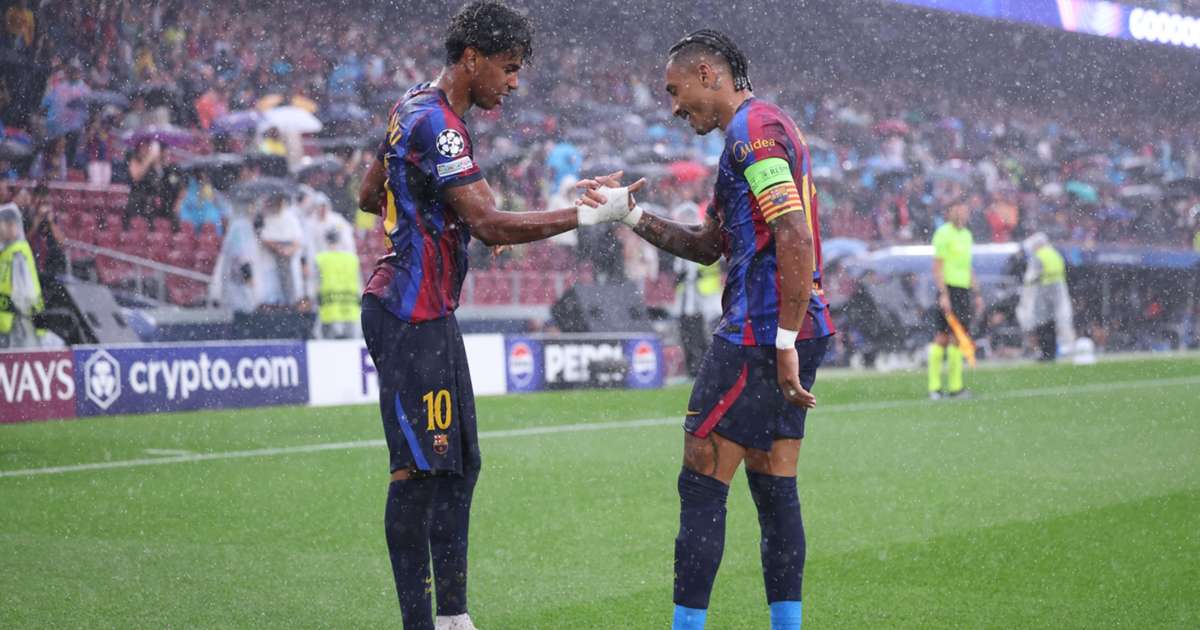
Yamal produced a superb performance, scoring Barcelona’s fourth goal with a free-kick and then providing the cross for Gabriel Jesus to score the fifth. StatMuse credited him with one goal, two assists and a 9.1 rating.
He also played the entire match.
But the question is not who was brilliant.
The question is who changed what Barcelona can be as a team?
And that answer may be Raphinha.
Yamal represents Barcelona’s future and increasingly their creative present. He can isolate defenders, create from the right and produce moments that appear impossible until the ball is already in the net.
Raphinha offers something slightly different.
He gives Barcelona controlled violence.
He attacks space.
He presses.
He runs beyond the last line.
He makes defenders turn.
He can finish attacks himself.
And, crucially, he has the experience to understand when a Champions League match is asking for patience and when it is asking for punishment.
That combination is difficult to replace.
Raphinha Double Showed a Different Kind of Leadership
 There was another layer to the night.
Raphinha started as Barcelona’s captain.
He scored inside three minutes.
He scored again after half-time.
Then, when he was substituted in the 71st minute, the armband passed to Yamal.
That moment was symbolically important.
Reuters reported that Yamal became Barcelona’s youngest-ever captain at 19 years and 58 days, taking the record from Bojan Krkic.
But look at what happened before that handover.
The captain’s responsibility had already been expressed through Raphinha’s football.
He set the tone early.
He made Feyenoord defend immediately.
He gave Barcelona a cushion.
And he left the pitch after another match-defining contribution.
That is leadership in a more traditional football sense.
Yamal’s leadership may ultimately become greater because of his age, talent and responsibility. Raphinha’s leadership right now is based on production and authority.
Barcelona need both.
The First Goal Was a Tactical Warning
Raphinha’s opening goal deserves more attention than a simple highlight reel can provide.
The Brazilian received the opportunity, attacked the defensive line and used a sharp change of direction to leave defenders struggling on a rain-soaked pitch before finishing.
Barcelona’s official report noted that two Feyenoord defenders were left on the ground during the move.
That sequence exposed a central problem for the visitors.
How do you defend Barcelona when the player operating centrally can also behave like a winger?
If Feyenoord’s centre-backs stepped out, space appeared behind them.
If they stayed deep, Barcelona could circulate the ball around the block.
And if they shifted towards Yamal on the right, Raphinha could attack the central corridor.
This is one reason Barcelona’s attacking structure looked so difficult to contain.
The danger did not originate from one position. It moved.
Pedri’s Role Was the Quiet Engine
 Raphinha’s second goal also highlighted another important component of the system: Pedri.
There is always a temptation to focus on scorers when Barcelona produce a five-goal victory.
But Pedri’s ability to identify the run before the defence reacts remains one of the most valuable features of this team.
His pass for Raphinha’s second goal was not simply accurate.
It was timed.
Raphinha did not have to stop or adjust his movement.
He could continue his run because Pedri released the ball at precisely the correct moment. Barcelona’s official report specifically highlighted the quality of Pedri’s pass and Raphinha’s timing.
That connection could become crucial later in Europe.
Elite Champions League football is often decided by fractions of a second.
Barcelona now have a forward making those runs and a midfielder capable of finding them.
That is a dangerous combination.
Lamine Yamal Was Still Brilliant — and That Actually Helps Barcelona
 The most encouraging part of this performance may be that Barcelona did not need Yamal to carry the entire attacking burden.
He still produced.
He scored.
He assisted.
He created danger.
And he finished the match with the captain’s armband.
But he did not have to be the single source of inspiration.
That is what separates a promising team from a serious European contender.
A great player can win you a game.
A great squad gives you several ways to win it.
Barcelona now have that possibility.
Against Feyenoord, Raphinha scored twice.
Yamal contributed directly to three of the goals.
Karim Adeyemi scored with a spectacular finish.
Gabriel Jesus came off the bench and scored his first Barcelona goal.
Even the structure around them mattered, with João Cancelo hitting the post and Barcelona repeatedly creating opportunities in and around the penalty area.
The attack is becoming less dependent on one superstar.
That is potentially enormous.
The Pressing Made the Five Goals Possible
It would be a mistake to discuss Barcelona 5-1 Feyenoord only through attacking quality.
The foundation was the pressure without the ball.
Barcelona’s official report described the team as playing with confidence and intensity, noting that Adeyemi led the press while Rodri and Pedri controlled midfield.
This matters because Flick’s preferred attacking football is much easier to sustain when the team can immediately recover possession.
The idea is simple.
Lose the ball.
React instantly.
Force the opponent into a rushed decision.
Win it back high.
Attack before the defensive structure is restored.
That cycle makes possession dangerous.
SEE ALSO: Rodri Pedri Partnership: Barcelona’s New Midfield Weapon That Could Change Everything
Barcelona’s 72% possession therefore should not be treated as a decorative statistic. Their territorial dominance was linked to their ability to continuously restart attacks.
And Raphinha is central to that.
His energy means he can contribute even when he is not receiving the ball.
He can chase.
He can close passing lanes.
He can force a defender into an uncomfortable clearance.
That work makes his goal tally even more valuable because his influence is not dependent solely on finishing.
Raphinha Is Starting the Season Like a Player With Something to Prove
There is another intriguing subplot surrounding the Brazilian.
After the Feyenoord victory, Raphinha was asked about the Ballon d’Or and his absence from the final 30 nominees.
His response was telling: “I don’t talk about that, I only talk about Barcelona.”
That answer fits the football he is producing.
Rather than campaigning through interviews, he is producing on the pitch.
The numbers are already remarkable.
Two goals against Feyenoord took him to eight goals in five matches. He has scored in all five of Barcelona’s competitive games this season, a feat the club notes had not been achieved by a Barça player in the opening five matches since Luis Suárez in 1958.
His two goals against Feyenoord also moved him to 21 Champions League goals for Barcelona, putting him fifth on the club’s all-time scoring list in the competition, behind Lionel Messi, Luis Suárez, Rivaldo and Robert Lewandowski.
That is not a small footnote.
It is historical territory.
Four Five-Goal Victories in Five Matches
There is another statistic that reveals just how aggressively this Barcelona side has started.
Barcelona’s official report says the Feyenoord victory was their fourth five-goal haul in the first five matches of the season.
That is an extraordinary attacking trend.
And importantly, these victories are not all being produced in identical ways.
Barcelona can attack through Yamal’s individual brilliance.
They can exploit Raphinha’s movement.
They can use Pedri’s passing.
They can bring substitutes into dangerous positions.
They can create from wide areas or through the middle.
That variety is arguably more important than any individual goal total.
Because once Barcelona reach the knockout rounds, opponents will spend weeks trying to identify one weakness.
The answer may be that there isn’t one obvious route to stop them.
The One Warning Flick Cannot Ignore
For all the excitement, this was not perfection.
Feyenoord eventually scored through Sem Steijn in the 82nd minute, preventing Barcelona from recording a clean sheet. UEFA’s match report also noted that Feyenoord had periods in which they threatened, while Barcelona had already allowed the visitors opportunities before the Dutch side finally converted.
StatMuse’s model gave Feyenoord 1.08 expected goals despite their four shots, showing that the visitors generated some quality moments even in a heavily one-sided match.
That is the area Flick will need to monitor.
Europe punishes defensive lapses more severely than domestic football.
Barcelona can dominate possession against many opponents.
But against the best Champions League teams, one transition can change an entire tie.
The attacking structure looks frightening.
The defensive control still needs to prove itself at the highest level.
What Barcelona 5-1 Feyenoord Really Tells Us
 The easiest conclusion is that Barcelona are ready to win another European trophy.
That would be premature.
One victory, even a five-goal victory, does not settle a Champions League campaign.
But it does reveal something important.
Barcelona have entered this season with multiple elite attacking identities.
Yamal can be the magician.
Adeyemi can bring pace and verticality.
Gabriel Jesus can provide movement from the bench.
Pedri can unlock defensive structures.
And Raphinha can now function as the relentless scorer, presser and central attacker who connects everything.
That may be Flick’s most valuable development.
Because the Barcelona of the past could sometimes become too dependent on individual brilliance.
This Barcelona side is beginning to look more collective.
Flick said before the season that Yamal’s development and the team’s need for intensity and pressing were crucial to their ambitions, while he has separately praised Raphinha’s ability to deliver exactly what the team needs from the centre-forward position.
Against Feyenoord, both ideas came together.
What’s Next for Raphinha and Barcelona?
The Champions League has only just started, but Barcelona could hardly have asked for a stronger opening statement.
UEFA’s official report named Raphinha Player of the Match, confirming that the Brazilian was not merely one of many good performers on the night.
Meanwhile, Yamal continues to grow into a leadership role that could define Barcelona’s next era.
That is precisely why Raphinha’s emergence is so significant.
Barcelona do not need to choose between the Brazilian and the teenager.
They need both.
Yamal gives them imagination.
Raphinha gives them edge.
And when those qualities exist in the same attacking structure, Barcelona become much harder to prepare for.
The five goals against Feyenoord were impressive.
The bigger warning for Europe is that Barcelona may no longer need Lamine Yamal to be their entire story.
Raphinha is building a story of his own — and right now, it is being written in goals.
What did you make of Raphinha’s performance compared with Lamine Yamal’s? Share your view in the comments.