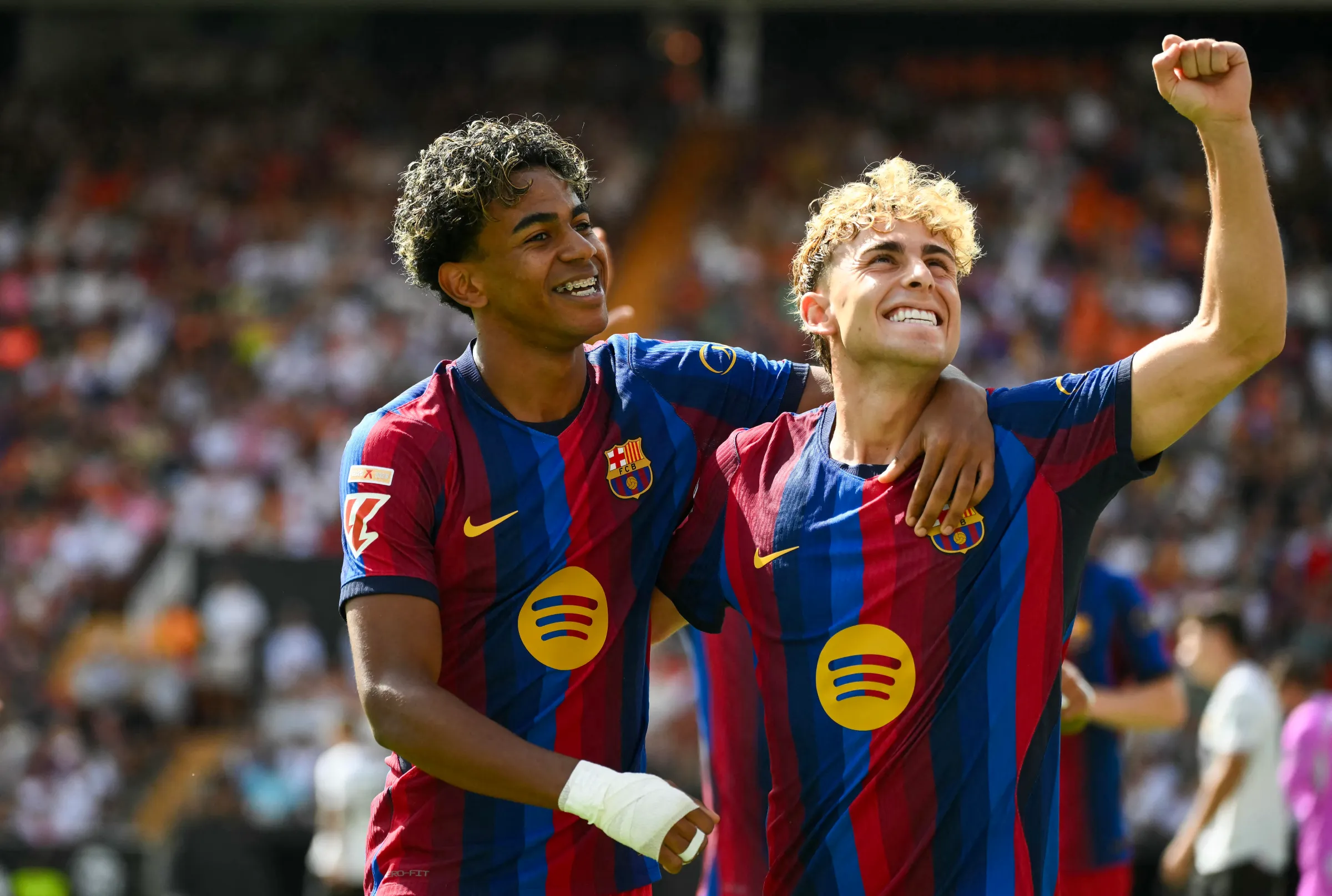
Barcelona 5-0 Valencia looked, at first glance, like another Lamine Yamal show.
Two goals from the teenager. Five goals for Barcelona. Another statement victory. Another night in which Yamal reminded everyone why he is increasingly being discussed among the defining players of his generation.
But that reading misses the most important development at Mestalla.
The real story was happening underneath the goals.
For the first time in LaLiga this season, Hansi Flick started Rodri and Pedri together in midfield. What followed was not merely another Barcelona attacking exhibition. It was a glimpse of a different version of the team: more controlled, more patient and, crucially, more capable of giving its most creative players the freedom to attack.
Barcelona dominated Valencia 5-0, with Yamal scoring twice while Fermín López, Raphinha and Pedri completed the scoring. The result maintained Barcelona’s perfect start to the league campaign, with four victories from four matches and 17 goals scored.
The obvious headline is Yamal.
The more interesting headline is Rodri and Pedri.
Because if this partnership develops the way Barcelona hopes, the biggest consequence may not be that Rodri controls games.
It may be that Pedri becomes even more dangerous because he no longer has to control everything himself.
The Barcelona 5-0 Valencia Scoreline Hid a More Important Tactical Experiment
 Flick lined Barcelona up in a 4-3-3, while Carlos Corberán’s Valencia started with a 5-4-1.
That immediately created a familiar tactical problem.
Valencia wanted to defend with numbers behind the ball. Barcelona wanted to stretch the defensive block, move it from side to side and eventually create the spaces where Yamal, Raphinha and Fermín could attack.
But there was something different about Barcelona’s midfield structure.
Rodri provided a stable reference point.
Pedri could operate with greater freedom.
And the result was a Barcelona side that appeared capable of controlling the game without sacrificing its attacking threat.
That balance is what makes this performance more significant than the scoreline alone.
Barcelona did not simply overwhelm Valencia through individual quality.
They repeatedly created situations in which their individual quality could become decisive.
That is the difference between a talented team and a structurally dominant team.
Rodri’s Real Contribution Was Not Just Passing
 Rodri’s first LaLiga start for Barcelona was always going to attract attention.
The obvious question was whether the former Manchester City midfielder could immediately impose his control on Barcelona’s possession game.
The answer was encouraging.
Flick specifically praised Rodri after the match, describing him as an important leader and emphasizing the sense behind his actions on the ball.
But the more interesting aspect was what Rodri allowed other players to do.
A midfielder like Rodri does not need to dominate the match through spectacular passes.
His value often comes from making the game simpler.
Receive.
Scan.
Move the ball.
Position himself correctly.
Protect the centre.
Recycle possession.
Slow the match down when necessary.
Accelerate it when the opportunity appears.
That type of control creates freedom elsewhere.
And Pedri was the biggest beneficiary.
Rodri and Pedri: Why the Partnership Could Be Special
 There is an obvious concern whenever two technically gifted midfielders play together:
Who controls the game?
In Barcelona’s case, the answer may be that they control different parts of it.
Rodri can provide the platform.
Pedri can provide the interpretation.
That distinction is important.
Pedri is at his best when he can receive between lines, manipulate pressure and combine around the opposition’s defensive structure.
But if Pedri has to constantly drop deeper to help Barcelona progress the ball or protect transitions, some of his attacking influence naturally disappears.
SEE ALSO: Rodri Pedri Partnership: Barcelona’s New Midfield Weapon That Could Change Everything
Rodri changes that equation.
With Rodri behind him, Pedri can spend more time thinking about what happens after the first line of pressure has been broken.
That is where Pedri becomes dangerous.
His goal in the 79th minute was the perfect symbol of this relationship. Pedri combined with Dani Olmo before finishing Barcelona’s fourth goal.
The goal itself was important.
But the bigger point was his position.
Pedri was able to arrive in an advanced area rather than being permanently tied to the deepest phase of Barcelona’s possession.
That is precisely the type of freedom Barcelona will want to see more often.
The Yamal Story Is Bigger Than His Two Goals
 None of this diminishes Lamine Yamal.
If anything, it explains why Yamal could become even more dangerous.
Yamal scored Barcelona’s opener after only six minutes and added his second late in the match to complete the 5-0 victory.
He also had another effort ruled out for offside.
But Yamal’s influence went beyond the goals.
Barcelona’s structure repeatedly created situations where he could isolate defenders.
That is exactly what elite wingers want.
You do not want your best one-v-one player constantly receiving the ball with two or three defenders already positioned around him.
You want to move the defensive block first.
Move the ball through midfield.
Force defenders to shift.
Then release the winger into the resulting space.
Rodri and Pedri help Barcelona do that.
Rodri can stabilize circulation.
Pedri can accelerate combinations.
Fermín can attack spaces.
Raphinha can threaten the opposite side.
And Yamal can receive in situations where his individual ability becomes devastating.
This is why calling the match simply a Yamal masterclass undersells Barcelona’s tactical development.
Yamal was the most visible weapon.
The midfield structure was the mechanism creating the conditions for those weapons.
Valencia’s 5-4-1 Was Designed to Survive — Barcelona Made It Collapse
 Corberán did not send Valencia into the match with an open, reckless structure.
The official lineup shows Valencia operating in a 5-4-1.
That shape is designed to give a team numerical protection.
Five defenders can protect the box.
Four midfielders can narrow the central spaces.
The lone striker can remain available for transitions.
On paper, that should make it difficult for Barcelona to play directly through the middle.
But the problem was that Barcelona could move the ball around the block quickly enough to create instability.
Barcelona’s control was reflected statistically as well. One match-data analysis recorded 73% possession, 790 passes and 19 shots for Barcelona, compared with 27% possession, 280 passes and three shots for Valencia.
That tells an important story.
Valencia were not merely losing the scoreboard.
They were losing territory.
They were losing possession.
They were losing the ability to dictate where the game was played.
And once that happens against a team containing Yamal, Raphinha, Pedri and Fermín, the defensive block eventually becomes stretched.
The First Goal Explained Barcelona’s New Possibilities
 The opening goal arrived after just six minutes.
Pedri helped initiate the move, Fermín delivered the ball forward and Yamal finished the attack.
That sequence is important because it connects the three themes of this article.
Rodri gives control.
Pedri gives creativity.
Yamal gives destruction.
The Spanish midfielders do not need to perform the same job.
That is precisely why their partnership has potential.
Rodri does not need to become Pedri.
Pedri does not need to become Rodri.
Instead, they can make each other’s strengths more valuable.
Fermín Lopez Was Another Important Piece
 There is another player who deserves attention: Fermín López.
He scored Barcelona’s second goal and provided assists in the match, producing the kind of high-energy performance Flick has increasingly valued. Reuters highlighted his contribution of one goal and two assists.
Flick also praised Fermín’s intensity, particularly his willingness to contribute both inside and outside the penalty area.
That matters tactically.
Barcelona are not simply building a possession team that passes endlessly around the opponent.
They want movement.
They want players attacking spaces.
They want pressure after losing the ball.
They want midfielders capable of becoming attackers.
And that makes the presence of Rodri even more useful.
The more reliable Barcelona’s defensive structure becomes, the more freedom players such as Fermín and Pedri can take in attacking areas.
Hansi Flick May Have Discovered Barcelona’s New Balance
Flick’s post-match comments were particularly revealing.
He described Barcelona’s performance as “fantastic” and “almost perfect”, highlighting their control and dominance. He also acknowledged that the team still needs to improve its management of games after taking a large lead.
That second point is important.
Barcelona scored five.
But Flick was not completely satisfied.
Why?
Because elite teams are not judged only by how spectacularly they attack.
They are judged by how well they control the match.
And that is where Rodri becomes potentially transformative.
Barcelona have plenty of players capable of producing chaos.
Yamal can create chaos.
Raphinha can create chaos.
Fermín can create chaos.
Olmo can create chaos.
Pedri can create chaos.
Rodri’s job may be to make sure Barcelona chooses when to create that chaos.
That is a completely different level of control.
Pedri’s Own Verdict Matters
Perhaps the most revealing evidence came from Pedri himself.
After the match, Pedri rejected the suggestion that playing alongside Rodri was hurting his game. Instead, he said the partnership benefits him and suggested the connection can become even stronger with more matches together.
That should be taken seriously.
Players understand positional relationships differently from supporters watching from the outside.
Pedri knows exactly how much freedom he receives when someone like Rodri occupies the deeper role.
And the Valencia performance provided the first major evidence that the theory can work.
Barcelona’s Biggest Challenge Now Is Making This Repeatable
One spectacular night does not create a dynasty.
Barcelona’s 5-0 victory came against a Valencia side that remains at the bottom of the table after four matches, with only one point.
So the performance needs context.
The real test will come against opponents capable of pressing Rodri, blocking Pedri’s preferred zones and preventing Yamal from receiving isolated on the wing.
That is where this partnership will truly be judged.
Can Rodri escape pressure against elite pressing teams?
Can Pedri remain high enough to influence the final third?
Can Barcelona protect transitions when both full-backs advance?
Can Yamal continue receiving favourable one-on-one situations?
And perhaps most importantly:
Can Barcelona control difficult matches as comfortably as they controlled Mestalla?
Those are the questions that will determine whether this was simply a brilliant September afternoon or the beginning of something much bigger.
The Real Barcelona Story Is Not Yamal vs Everyone
Football naturally gravitates toward its stars.
Yamal scored twice, so the spotlight belongs to him.
But Barcelona’s most important development may have happened several metres behind him.
Rodri’s arrival gives Flick something Barcelona have desperately valued for years: a midfielder capable of controlling the rhythm of a match while providing defensive security and leadership.
Pedri, meanwhile, gets an environment in which he does not necessarily have to be everywhere.
That could be enormous.
Because the best version of Pedri is not necessarily the midfielder who touches the ball the most.
It may be the midfielder who touches it in the most dangerous places.
And if Rodri can consistently give him those conditions, Barcelona may have found a midfield partnership capable of supporting the next stage of their attacking evolution.
What’s Next for Barcelona?
The 5-0 victory leaves Barcelona with four wins from four league matches and 17 goals scored.
The next challenge is Europe, where the intensity and tactical sophistication will rise significantly.
That is where the Rodri-Pedri experiment becomes truly fascinating.
Because Barcelona already have extraordinary attacking talent.
They already have Yamal.
They already have Raphinha.
They have Fermín.
They have Olmo.
What they may have lacked was a reliable mechanism for controlling games while allowing all those attacking personalities to express themselves.
Against Valencia, we saw the first serious glimpse of that mechanism.
Rodri did not make Pedri better by taking the ball away from him. He may make Pedri better by giving him less to worry about.
And that could ultimately be the most important lesson from Barcelona’s 5-0 victory at Mestalla.
The goals made the result spectacular.
Yamal made it memorable.
But Rodri and Pedri may have made it significant.
The question now is whether this partnership can turn one dominant night into the foundation of Barcelona’s next great midfield.