England did not simply beat Croatia in Rijeka. They removed the uncertainty that had followed Thomas Tuchel’s side into the autumn international window.
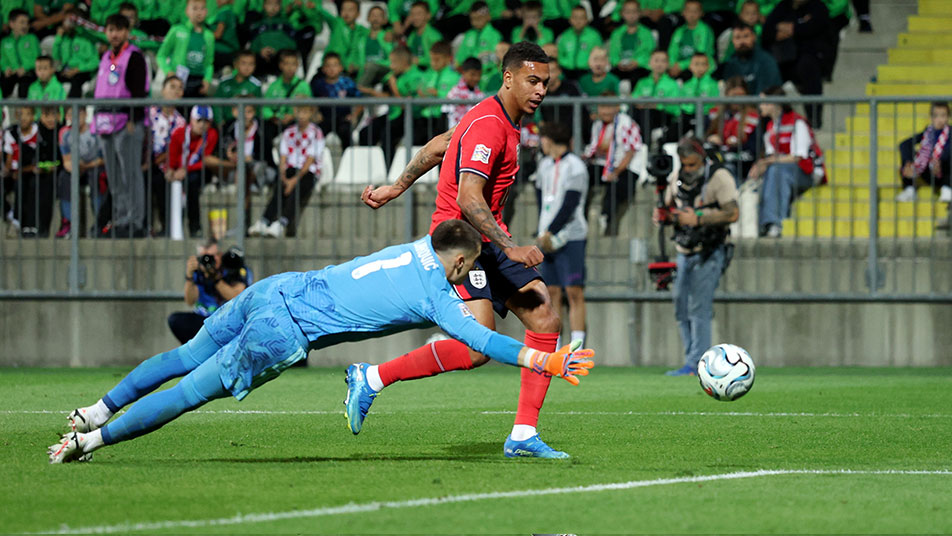
The 7-0 scoreline was historic — Croatia’s heaviest defeat and England’s biggest UEFA Nations League win — but the more useful story was how it happened. Harry Kane and Bukayo Saka scored twice, Jude Bellingham produced a goal and three assists, Anthony Gordon and Morgan Rogers also found the net, and England played with a level of control that made the result feel less like a chaotic goal rush and more like the product of a clear plan.

England stopped building attacks around one idea
The biggest change was variety. England could progress centrally through Bellingham, move quickly into Saka’s side, release Gordon into space or use Kane as the reference point between Croatia’s centre-backs. Croatia could not protect every route at once.
Kane’s opening goal arrived after only eight minutes, which immediately changed the game. Croatia could no longer sit in a compact mid-block and wait for England to become impatient. Once they had to step forward, spaces appeared between midfield and defence. England attacked those spaces repeatedly.
That is important because Tuchel’s England have not always lacked talent; they have sometimes lacked clarity. Against Croatia, players knew where the next pass was. The ball moved with purpose rather than circulation for its own sake.

Bellingham became the connector, not just the star
Bellingham’s four goal involvements will dominate the numbers, but the shape around him mattered just as much. He did not have to come deep for every possession or force the final action himself. England gave him runners ahead of the ball and midfield security behind it.
That allowed him to operate where he is most dangerous: receiving between lines, turning towards goal and choosing between a shot, a through-ball or a switch of play. His three assists were a reminder that his influence is not limited to scoring from midfield.
Alex Scott gave England a calmer base
Alex Scott’s first England start also deserves attention. The Bournemouth midfielder completed 97 per cent of his passes during his 70 minutes, according to reports after the game, and his discipline helped England maintain control while more attacking players took risks higher up the pitch.
It is the type of performance that changes squad conversations. England do not need every midfielder to be another Bellingham. They need players who can receive under pressure, move the ball quickly and protect the structure when the front line attacks.
That midfield balance could become even more valuable when England have players returning from injury. The wider attacking depth was already a talking point when Cole Palmer withdrew from the England squad, and the Croatia match showed that Tuchel has multiple ways to build a functional side without forcing every available star into the same XI.
The pressing made the attack look faster
England’s best attacking moments often began without the ball. Croatia were repeatedly hurried into passes they did not want to make. England recovered possession high enough to attack before the hosts could reset their defensive shape.
That reduced the distance Kane, Saka and Gordon had to travel before becoming dangerous. It also meant England could attack a moving defence rather than a settled line of five or six players.
Tuchel described the performance as complete, and that word fits because the seven goals were connected to what happened earlier in each phase. England pressed together, recovered the ball together and then attacked with numbers. The front players were not waiting for service; they were helping create the conditions for it.
Kane and Saka still give the system an elite finish
Tactical structure matters, but it only becomes decisive when top players finish chances. Kane moved to 89 England goals with his brace and continued a remarkable run of scoring away from home. Saka, meanwhile, scored twice with his right foot — unusual enough to underline the confidence with which he played.
England can create a sophisticated attacking framework, but Kane’s timing in the penalty area and Saka’s one-against-one quality remain the difference between control and punishment.
The next challenge is repeatability. A 7-0 win can distort judgement if it is treated as proof that every problem has disappeared. Croatia were poor, lost their shape and never recovered emotionally after the early goals. Better opponents will not offer the same freedom.

What England should carry forward
The lesson is not that England must score seven again. It is that the spacing, pressing and role definition can travel to tougher matches. Kane needs runners close enough to exploit his link play. Bellingham needs freedom without becoming responsible for every phase. Saka needs quick access to the ball before a defence doubles up on him. And the deeper midfielders need to make the ambitious players feel safe.
That formula gives Tuchel a more convincing route forward than simply naming the most famous XI. England’s strongest side may now be the one with the best connections, not necessarily the biggest collection of names.
The result also sharpens the comparison with Spain, whose own attacking rhythm continues to develop around Lamine Yamal. The Football Xtra previously examined Yamal’s growing influence at the highest level, and England’s next step is proving they can build the same kind of repeatable identity.
Read Here: England Football — Croatia 0-7 England stats and records