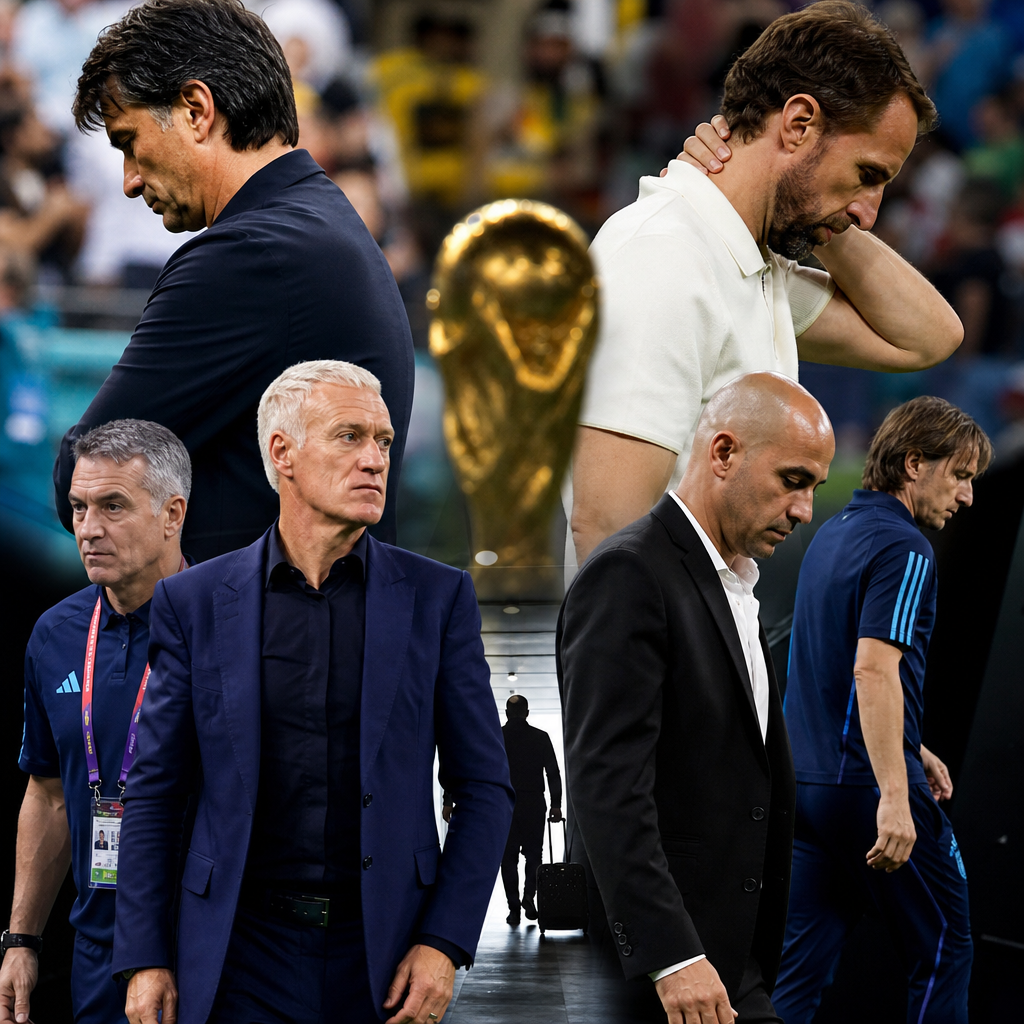
Why do world cup coaches leave so often? In international football, the answer usually comes down to a brutal mix of results, timing, and trust. The latest source material points to exactly that pattern: thirteen coaches have either been sacked or walked away from their national-team posts, with Tunisia’s Sabri Lamouchi among the clearest examples. His appointment on 14 January was supposed to bring stability after Tunisia’s painful Africa Cup of Nations exit, but his spell ended after a heavy 5-1 defeat to Sweden in the opening group match.
Table of Contents
- The immediate story: Sabri Lamouchi’s brief Tunisia spell
- What happened across the wider landscape
- Why this matters beyond one job
- The football-business angle: short-term pressure and costly resets
- The tactical lens: when one defeat becomes decisive
- Why national-team jobs can be harsher than club roles
- What Tunisia’s decision suggests about governance
- What comes next
The immediate story: Sabri Lamouchi’s brief Tunisia spell

Lamouchi arrived in January to succeed Sami Trabelsi after Tunisia were knocked out on penalties by Mali in the last 16 of the Africa Cup of Nations. That context matters because Tunisia were not starting from a position of comfort; they were already trying to recover from a tournament exit that came down to spot-kicks. In such situations, the national team coach often inherits both the sporting challenge and the emotional aftermath.
The problem for Lamouchi was that results did not give him the breathing room he needed. Tunisia’s opening group match ended in a 5-1 loss to Sweden, and that result quickly changed the conversation from rebuilding to crisis management. After the match, Lamouchi said: “We have our pride. We need to react.”
That sentence captures the central contradiction of international coaching. A coach may be hired to steady the ship, but one heavy defeat can make the ship feel as though it is already adrift again. In Tunisia’s case, the response from the federation followed swiftly. The Tunisian FA said: “The Federation Tunisienne de Football announces the termination of its contractual relationship with head coach Sabri Lamouchi by mutual agreement and wishes him every success in his future professional endeavours.”
The phrasing is important. “By mutual agreement” is the language often used in football when both sides want a clean separation. It can soften the image of dismissal, but it does not change the reality: the coach is gone, and the federation is already moving on.
What happened across the wider landscape
The headline figure in the source material is that thirteen coaches have either been sacked or have walked away from their national teams. That number alone says a great deal about the instability that can surround international football management.
Why do world cup coaches leave so often in this environment? The short answer is that the job is measured in tiny slices of time. Unlike club football, national-team coaches do not have daily contact with their players. They are judged on limited windows, narrow tournament margins, and a small sample of competitive fixtures. A coach can spend months preparing for a short cycle, only for one bad result to reshape the entire story.
In that setting, exits often happen in one of two ways.
Sacked after results fail to justify the appointment
This is the most obvious route out of a job. A federation hires a coach to improve results, change the culture, or reset expectations. If the team then suffers a damaging defeat, especially in a tournament or qualifying campaign, the board may decide that the project is over before it has properly begun.
Lamouchi’s case fits that pattern. He was appointed on 14 January. By the time Tunisia lost 5-1 to Sweden in their opening group match, the pressure had already become overwhelming.
Walking away when the relationship breaks down
The other route is less dramatic on paper but often just as telling. Coaches may leave because they feel the environment no longer allows them to work effectively, or because they believe the situation has become unsustainable. In international football, where the coach often depends on federation support, political alignment, and clear planning, a breakdown in trust can be enough to end a spell early.
The source material does not give the full list of those thirteen departures, but the existence of that number itself suggests a broader cycle of short-term thinking, urgent reactions, and limited patience. Why do world cup coaches leave so often? Because international football amplifies the consequences of every result.
Why this matters beyond one job
A coaching change in national-team football is never just about one person. It affects preparation, tactical continuity, player confidence, federation credibility, and the broader direction of a country’s football program.
When a federation appoints a coach, it is making a statement about what it wants to become. Some federations want structure. Some want a tactical identity. Some want tournament resilience. Others simply want results, quickly. When that appointment ends almost immediately, the message to the rest of the football ecosystem can be unsettling. Why do world cup coaches leave so often? Because the answer is rarely only about football; it is also about governance.
Players feel the instability first
Players are the ones who have to adapt to changing ideas, changing staff, and changing expectations. A national-team camp is usually short, so there is little time to absorb a new philosophy. If a coach is replaced after just a handful of matches, players may find themselves starting again before they have fully learned the first plan.
That can be especially disruptive for teams that rely on cohesion rather than individual star power. A side trying to build patterns of play, pressing triggers, or defensive spacing needs repetition. Coaching turnover cuts into that repetition.
Federations are judged on their decision-making
A federation that changes coach too often risks creating the impression that there is no long-term plan. On the other hand, keeping a coach after a poor run can be equally controversial if supporters and stakeholders feel the results are unacceptable. This is the balancing act at the heart of football governance.
In Tunisia’s case, the federation moved quickly after the Sweden defeat. That may have been driven by concern over results, confidence in alternative plans, or an assessment that the relationship had already run its course. Whatever the internal reasoning, the public message was clear: the current arrangement would not continue.
The football-business angle: short-term pressure and costly resets
International football may not have the same transfer-market churn as club football, but coaching dismissals still carry a financial and operational cost. Why do world cup coaches leave so often when the work is so specialized? Partly because the business side of the sport rewards quick reactions, even when those reactions create new problems.
Resets are expensive in football terms
Even when a termination is described as “by mutual agreement,” it often reflects an attempt to manage the business side of a separation. There can be contractual obligations, settlement discussions, and new recruitment costs. The source material does not provide figures, so it would be wrong to speculate about the sums involved in Lamouchi’s departure. But the broader principle is clear: every coaching change creates administrative and financial work.
For federations, that means the issue is not just the result on the pitch. It is also about the cost of disruption, the resources needed to appoint a replacement, and the time lost while the team transitions.
For readers who want a broader timeline of the tournament context, our guide to FIFA World Cup 2026: 27 Days to Go…., 15 Key Things Every Fan MUST Know Before the Big Event. is a useful companion.
Continuity has a value
A stable coaching structure is often cheaper in the long run than repeated churn. The reason is simple: stability supports planning. A coach with time can work on squad identity, integrate younger players, and establish tactical habits that survive beyond one qualification window or one tournament.
The problem is that international football often rewards patience only after the fact. A federation may know that continuity is valuable, but if a result like Tunisia’s 5-1 loss arrives early in a cycle, the short-term instinct to act can override the long-term logic.
Reputation also has a price
There is another business dimension that matters: reputation. Coaches who are dismissed quickly can find their next appointment shaped by the narrative of their last one, even if the context was complicated. Federations, too, can be affected. A run of rapid dismissals can make a national setup look unstable to prospective candidates, support staff, and sometimes players themselves.
In that way, thirteen coaching exits is more than a statistical quirk. It points to a market in which security is limited and public judgment arrives fast.
The tactical lens: when one defeat becomes decisive
The source material does not go into tactical detail beyond the result, but the scoreline alone tells you why the situation escalated. A 5-1 loss in an opening group match is the kind of outcome that can dominate every discussion that follows.
Defensive structure under the microscope
When a team concedes five goals, the attention immediately turns to organisation. Were the lines too stretched? Did the midfield lose control? Were the full-backs exposed? Was the team too open after conceding first? Those are the kinds of tactical questions that follow a heavy defeat, even when the coach has had limited time with the squad.
Because national-team camps are short, a coach cannot always implement a fully mature tactical system. That makes it harder to absorb setbacks. A club side can spend weeks drilling patterns and repairing mistakes; a national team may have only days before the next competitive match.
Momentum can collapse quickly
Tournament football is often about emotional momentum as much as tactical quality. If a team loses its opening match heavily, it may enter the next game burdened by the weight of the previous scoreline. The coach then has to manage not just the tactical reset but also the psychological recovery.
That helps explain why Lamouchi’s comment after the match focused on pride and reaction. In a crisis, coaches often revert to values words because they are trying to restore belief as much as solve technical problems.
Why national-team jobs can be harsher than club roles
At club level, a manager can influence recruitment, training rhythm, and the day-to-day environment. A national-team coach has far fewer levers to pull.
Limited time, limited control
The national coach works with players in short bursts and depends heavily on club form, fitness, and availability. If results go badly, the coach may be blamed even when the structural problems run deeper. That can include youth development gaps, limited squad depth, or a federation’s broader planning failures.
Expectations are often outsized
The public tends to expect a national team to look cohesive and confident immediately. There is no long bedding-in period in the eyes of fans or media. One poor result can trigger the suggestion that the coach is the wrong fit. That is especially true in tournament settings, where every match is magnified. Why do world cup coaches leave so often in those moments? Because the margin for patience disappears almost at once.
The margin for error is tiny
Club coaches can survive poor patches by stringing together later wins. National-team coaches may not get that luxury. A loss in a qualifying campaign, a poor tournament game, or a bad group-stage start can become the end of the story almost overnight.
That is why the thirteen-coach figure in the source material feels so revealing. It is not just about one federation or one tournament. It reflects a broader environment in which patience is scarce and outcomes are immediate.
What Tunisia’s decision suggests about governance
The termination of Lamouchi’s contract “by mutual agreement” suggests a federation trying to preserve some dignity in the separation. That is common in football governance, where the language around departures is often carefully chosen.
But the deeper governance question is whether the appointment itself had enough time to succeed. Lamouchi was appointed on 14 January after Tunisia’s AFCON penalty exit to Mali. That means the federation had already moved from one pressure point to another in a short period. Then, after the 5-1 loss to Sweden, the project ended again.
From a governance perspective, the lesson is not simply that a coach was removed. It is that a federation must decide whether it is hiring for immediate turnaround or longer-term rebuild. When those two aims are mixed together, the resulting project can become fragile very quickly.
What comes next
The source material does not provide details on Tunisia’s next appointment or the remainder of the list of thirteen departures. What it does make clear is that the national-team coaching market remains highly volatile.
For Tunisia, the next step will be to decide what kind of profile is required: a stabiliser, a tactician, a motivator, or someone who can bridge a transitional phase. Those choices matter because a national-team appointment is not just about the next match. It is about what the federation wants the team to look like when pressure rises.
More broadly, the churn among national-team coaches underlines how little room there is for extended adaptation. In international football, one defeat can change a project’s direction, one tournament can define a contract, and one public statement can mark the end of an era.
For a match-by-match perspective on how national teams are judged, the Guardian report on World Cup coaches leaving their jobs provides the core source behind this analysis.
The source material, from The Guardian, makes that clear through Lamouchi’s brief Tunisia tenure and the wider count of coaches who have either been dismissed or stepped aside. It is a reminder that in this part of the game, stability is often temporary and judgment arrives fast.
Why do world cup coaches leave so often? The answer is usually the same combination of pressure, results, and trust, and it is why the phrase keeps returning in any discussion of international management. Why do world cup coaches leave so often when the role is meant to be stable? Because national-team football offers little time to recover from bad outcomes, and even a single defeat can turn confidence into a dismissal.
That is why the story of Tunisia’s Sabri Lamouchi matters beyond one result. Why do world cup coaches leave so often after such short spells? In part because federations want instant progress, but also because the structure of the job makes patience difficult. A coach may arrive with a plan, yet the next headline often depends on the next scoreline.
In practical terms, why do world cup coaches leave so often in the modern game? The answer sits in the gap between expectation and reality. Supporters want identity, federations want qualification, and coaches need time. When those three things do not align, changes follow quickly.
Why do world cup coaches leave so often after tournament setbacks? Because tournament football compresses an entire project into a handful of matches. One poor performance can distort the perception of months of work, and that can be enough to end a contract or trigger a mutual parting of ways.
Why do world cup coaches leave so often even when the long-term logic points to continuity? Because the short-term reality is unforgiving. The Tunisia case shows how a single heavy defeat, combined with earlier disappointment, can make a federation decide that a fresh start is the safer option.
Why do world cup coaches leave so often is therefore not just a search query but a genuine feature of international football. The answer is visible in the thirteen departures described in the source material, and in the way one result can shift a federation’s entire direction overnight.