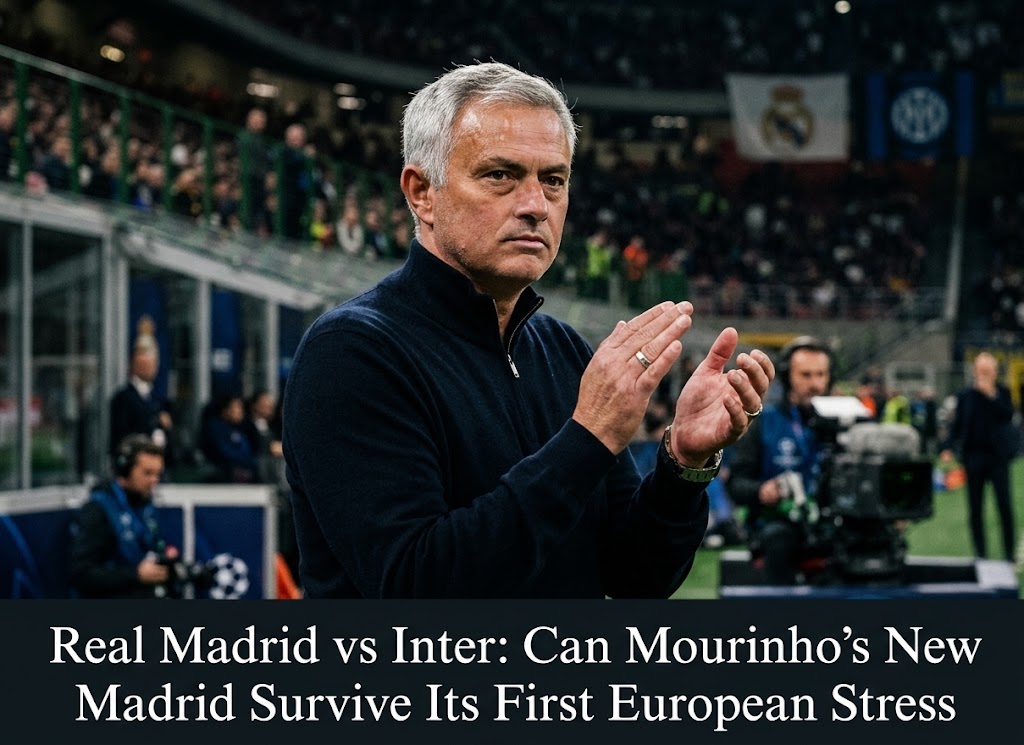
Real Madrid vs Inter is the kind of Champions League fixture that can expose weaknesses a domestic league table is capable of hiding.
José Mourinho’s second spell at Real Madrid has started with three victories from the opening four league matches, but the first warning sign arrived at the worst possible moment: Madrid’s 1-0 defeat away to Real Betis immediately before their Champions League opener.
Now comes Inter.
The Italian champions arrive at the Santiago Bernabéu after producing one of the most impressive comebacks of the early Serie A season, recovering from two goals down to defeat Napoli 3-2 at San Siro.
The contrast is striking.
Madrid need to respond.
Inter arrive with momentum.
And Mourinho knows exactly what is at stake.
Speaking before the game, the Portuguese coach made his priority unmistakable: he does not want Madrid simply to play well; he wants them to win. He specifically referred to the Betis defeat as an example of a performance in which playing well ultimately meant nothing because the result went against his team.
The setting makes the examination even more intriguing.
The 2026/27 Champions League league phase begins this week, and Madrid’s opening fixture is one of the competition’s biggest possible Matchday 1 encounters. Real Madrid confirmed that Inter will visit the Bernabéu on Tuesday, September 8 at 21:00 CEST.
For Mourinho, this is more than another European fixture.
It is the first opportunity to discover whether his new Real Madrid can translate domestic promise into Champions League authority.
Real Madrid vs Inter: Two Teams Arriving With Very Different Momentum
Real Madrid’s opening league run initially suggested a side moving quickly in Mourinho’s direction.
They beat Espanyol 2-1 away, followed that with a 4-1 home victory over Real Sociedad and then defeated Málaga 4-0.
But the 1-0 loss at Real Betis changed the conversation.
Inter, meanwhile, have taken the opposite route.
Their latest league match against Napoli appeared to be heading towards a damaging home defeat after the visitors scored twice early in the second half.
Instead, Inter responded emphatically and won 3-2, completing the comeback late in the match.
That result is particularly important because Champions League football frequently rewards teams capable of surviving difficult phases rather than teams that simply dominate comfortable matches.
Inter have just demonstrated that resilience.
Madrid now have to demonstrate it themselves.
1. Mourinho’s 4-2-3-1 vs Inter’s Defensive Structure
 One of the most fascinating tactical questions in Real Madrid vs Inter is how Mourinho’s attacking structure will interact with Inter’s defensive organisation.
Inter’s shape gives them several ways to defend.
Cristian Chivu has indicated that he does not want his team to abandon its identity simply because the opponent is Real Madrid. In his pre-match comments, he stressed the need for greater concentration while maintaining their own footballing principles.
That is important.
Inter are not travelling to Madrid simply to survive.
They want to remain recognisable.
Madrid’s attacking structure, meanwhile, has been built around a 4-2-3-1, with Kylian Mbappé leading the line and Vinícius Júnior operating from the left.
According to UEFA’s predicted line-up, Madrid could field Thibaut Courtois; Konaté, Rüdiger, Huijsen; Dumfries, Valverde, Bellingham, Brahim Díaz, Cucurella; Vinícius and Mbappé.
That projected structure immediately reveals Mourinho’s biggest tactical weapon:
Madrid can attack Inter through multiple vertical lanes.
Mbappé can threaten the space behind.
Vinícius can isolate defenders.
Bellingham can arrive from midfield.
Brahim can operate between the lines.
That creates a problem for Inter.
If their defensive line drops too far, Madrid can dominate territory.
If it pushes higher, Mbappé and Vinícius gain the space they want.
The solution will be maintaining the correct distance between Inter’s defensive and midfield lines.
That may become the central tactical battle of the match.
2. Mbappé and Vinícius vs Inter’s Back Three
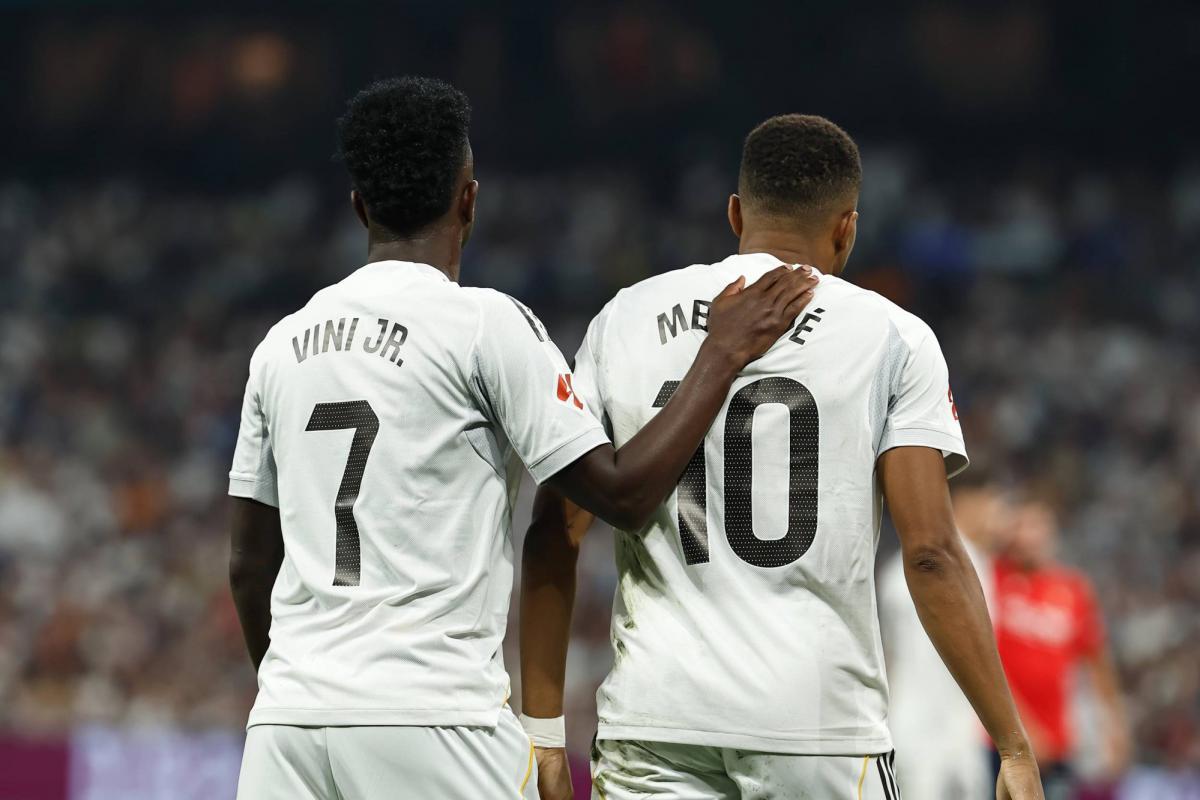 If Inter are to leave Madrid with a positive result, they have to solve one enormous problem:
How do you defend Mbappé and Vinícius without destroying your defensive shape?
Kylian Mbappé has already started the new league campaign in outstanding scoring form.
Inter’s own official match guide notes that the Frenchman has scored four goals in four LaLiga appearances, following his status as last season’s Champions League top scorer.
That is a frightening statistical profile for an opponent making its Champions League debut against Madrid.
But Mbappé is not Inter’s only concern.
Vinícius creates a different problem.
Mbappé wants to attack the central channel and run behind.
Vinícius can start wide, isolate a defender and then attack inside.
If Inter send an additional defender towards Vinícius, Madrid can potentially exploit the resulting central space.
If they remain narrow, Vinícius receives one-versus-one opportunities.
This is where Chivu’s tactical discipline will be tested.
The Inter coach acknowledged that Real Madrid can hurt opponents in several ways — both through sustained pressure and transition attacks.
That observation is critical.
Madrid do not need 65% possession to destroy an opponent.
They can hurt Inter after recovering the ball.
3. Valverde and Bellingham: Can Madrid Control the Midfield?
 Perhaps the most underestimated battle in Real Madrid vs Inter will happen away from the penalty areas.
Midfield.
Madrid’s situation is complicated by absences.
UEFA’s latest team-news information lists Eduardo Camavinga, Arda Güler and Bernardo Silva as suspended, while Tchouaméni is doubtful. Other injuries also affect Mourinho’s options.
Mourinho had already warned before the Betis match that the suspensions could create a significant midfield problem, particularly because Valverde could be the only established first-team midfield option available depending on Tchouaméni’s condition.
That makes the midfield selection extremely important.
Valverde provides energy, defensive coverage and the ability to carry the ball over long distances.
Bellingham offers something different.
He can move higher, attack the box and operate between the opposition’s midfield and defence.
But against Inter, Madrid cannot simply send Bellingham forward.
Inter possess enough midfield intelligence to exploit the space behind him.
Hakan Çalhanoğlu’s ability to dictate tempo, combined with Nicolò Barella’s movement and energy, can make Madrid pay if their midfield becomes stretched.
The danger is obvious:
Madrid need Bellingham close enough to Mbappé and Vinícius to support attacks, but they also need him connected to the midfield.
That balancing act could determine whether Madrid control the match or become vulnerable during transitions.
4. Inter’s Counterattacks vs Mourinho’s Defensive Transition
Mourinho has historically understood the importance of defensive transitions better than most elite coaches.
That will be tested here.
Inter’s greatest opportunity may come immediately after Madrid lose possession.
Chivu’s team can absorb pressure, regain the ball and attack quickly.
Madrid’s attacking players naturally push high.
That creates space.
If Vinícius and Mbappé are both ahead of the ball when possession is lost, Madrid’s midfielders and defenders must react instantly.
This creates a fascinating tactical paradox.
Mourinho wants Madrid to attack aggressively.
But the more aggressively they attack, the more dangerous Inter’s counterattack becomes.
The solution is not necessarily to attack with fewer players.
It is to attack with better rest-defence positioning.
Madrid need enough players behind the ball to stop Inter’s first pass forward.
That could mean Valverde becoming particularly important.
His athleticism allows him to cover large spaces when attacks break down.
The same principle applies to the full-backs.
If Madrid push both wide players forward simultaneously, Inter could find opportunities in the channels.
Therefore, the success of Madrid’s attack may depend partly on how well they prepare for the moment when that attack ends.
5. The Lautaro Martínez Problem
 While the spotlight naturally falls on Mbappé and Vinícius, Inter possess their own elite match-winner.
Lautaro Martínez.
The Argentine striker was central to Inter’s comeback against Napoli, and his relationship with the players around him gives Chivu multiple ways to attack.
Lautaro does not need constant service into the box.
He can drop.
He can combine.
He can pull defenders away.
He can then attack the space created by his own movement.
Against a Mourinho defence, those movements will matter.
Mourinho’s centre-backs will need to decide how aggressively they follow him.
If they stay deep, Lautaro can receive between the lines.
If they step forward, Inter can attack the space behind them.
That is exactly the kind of tactical dilemma elite strikers create.
And Lautaro is not alone.
Inter can use Marcus Thuram’s physical presence and running power to stretch Madrid’s defensive structure.
Chivu also suggested that Thuram is in better condition and has gained confidence following his recent goal, although the exact starting decision remained his to make.
If Thuram starts alongside Lautaro, Madrid’s centre-backs could face a very different challenge from the one presented by a single striker.
Mourinho vs Chivu: The 2010 Champions League Final Connection
There is also a remarkable historical layer to Real Madrid vs Inter.
Mourinho and Chivu know each other from Inter’s historic 2009/10 Champions League-winning campaign.
Chivu was part of Mourinho’s Inter side that conquered Europe, including the famous 2-0 final victory over Bayern Munich at the Santiago Bernabéu.
Now, more than 16 years later, the two meet at the same stadium from opposite sides of the tactical battle.
Chivu has spoken warmly about Mourinho, describing him as a great person and recalling the support Mourinho gave him during a difficult period in his career.
But sentiment disappears once the referee blows the whistle.
Mourinho himself made that clear.
He said that the meeting is special after the match, but during the game it is simply another match.
That is Mourinho’s mentality.
History can create headlines.
It cannot score goals.
The Psychological Battle: Madrid Cannot Panic
The most important part of Mourinho’s job may not be tactical.
It may be psychological.
Real Madrid have already experienced their first defeat.
That creates a temptation to respond immediately.
But Champions League football punishes emotional decisions.
If Madrid concede first, the Bernabéu could become anxious.
If Madrid fail to score during the opening 30 minutes, the pressure may increase.
Mourinho therefore needs his team to remain patient.
His message before the game was revealing.
He said he wants to treat the fixture as a unique match rather than thinking about the seven other league-phase games still to come. Every point matters, but his focus is on winning this specific game.
That is an important change in mentality.
The new Champions League league phase provides eight matches rather than the old six-game group stage, but Mourinho does not want his players using that as an excuse for a slow start.
He wants three points.
What the Numbers Say About Real Madrid vs Inter
The historical and statistical picture gives Madrid a significant advantage.
Opta’s latest prediction model gives Real Madrid a 56.0% probability of winning the match. The model also notes that Madrid have won all four of their Champions League meetings with Inter this century and that they have won each of their last seven home matches against the Italian side.
Inter’s record against Spanish opposition away from home is considerably less encouraging.
Opta notes that Inter have failed to win any of their last 13 away matches against Spanish teams, recording four draws and nine defeats.
Those numbers favour Madrid.
But statistics are not destiny.
Especially not when Inter arrive as Serie A champions and have just demonstrated their ability to recover from a two-goal deficit against Napoli.
What Must Mourinho Get Right?
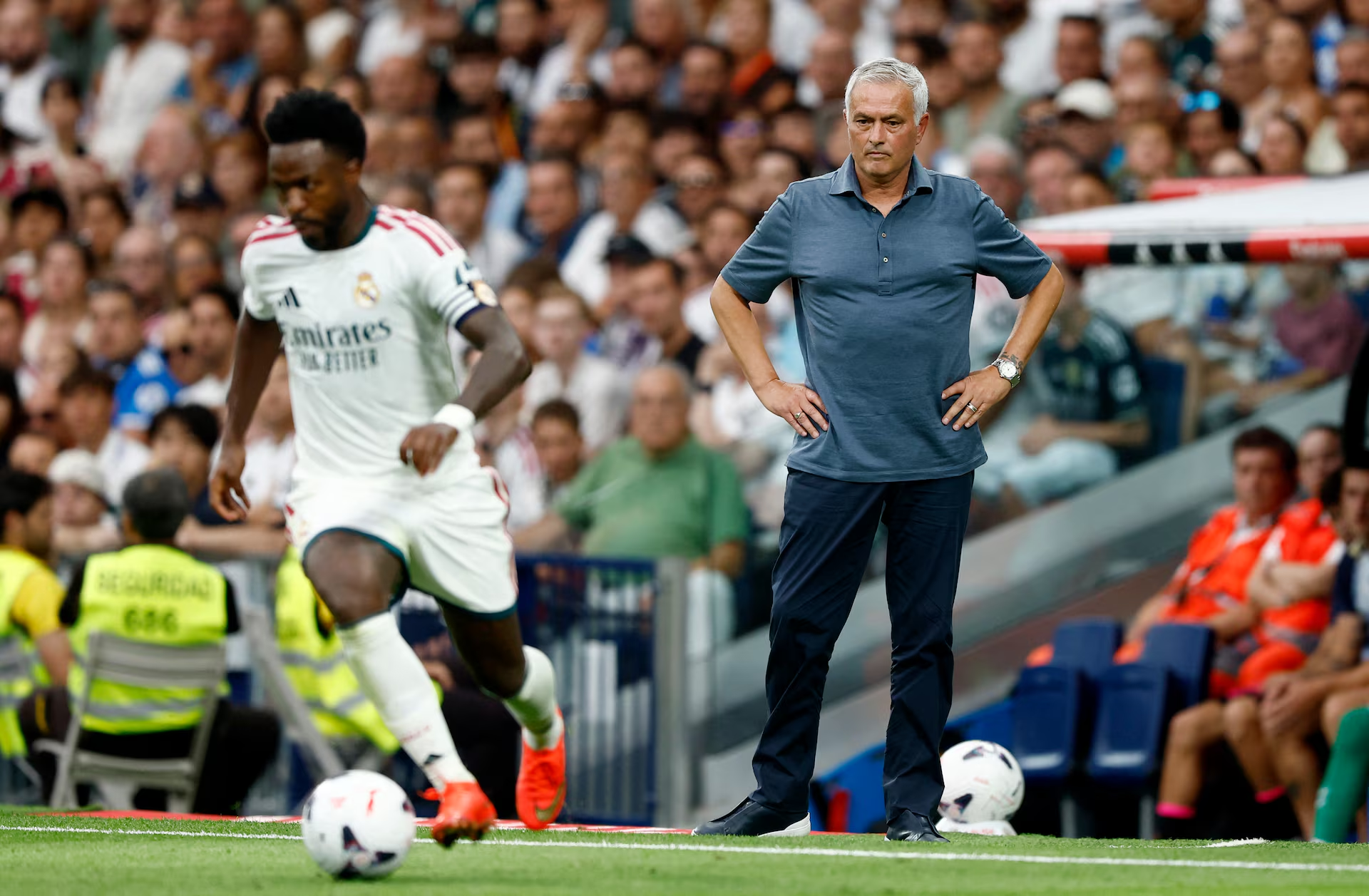 For Madrid to win, five things stand out:
1. Protect the midfield.
The suspensions make this especially important.
2. Keep Mbappé high.
He needs to occupy Inter’s defenders rather than constantly dropping away from goal.
3. Create isolated situations for Vinícius.
Madrid’s left side could be their most dangerous attacking outlet.
4. Control transitions.
Inter’s counterattack cannot be allowed to become the game’s defining feature.
5. Stay patient.
The Bernabéu will demand intensity, but Madrid must avoid turning urgency into tactical chaos.
What Must Chivu Get Right?
 Inter’s priorities are equally clear.
Protect the central spaces
Bellingham, Brahim and Mbappé can destroy a team if they receive between the lines.
Attack Madrid’s defensive transitions
Every Madrid turnover should be treated as an opportunity.
Prevent Mbappé from running behind
Give the Frenchman open grass and Inter could be in serious trouble.
Make Madrid defend
The more Inter force Madrid backwards, the less freedom Mbappé and Vinícius have to attack.
Stay brave
Chivu has already indicated that Inter should not abandon their identity simply because the opponent is Real Madrid.
That could be the key to the entire match.
Real Madrid vs Inter Prediction
On paper, Madrid have the advantage.
They have home support, the stronger recent head-to-head record, Mbappé’s scoring form and the individual quality to decide the game.
Opta’s model also gives them a clear statistical edge.
But the circumstances make this far more difficult than a conventional home fixture.
Mourinho’s midfield options are affected by suspensions.
Madrid have just lost to Betis.
Inter arrive after a comeback victory over Napoli.
And Chivu knows exactly what Mourinho demands from a Champions League team.
The most likely outcome is therefore a tight match rather than a Madrid walkover.
Prediction: Real Madrid 2-1 Inter.
Mbappé’s movement and Madrid’s home advantage could ultimately prove decisive, but Inter have enough attacking quality to expose Madrid’s defensive transitions.
What’s Next for Mourinho’s New Madrid?
The significance of Real Madrid vs Inter goes beyond three points.
For Mourinho, this is the first genuinely elite European examination of his second Madrid project.
The domestic victories have provided momentum.
The Betis defeat provided the warning.
Inter provide the test.
And the test is not simply whether Madrid can score.
SEE ALSO: Mourinho Real Madrid Return: The Billion-Dollar Business Strategy Behind His Comeback
Everyone knows they can.
The real question is whether Mourinho can build a team capable of controlling how the game is played when the opponent possesses enough quality to punish every structural mistake.
That is the difference between a talented Real Madrid side and a serious Champions League contender.
Madrid already have the stars.
They have Mbappé.
They have Vinícius.
They have Bellingham.
They have Courtois.
What Mourinho must prove now is that these individual weapons can operate within a collective structure strong enough to survive the hardest European nights.
Inter will arrive at the Bernabéu with no intention of simply admiring the occasion.
Chivu has promised courage, personality and a desire to remain dominant.
Mourinho wants exactly one thing in response.
Victory.
And that is why Real Madrid vs Inter could tell us far more about Mourinho’s new Madrid than the final score alone.
Can Mourinho’s Madrid pass its first European stress test? Share your prediction in the comments.