Aston Villa did not just win a European trophy.
They changed the story of the club.
On a historic night in Istanbul, Villa beat SC Freiburg 3-0 in the 2025/26 UEFA Europa League final, with goals from Youri Tielemans, Emiliano Buendía and Morgan Rogers. The victory gave Villa their first major trophy in 30 years and their first continental title since the famous European Cup triumph of 1982. It also gave Unai Emery a record-extending fifth Europa League title as a manager.
For Villa fans, this was not only about one final.
It was about the years of waiting. The relegation pain. The financial uncertainty. The ownership changes. The almost moments. The rebuilding. The return to Europe. And finally, a night when Aston Villa looked like a serious European club again.
This is the story of how Villa went from struggle to silverware — and why this Europa League triumph may be the start of something even bigger.
I. The Night Aston Villa Changed Their Story
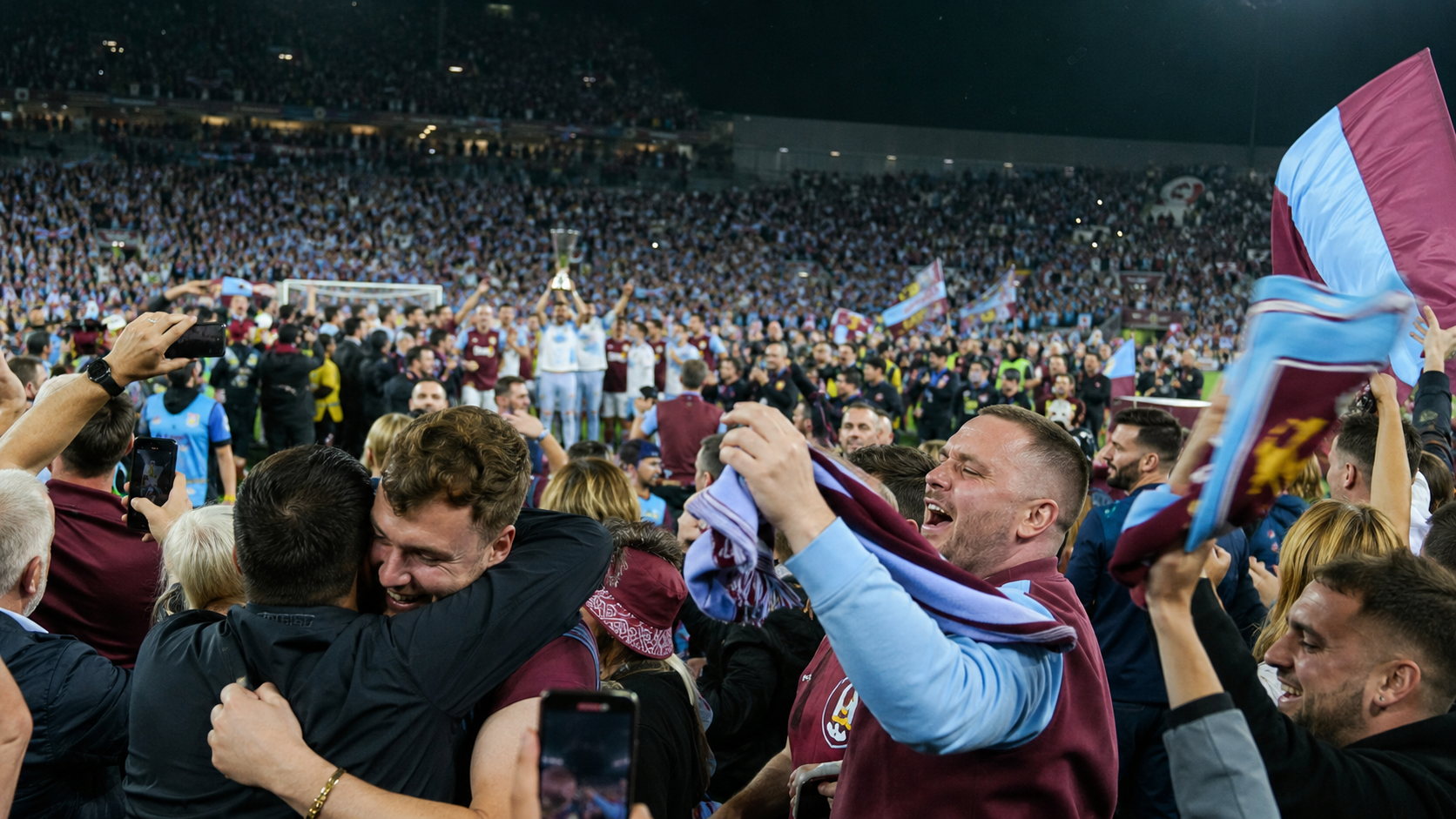 Finals can be tense, nervous and ugly. Aston Villa made theirs look controlled.
Against Freiburg, Villa did not simply hold on and hope. They played like a team that understood the occasion. Tielemans gave them the first breakthrough, Buendía added the second before half-time, and Rogers sealed the victory in the second half. Reuters described it as a commanding 3-0 win, with Villa largely outclassing Freiburg on the night.
The scoreline mattered because it showed maturity.
Villa were not lucky winners. They were organised, calm and ruthless. They defended the big moments, controlled the emotional rhythm of the game and punished Freiburg when chances arrived.
For a club that had spent years trying to return to relevance, this was more than a trophy lift. It was a statement.
Aston Villa are back in Europe — not as tourists, but as winners.
II. Why This Trophy Matters So Much
To understand why this Europa League win means so much, you have to understand the wait.
Aston Villa are one of English football’s historic clubs. They were European Cup winners in 1982. They have deep roots, a major stadium, a loyal fanbase and a proud place in the game’s history.
But modern football had not always been kind to them.
Before this Europa League victory, Villa’s last major trophy was the League Cup in 1996. Their last European title came in the early 1980s. UEFA itself described this Europa League win as Villa’s first continental title since the 1981/82 European Cup.
That gap matters.
For younger Villa fans, this was the first time they had seen the club win a major trophy. For older supporters, it was the return of a feeling many feared might never come back.
That is why this trophy is not only silverware.
It is emotional proof that the club’s best days do not have to stay in the past.
III. From Historic Club to Relegation Pain
 Villa’s decline did not happen overnight.
For years, the club remained respected, but it slowly drifted away from the elite level of English football. There were good players, strong squads and exciting moments, but not enough consistency or structure to compete permanently with the Premier League’s biggest clubs.
Then came the collapse.
In 2016, Aston Villa were relegated from the Premier League. For a club of Villa’s size, relegation was not just a sporting failure. It was a shock to identity.
Villa were no longer simply trying to climb the table. They were trying to rebuild their entire football life.
The Championship is not an easy place for a big club to recover. Every match becomes a test of pressure. Every opponent wants to beat you. Every season outside the Premier League increases financial risk.
Villa eventually returned, but the relegation years showed how far the club had fallen.
That is what makes the Europa League win so powerful. It is not just a European success. It is the final proof that Villa survived one of the hardest chapters in their modern history.
IV. The Financial Crisis and Ownership Problems
 The sporting struggle was only one side of Villa’s problem.
The financial picture was also unstable.
Tony Xia bought Aston Villa in 2016, but the project became increasingly difficult. After Villa lost the 2018 Championship play-off final, the club faced serious financial pressure. Reports at the time said Nassef Sawiris and Wes Edens took a controlling stake in 2018, with the Financial Times reporting that NSWE would take a 55% stake for about £30m.
That moment was critical.
Villa had missed out on promotion. The club needed money, stability and serious ownership. Without that change, the road back to the Premier League — and eventually to European success — could have looked very different.
The lesson was clear: Villa did not only need better players. They needed stronger foundations.
V. The Sawiris and Edens Takeover
 The arrival of Nassef Sawiris and Wes Edens changed Aston Villa’s direction.
Through NSWE and later the wider V Sports structure, Villa gained owners with ambition, capital and a long-term vision. The club itself announced in July 2018 that NSWE, jointly controlled by Sawiris’ NNS group and Wes Edens, had made a significant investment in Aston Villa.
That ownership change helped move Villa away from crisis management.
The club began to look more stable. The football structure improved. Investment became more strategic. The ambition was no longer simply survival or promotion. It was to return Villa to a level that matched the club’s history.
This is an important part of the Europa League story.
Emery and the players won the trophy on the pitch. But the conditions for that success were built by ownership stability, better planning and a clearer football direction.
VI. Dean Smith, Promotion and the Jack Grealish Bridge
Before Unai Emery, there was Dean Smith.
Smith’s role in Villa’s modern rise should not be forgotten. He helped bring the club back to the Premier League and restored belief at a time when Villa badly needed emotional connection.
Jack Grealish was the symbol of that period.
He was local, talented, fearless and deeply connected to the club. He represented the bridge between the Championship struggle and Villa’s Premier League return. His eventual sale to Manchester City was painful for supporters, but it also gave Villa major financial power to reshape the squad.
That period was not perfect. Some recruitment after Grealish’s exit was inconsistent. But the club had returned to the Premier League, and it had begun building toward something bigger.
Smith gave Villa the lift. Grealish gave Villa identity. The owners gave Villa stability.
But Villa still needed a world-class football system.
VII. Gerrard’s Failure and the Need for Identity
Steven Gerrard arrived with a big name and serious expectations.
But the project never fully worked.
Villa under Gerrard had talent, but not enough clarity. The team lacked rhythm, structure and long-term tactical identity. Results became inconsistent, and the atmosphere around the project began to weaken.
This is not about blaming everything on one coach. Villa were still growing, still adjusting and still trying to understand what kind of club they wanted to become in the Premier League.
But Gerrard’s failure made one thing obvious: Villa needed more than motivation.
They needed a coach with detail.
They needed a coach with European experience.
They needed a coach who could make good players better through structure.
That is where Unai Emery changed everything.
VIII. Unai Emery Arrives: The Coach Who Gave Villa a System
 Unai Emery’s arrival was the turning point.
When he took over, Villa were not operating like a club ready to win European trophies. They were talented but inconsistent. Dangerous but not controlled. Ambitious but not yet complete.
Emery brought method.
He brought European experience, training-ground detail and a clear understanding of knockout football. Reuters noted that Emery transformed Villa from a side near the lower end of the Premier League into European contenders and now Europa League winners.
That transformation is central to this story.
Emery did not simply improve results. He changed the way Villa looked.
The team became harder to break down. More intelligent in possession. Better at managing matches. More dangerous in transition. More organised defensively. More mature emotionally.
That is why this Europa League win feels like the result of coaching, not accident.
IX. Tactical Transformation Under Emery
Villa under Emery are not built on chaos. They are built on detail.
His teams understand space, timing and game state. They know when to press and when to drop. They know how to defend in compact lines and how to attack quickly when the moment opens.
The tactical transformation can be seen in several areas.
First, Villa became more compact without the ball. They learned how to close central spaces and force opponents into less dangerous areas.
Second, they became more disciplined in transitions. Under Emery, Villa do not attack blindly. They attack with structure behind the ball, which helps them avoid being exposed when possession is lost.
Third, their wide play improved. Emery’s system often gives full-backs and wide attackers clear roles, allowing the team to create overloads while still protecting the defensive shape.
Fourth, Villa became better at set pieces. The Guardian reported after the final that Emery credited set-piece coach Austin MacPhee, while captain John McGinn praised MacPhee’s inventive strategies.
That kind of detail matters in Europe.
Europa League knockout football is rarely about beauty alone. It is about controlling moments. Emery is one of the best managers in Europe at doing exactly that.
X. The Players Who Delivered the Trophy
The system gave Villa structure, but the players delivered the trophy.
Morgan Rogers was one of the stars of the campaign. Reuters reported that he was named Europa League Player of the Season after scoring in the final and providing an assist during Villa’s victory.
Rogers’ rise matters because he represents the modern Villa: young, powerful, technically confident and fearless on the European stage.
Youri Tielemans brought control and intelligence. His goal in the final was important, but his wider value is his ability to manage rhythm in midfield.
Emiliano Buendía gave Villa creativity and emotion. His goal before half-time in the final helped push the match away from Freiburg and gave Villa a commanding platform.
Emiliano Martínez again showed his big-match character. The Guardian reported that Martínez said he played the final with a broken finger, yet he still helped Villa complete the job.
John McGinn carried the emotional weight of the club. He has been part of Villa’s journey from the Championship years to European glory. For him, lifting that trophy was more than a professional achievement. It was the reward for years of loyalty and struggle.
This was not one player’s trophy.
It was a squad victory.
XI. The Final: How Villa Won It
The final itself was a perfect example of Emery’s European football.
Villa did not need to dominate every second. They needed to control the important moments.
Tielemans opened the scoring in the 41st minute. Buendía scored again just before half-time. Rogers added the third in the 58th minute. Reuters reported that Rogers’ goal came from Buendía’s assist, completing a dominant Villa performance.
That sequence tells the story.
Villa struck before half-time, then came out and killed the contest after the break. They did not allow Freiburg to turn the final into a nervous, emotional battle.
This is what Emery’s best teams do.
They understand when a match is vulnerable.
They punish.
XII. Prince William and the Royal Villa Connection
 Prince William did not win Aston Villa the Europa League.
But his support is still part of the club’s modern story.
He is one of the most famous Aston Villa supporters in the world, and his connection with the club brings a unique kind of visibility. Around the final, reports highlighted his long-standing Villa support and his presence around the club’s biggest European moment.
This matters from a football culture and branding perspective.
Villa’s identity is not only about money, tactics or ownership. It is also about story. Having a high-profile royal supporter gives Villa a cultural angle that very few clubs can match.
Did it directly contribute to the trophy? No.
The trophy was won by Emery, the players, the staff, the owners and the supporters.
But in modern football, attention has value. Prince William’s support helps Villa stand out globally and gives the club a softer form of international brand power.
XIII. Villa’s Financial Rise
Aston Villa’s football rise has been matched by a major financial transformation.
The club’s 2022/23 accounts showed how challenging the growth phase had been. Reuters reported in 2024 that Villa recorded a £119.6m loss, despite revenue rising to £217.7m. The club said it remained compliant with Premier League financial rules, but the numbers showed the pressure behind Villa’s ambition.
The picture has since improved significantly.
Reports from Villa’s more recent accounts show revenue rising to £378.1m, up from £275.7m the previous year, with Champions League participation playing a major role in that increase.
That is a huge jump.
It shows how European football changes a club’s financial ceiling. More broadcast revenue. More matchday income. More commercial leverage. More sponsor interest. More global visibility.
Villa’s Europa League triumph now gives them another layer of credibility.
They are no longer only a club with history. They are a club with recent European success.
XIV. The Financial Benefits of Winning the Europa League
 Winning the Europa League brings direct money and indirect value.
UEFA’s 2025/26 distribution model shows the Europa League has a total distribution pot of €565m. Clubs receive a league-phase starting amount of €4.31m, with performance bonuses of €450,000 per win and €150,000 per draw. Knockout-stage bonuses include payments for reaching the round of 16, quarter-finals, semi-finals, final and an additional winners’ bonus.
A reasonable estimate for Villa’s direct Europa League earnings from the full campaign is around:
€25m–€35m
That range depends on league-phase results, final ranking, knockout progression, value-pillar distribution and performance bonuses.
But the true value of the trophy is bigger than the UEFA prize money.
Villa also gain:
- stronger sponsorship leverage
- higher global visibility
- increased merchandise demand
- stronger player attraction
- greater matchday and hospitality demand
- qualification for the UEFA Super Cup
- improved brand value
- a stronger platform entering the Champions League
The Europa League prize money is important. But the commercial and sporting consequences may be even more valuable.
XV. Champions League Next Season: Opportunity and Risk
Villa’s Europa League win also secures a place in next season’s Champions League. Reuters reported that the victory gives Villa a Champions League spot for next season.
That is massive.
The Champions League brings more money, more prestige and more pressure.
UEFA’s 2025/26 Champions League distribution model gives clubs a much larger financial platform than the Europa League, with the Champions League and Super Cup accounting for the largest share of UEFA’s club competition distribution.
For Villa, this creates a new challenge.
They must strengthen the squad without breaking financial rules. They must keep key players. They must manage Premier League demands and Champions League nights. They must avoid becoming a one-season European story.
That is where Emery becomes even more important.
He knows Europe. He understands knockout football. He understands how to build a squad that can compete across different competitions.
But the Champions League will test Villa at a higher level.
Winning the Europa League gets them into the conversation.
Staying in the Champions League conversation will be much harder.
XVI. What This Means for Aston Villa’s Future
This trophy changes Aston Villa’s status.
They are no longer just a club with potential. They are no longer just a historic name trying to return to relevance. They are now a European trophy-winning club in the modern era.
That matters for recruitment.
Players listen differently when a club has won in Europe. Agents take the project more seriously. Sponsors see a stronger platform. Fans believe with more confidence.
Villa’s future now depends on how they handle success.
- Do they invest wisely?
- Do they keep Emery supported?
- Do they protect the squad from being picked apart?
- Do they grow commercially without losing identity?
- Do they become a regular European club rather than a one-off success story?
These are the questions that come with ambition.
The trophy is the reward.
But it also raises the standard.
XVII. Final Thoughts: A Trophy That Means More Than Silverware
Aston Villa’s Europa League triumph was more than one brilliant night in Istanbul.
It was the result of years of pain and correction.
- From relegation to Europe.
- From financial fear to record revenue.
- From ownership uncertainty to stability.
- From tactical confusion to Emery’s structure.
- From a 30-year trophy drought to European glory.
This is why the trophy means so much.
Prince William’s support brought colour and global attention, but Villa’s victory was built by football people: Emery, the players, the staff, the owners and the supporters who stayed through the hard years.
Now Villa enter a new chapter.
They are Europa League winners.
They are heading to the Champions League.
And after years of waiting, Aston Villa finally look like a club moving toward the future rather than trying to recover the past.