Arsenal perfect start is no longer just about results. It is becoming a statement about the evolution of Mikel Arteta’s team.
Seven wins from seven competitive matches have followed to begin the 2026/27 campaign, with Arsenal’s latest victory coming in a completely different environment: a difficult Champions League night away to Napoli. Days later, Arteta rotated heavily and Arsenal still defeated Ipswich Town 4-2 in the Carabao Cup, with 16-year-old Max Dowman scoring twice.
That sequence matters.
Because if Arsenal’s early-season form were built simply on momentum, confidence or favourable opposition, the Napoli match would have been a warning sign.
Instead, it became something else.
It became evidence that Arsenal can control a European away game, absorb different tactical problems, create chances consistently and then rely on the quality of its squad when the calendar becomes congested.
The 1-0 scoreline in Naples actually tells only a fraction of the story.
Martin Ødegaard eventually provided the decisive goal in the second half, but Arsenal had already established control for long periods and created enough opportunities to win by a wider margin. Opta’s analysis recorded Ødegaard as Arsenal’s leading creator with six chances created, while other match analysis placed Arsenal’s expected-goals output around 4.1 compared with Napoli’s 0.3.
That is why the Napoli victory should not be dismissed as a narrow escape.
Arsenal did not simply survive Napoli. It controlled the conditions of the match.
And that is what makes this start increasingly interesting.
Arsenal Perfect Start Is About More Than Seven Wins
 Winning seven consecutive competitive matches is impressive.
But for a club attempting to compete simultaneously in the Premier League, Champions League and domestic cups, the more important question is how those victories are being achieved.
Arsenal have already had to solve different types of football problems.
They came from behind to defeat Chelsea 2-1 in the Premier League after Morgan Rogers gave the visitors an early lead. Kai Havertz equalised before Ødegaard scored the winner.
Then came Napoli.
That was a completely different challenge.
Napoli were playing at home, under Massimiliano Allegri, in the first Champions League match of the season. Arsenal had to manage an atmosphere designed to create pressure and an opponent capable of defending deep while looking for transitions.
Then came Ipswich.
Arteta changed almost the entire complexion of his XI, yet Arsenal still won 4-2.
That progression reveals something important.
The results are different, but the underlying identity remains recognisable.
Arsenal want control.
They want to dictate territory.
They want to recover the ball quickly.
They want technical players between the lines.
And they want their full squad to understand the same principles.
That consistency is arguably more important than the unbeaten record itself.
Arsenal’s Champions League Win Against Napoli Was No Accident
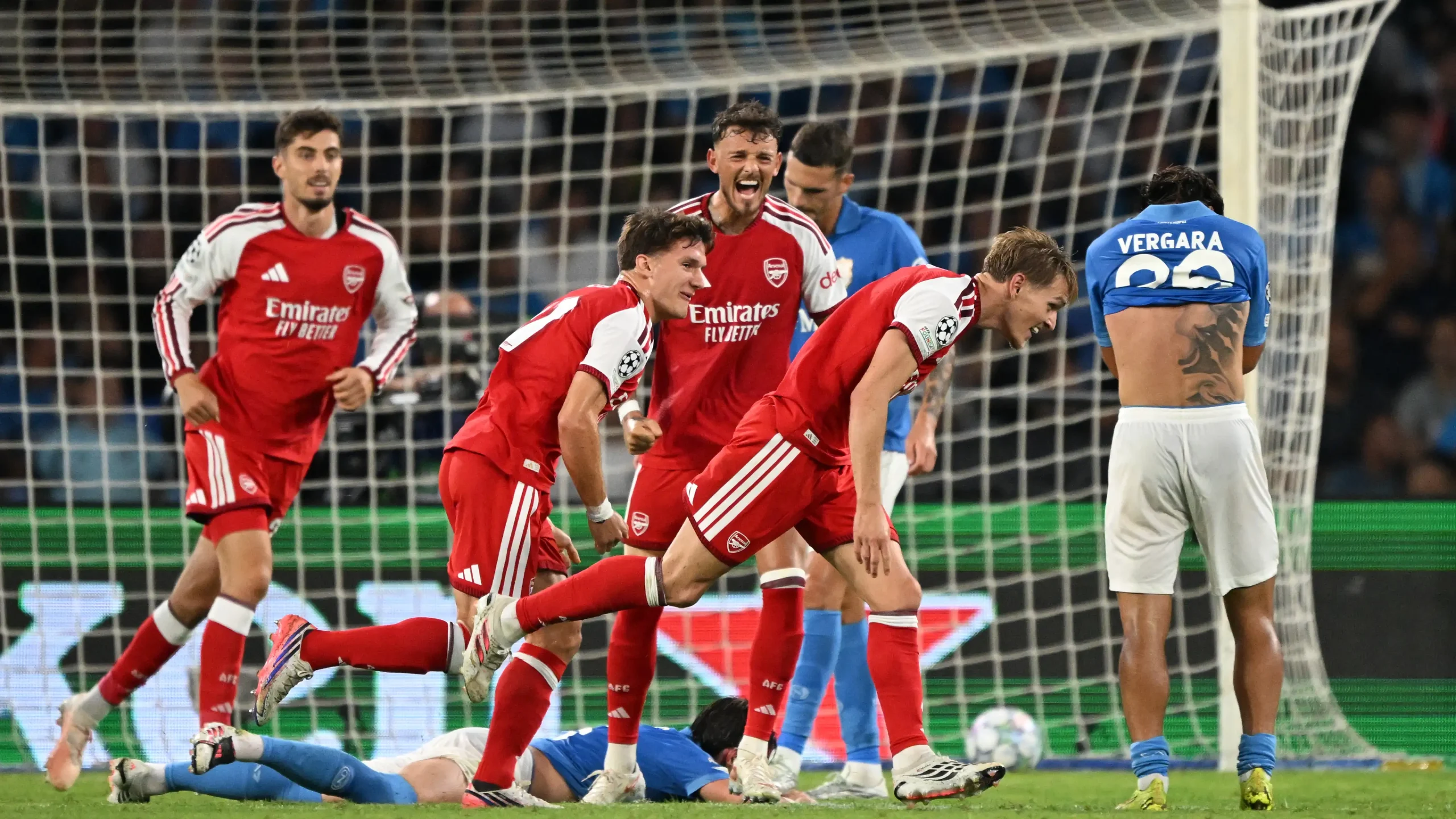 The most revealing performance of the early campaign remains the 1-0 victory at Napoli.
A narrow scoreline can sometimes create the illusion that a match was balanced.
This one was not.
Arsenal generated repeated opportunities and controlled large portions of the contest, while Napoli struggled to create sustained attacking pressure.
The final goal came in the 75th minute when Ødegaard finished a flowing move, with Christos Tzolis providing the assist.
But the goal was not the main story.
The main story was that Arsenal continued doing the same things before and after the goal.
They kept the ball.
They kept moving Napoli’s defensive block.
They continued looking for the next pass.
And defensively, they prevented Napoli from turning possession into meaningful chances.
That is a sign of a team that understands game control.
A less mature side might have become frustrated after failing to score early.
Another team might have become vulnerable after missing several chances.
Arsenal did neither.
They kept playing.
Eventually, the breakthrough came.
Ødegaard Is Becoming the Symbol of Arsenal’s Control
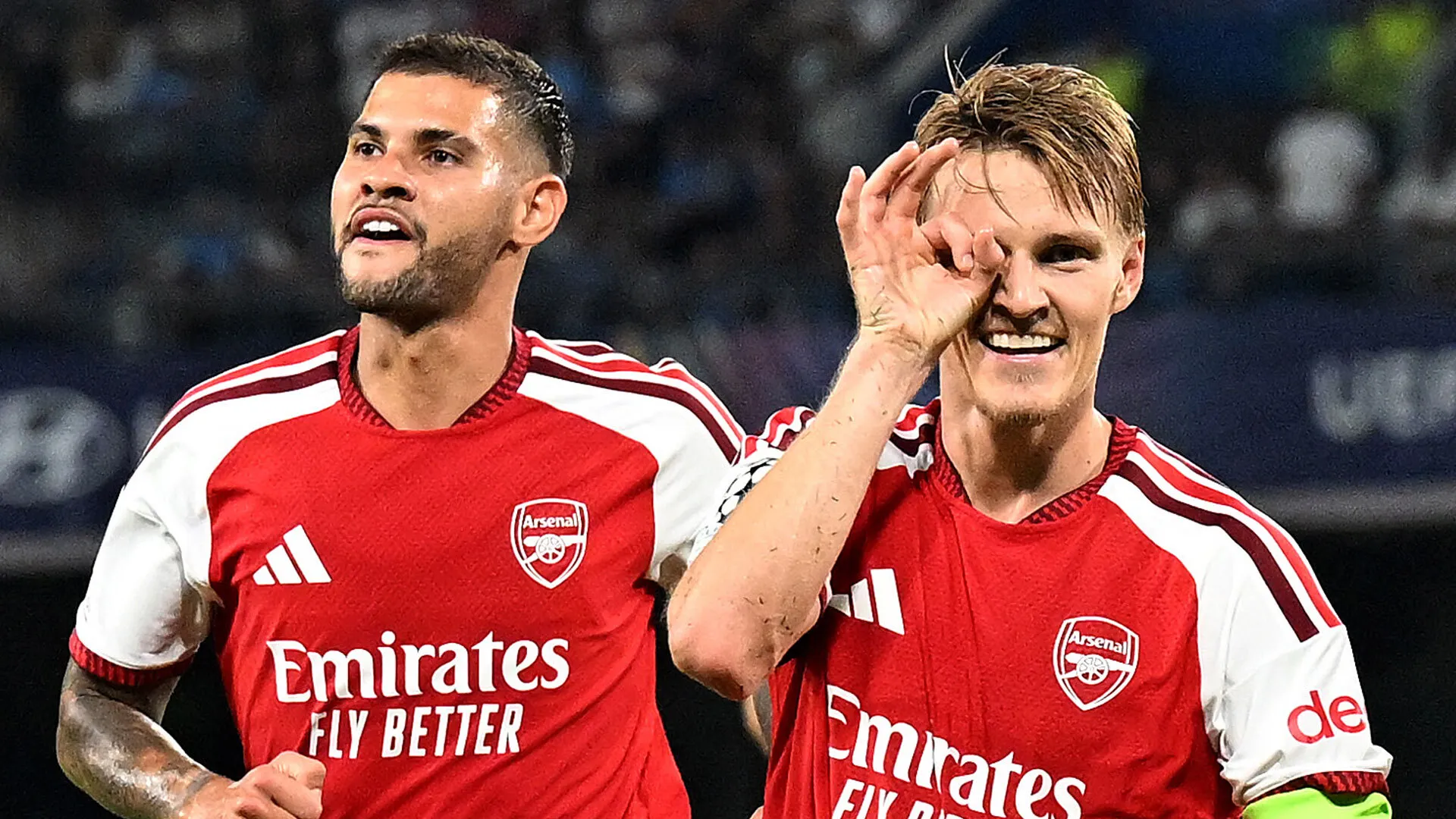 Martin Ødegaard’s goal in Naples deserved the headlines, but his wider performance explains why he remains so important to Arteta.
He was not simply Arsenal’s scorer.
He was the team’s connector.
Opta’s analysis credited him with six chances created, 120 touches and five line-breaking passes, figures that illustrate how deeply involved he was in Arsenal’s attacking structure.
This is important because Arsenal’s attacking model depends on more than individual dribbling.
Ødegaard frequently operates in spaces where he can receive the ball between Napoli’s midfield and defensive lines.
From there, he can:
- accelerate an attack;
- switch play;
- combine with the right winger;
- release an overlapping full-back;
- play the final pass;
- or shoot himself.
His goal demonstrated the final part of that equation.
But his six chances created demonstrated the larger one.
Arsenal do not need Ødegaard to score every match. They need him to make the attack function.
That distinction is crucial.
Arsenal’s Defensive Structure Is Becoming Just as Important
The other side of Arsenal’s perfect start is defensive control.
For several seasons, Arteta has attempted to build a team that can attack aggressively without losing its structure.
That balance is extremely difficult.
The more players a team commits forward, the more vulnerable it can become when possession is lost.
Arsenal’s solution has increasingly been based on positioning rather than simply numbers.
When one player moves forward, another occupies the space behind.
When a full-back enters midfield, a centre-back can adjust.
When the ball is lost, nearby players attempt to immediately restrict the opponent’s first pass.
This is why Arsenal can sustain pressure without completely exposing themselves.
Against Napoli, the defensive organisation was especially significant.
One analysis recorded Napoli with only one second-half shot, while Arsenal continued generating chances at the other end.
That statistic tells an important story.
Arsenal were not merely defending their 1-0 lead.
They were controlling Napoli’s ability to respond.
The New Arsenal Has More Than One Route to Goal
Another reason this start feels different is the number of attacking solutions available to Arteta.
Bukayo Saka remains a central reference point.
Ødegaard provides creativity.
Declan Rice provides progression and physicality.
New arrivals have expanded the midfield options.
And Arsenal now have greater variation in the final third.
This matters because Champions League football exposes predictable teams.
If a team relies almost entirely on one attacking pattern, elite opponents eventually identify it.
Arsenal’s challenge is therefore not simply to create chances.
It is to create them in different ways.
Against a deep defensive block, they need patience.
Against a high press, they need players capable of playing through pressure.
Against a low block, they need individual quality.
Against a transition-heavy team, they need defensive security.
Napoli presented one of those problems.
Arsenal solved it.
That is why the result matters.
Arsenal Perfect Start Is Also a Story About Squad Depth
Perhaps the biggest development of the last week came not in Naples, but at Portman Road.
Arteta made extensive changes for the Carabao Cup meeting with Ipswich.
And Arsenal still won 4-2.
The result itself was useful.
The bigger story was the players who delivered it.
Max Dowman, aged only 16, scored twice.
Noni Madueke and Mikel Merino also found the net, while 17-year-old Marli Salmon made his second senior start at centre-back.
Arsenal’s ability to rotate without completely losing its identity is extremely important.
A title-winning team cannot depend on 11 players.
A Champions League contender certainly cannot.
There will be injuries.
Suspensions.
International breaks.
Three-match weeks.
Long European trips.
Domestic cup matches.
Fatigue.
The teams that survive those periods are usually the teams with enough quality beyond their first-choice XI.
Arsenal’s early season is already providing evidence that Arteta has significantly more options.
Max Dowman Changes the Conversation About Arsenal’s Depth
 Dowman’s two goals deserve attention beyond the obvious headline.
He became only the second 16-year-old to score twice in a match for a Premier League club, joining Wayne Rooney, who achieved the feat in 2002.
But Arteta’s reaction is perhaps more interesting than the record.
The Arsenal manager has repeatedly stressed that Dowman must be protected and that opportunities need to come in the right context because of the physical demands of senior football.
That is sensible.
The danger with exceptional young players is not giving them opportunities.
The danger is allowing one extraordinary performance to distort their development.
Dowman’s performance against Ipswich does not mean he should suddenly become a regular starter in every competition.
What it does demonstrate is that Arsenal’s academy pipeline remains capable of producing players who can operate within Arteta’s tactical environment.
That is a major competitive advantage.
Arteta’s Arsenal Is Becoming Less Dependent on Individual Moments
 This may be the most important tactical development.
Earlier versions of Arteta’s Arsenal could sometimes appear dependent on individual brilliance.
Saka would produce something.
Ødegaard would create something.
A set piece would rescue a difficult match.
A defensive intervention would preserve a narrow advantage.
The current team appears increasingly capable of controlling games collectively.
Napoli is the clearest example.
Ødegaard scored.
But Arsenal’s dominance was not created by Ødegaard alone.
It came from:
positional structure + midfield control + pressing + movement + defensive stability + squad quality.
That combination makes a team much harder to stop.
If Saka is contained, another player can create.
If Ødegaard is tightly marked, Rice can carry the ball.
If the starting striker is unavailable, another attacking option can enter.
If the first-choice defender is rested, the structure can remain intact.
This is what elite squad construction should look like.
The Bruno Guimarães Factor
 One of the major additions to Arsenal’s squad this season has been Bruno Guimarães.
His presence gives Arteta another player capable of influencing games from midfield.
The significance is not simply that Arsenal have added a high-profile midfielder.
It is that Guimarães changes the number of tactical combinations available.
He can operate as a deeper midfielder.
He can progress the ball.
He can compete physically.
And he can help Arsenal maintain possession under pressure.
Arsenal’s official 2026/27 squad list includes Guimarães alongside Ødegaard, Rice, Zubimendi, Merino and other midfield options, giving Arteta considerable flexibility in that area.
For a Champions League campaign, that flexibility could become decisive.
The European season is not won by having one perfect XI.
It is won by surviving different tactical environments.
Why the Napoli Victory Matters More Than the Scoreline
Imagine Arsenal had won Napoli 3-0.
The headline would have been louder.
The social media reaction would have been bigger.
But the 1-0 victory may actually provide more useful evidence about the team’s development.
SEE ALSO; Arsenal Beat Napoli 1-0: Ødegaard Revealed Arteta’s Biggest European Upgrade
Why?
Because Arsenal had to win a difficult game without everything going perfectly.
They missed chances.
They had to wait.
They faced a disciplined opponent.
And they still maintained control.
That is the kind of experience Champions League teams need.
European knockout football frequently produces matches where the margin is tiny.
A team may dominate but score only once.
A goalkeeper may make one crucial save.
A set piece may decide everything.
The ability to remain calm when the scoreboard does not reflect the performance is therefore essential.
Arsenal demonstrated that quality in Naples.
The Remaining Question: Can Arsenal Convert Dominance Into Trophies?
This is where caution is necessary.
A perfect start in September does not win a Premier League title.
Seven wins do not guarantee Champions League success.
And one excellent European away performance does not prove that Arsenal will dominate Europe.
The season is still extremely long.
The physical demands will increase.
Opponents will adapt.
Injuries will arrive.
The Champions League schedule will become increasingly difficult.
And eventually Arsenal will experience a bad night.
The real test will be how the team responds when the first unbeaten run ends.
That is where championship-level mentality becomes important.
Arsenal’s Biggest Test May Be Managing Success
This is an underrated challenge.
When a team starts perfectly, expectations rise immediately.
Every subsequent draw becomes a crisis.
Every poor half becomes evidence that something is wrong.
Young players begin receiving enormous attention.
Opponents become more motivated.
Arsenal are no longer an emerging project.
They are the defending Premier League champions.
That changes the psychology of every match.
Arteta therefore has to manage two things simultaneously:
the football and the expectations.
The handling of Dowman is a perfect example.
The youngster’s performance creates excitement.
Arteta’s job is to make sure excitement does not become pressure.
The same principle applies to the senior squad.
The objective is not to win every September headline.
It is to still have a functioning, hungry and physically strong squad in April and May.
Arsenal Perfect Start Has Changed the Question
At the beginning of the campaign, the question was whether Arsenal could sustain their title-winning momentum.
Now the question is becoming more interesting.
How good can this version of Arsenal actually become?
The Napoli performance suggests that Arsenal can win in Europe without abandoning their identity.
The Chelsea comeback showed resilience.
The Ipswich victory demonstrated squad depth.
Dowman’s emergence demonstrated academy strength.
Ødegaard’s form demonstrated creative leadership.
And the defensive structure continues to provide a platform from which Arsenal can control matches.
Individually, none of these things guarantees anything.
Together, however, they form a compelling picture.
What’s Next for Arteta’s Arsenal?
The next challenge is maintaining this level when the novelty disappears.
Opponents now know Arsenal are in form.
They will prepare differently.
They will defend deeper.
They will target Arsenal’s build-up.
They will attempt to isolate Saka.
They will attempt to disrupt Ødegaard.
They will test the team’s response to physical pressure.
That is when Arteta’s tactical evolution will be properly examined.
The Arsenal manager has spent years building an identity based on control.
Now he has to take that identity into another phase.
From competing for trophies to defending them.
That requires more than good football.
It requires consistency.
Conclusion: The Napoli Win Was a Warning to Europe
Arsenal’s perfect start should not be interpreted as proof that they will win every competition they enter.
Football does not work that way.
But it does provide evidence.
Evidence that Arsenal are becoming more tactically flexible.
Evidence that their squad is deeper.
Evidence that their defensive structure is reliable.
Evidence that their academy is producing first-team options.
And, perhaps most importantly, evidence that they can travel to one of Europe’s difficult stadiums and impose their football.
The 1-0 victory over Napoli was therefore not an accident
It was the product of a team that appears to understand itself better.
The scoreline was narrow.
The performance was not.
Then, only days later, Arteta rotated heavily and watched a teenage academy product score twice as Arsenal defeated Ipswich 4-2.
That combination is what makes this Arsenal particularly intriguing.
The first XI can control Europe. The squad can survive rotation. The academy is producing talent. And Arteta now has more tactical solutions than ever.
The real question is no longer whether Arsenal can start strongly.
They already have.
The question is whether this perfect beginning is the first sign of a team finally equipped to remain at the top when the season becomes unforgiving.
For now, the evidence is becoming increasingly difficult to ignore.
Arsenal are not simply winning. They are building a team that looks increasingly prepared for the demands of winning repeatedly.
And that is a much more dangerous proposition for the rest of England and Europe.