
Five goals, three different leads in the first half, an opposing hat-trick and a late Erling Haaland finish — Manchester City’s 5–3 victory over Sunderland looked chaotic, but beneath the madness was something far more significant.
This was not simply another Manchester City victory. It was an early glimpse of what the post-Pep Guardiola era could become under Enzo Maresca.
City have now won their opening five Premier League matches, scoring freely while sitting three points clear at the top of the table. Yet the 5–3 scoreline also exposed the central question surrounding Maresca’s project: can City preserve their attacking freedom without sacrificing the control that defined Guardiola’s greatest teams?
The Sunderland game provided evidence for both sides of that argument.
Manchester City 5-3 Sunderland: An Eight-Goal Statement
 The scoreboard tells only part of the story.
City scored through Enzo Fernández, Rayan Cherki, Antoine Semenyo twice and Erling Haaland, while Sunderland’s Brian Brobbey responded with a remarkable hat-trick.
What made the match particularly unusual was City’s ability to repeatedly regain the lead.
They went:
- 1–0 ahead
- 2–1 ahead
- 3–2 ahead
—all inside the opening 45 minutes.
Opta records that this was only the seventh Premier League match in which a team had taken the lead three times in the first half.
That tells us something about Maresca’s City.
They are not simply trying to dominate opponents through long spells of possession. There is a greater emphasis on speed, verticality and attacking transitions.
And when the quality of City’s attacking players is considered, that can become extremely difficult for opponents to contain.
Enzo Maresca Has Not Simply Recreated Guardiola’s Manchester City
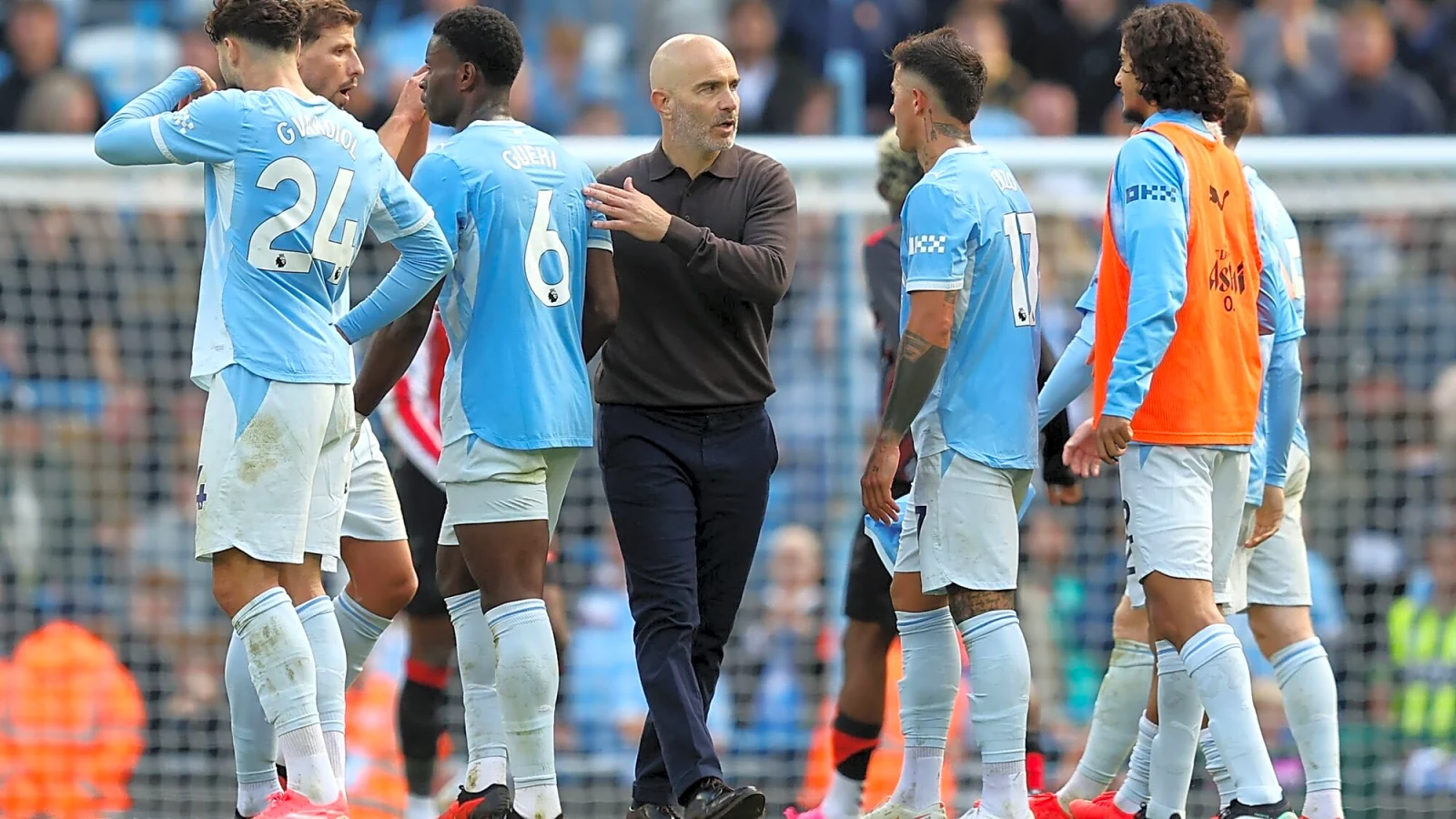 When Maresca replaced Guardiola, the obvious expectation was continuity.
After all, Maresca worked within Guardiola’s Manchester City environment and has long been associated with positional football. The Premier League’s tactical analysis before the season highlighted similarities between the two coaches, particularly their emphasis on possession, positional play and structured build-up.
But Maresca is not Guardiola.
And that distinction is becoming increasingly important.
Guardiola’s City were built around controlling space and controlling the opponent.
Maresca appears willing to allow more volatility when it creates opportunities to attack.
That difference was visible against Sunderland.
City could press aggressively, win the ball high and attack before Sunderland had reorganised.
Rayan Cherki’s goal was a good example. City recovered possession high up the pitch before the attack developed quickly and Cherki finished through a crowded penalty area.
That is not possession for possession’s sake.
It is possession used as a platform for immediate attacking punishment.
Manchester City Attack: Why the New Structure Is So Dangerous
The most interesting part of Maresca’s system is the variety of threats.
City no longer appear dependent on one particular attacking mechanism.
Against Sunderland, different players hurt the visitors in different ways.
1. Semenyo Provides Power From Wide Areas
Antoine Semenyo scored twice.
His role gives City something different from the classic Guardiola winger profile.
Rather than simply receiving the ball wide and combining inside, Semenyo can attack space aggressively, carry the ball and attack the penalty area with physicality.
His two goals demonstrated that threat.
The first came before half-time, while the second arrived shortly after the break to put City 4–2 ahead.
That creates a difficult dilemma for opposition full-backs.
If they move toward Haaland centrally, Semenyo can attack the space outside them.
If they stay wide, City can use their central players to exploit the gaps between the lines.
2. Cherki Gives City Another Creative Layer
Rayan Cherki adds a different dimension.
He is comfortable receiving between the lines, carrying the ball through congested areas and creating from central or half-space positions.
His goal against Sunderland came after City pressed high and recovered possession.
That combination of pressing + technical quality + rapid finishing is potentially one of Maresca’s most dangerous weapons.
3. Haaland Remains the Final Piece
Then there is Haaland.
The Norwegian scored City’s fifth goal in the 81st minute after Sunderland had repeatedly threatened an equaliser.
The goal also completed an unusual statistical milestone.
Haaland has now scored against all 25 Premier League opponents he has faced.
For Maresca, having that kind of striker changes the equation.
The City manager previously worked without a striker of Haaland’s profile during his Chelsea spell. Premier League analysis noted that Maresca’s Chelsea produced comparable expected goals to City over a similar period but scored significantly fewer goals.
Now he has arguably the most devastating finisher in English football.
That could fundamentally change how far his attacking system can go.
The 5-3 Scoreline Also Revealed Maresca’s Biggest Problem
For all the excitement surrounding the attack, the three goals conceded cannot be ignored.
Maresca himself admitted that he would rather win 1–0 than 5–3 and acknowledged that City needed to improve defensively.
That is arguably the most important takeaway from the match.
City had previously recorded four consecutive clean sheets before Sunderland scored three times.
The issue was not simply that Brobbey had an excellent game.
His three goals exposed different defensive weaknesses.
One came after Enzo Le Fée found him running through the centre.
Another followed Sunderland’s combination play down the flank.
The third came after a delivery into the penalty area and a second-ball situation.
In other words, Sunderland did not repeatedly score from exactly the same attacking pattern.
They found different routes into City’s defensive structure.
That is where Maresca has work to do.
Maresca’s Pressing Creates Both the Opportunity and the Risk
One of the major tactical differences between Maresca and Guardiola concerns pressing.
Premier League tactical analysis before the season highlighted that Maresca’s Chelsea pressed more aggressively than Guardiola’s City, with a greater tendency toward man-oriented pressing. It also identified Maresca’s preference for a 4-2-3-1 structure that can morph into a 3-box-3.
The benefit is obvious.
Win the ball high and City have Haaland, Semenyo, Cherki and other attacking players positioned close enough to immediately attack.
But there is a cost.
Aggressive pressing can stretch the team.
If the first wave is beaten, defenders can suddenly be exposed against forwards running into open space.
Sunderland demonstrated that perfectly.
Brobbey repeatedly found opportunities behind or around City’s defensive line.
That is the trade-off Maresca must solve.
The Sunderland Game Was Almost a Perfect Tactical Stress Test
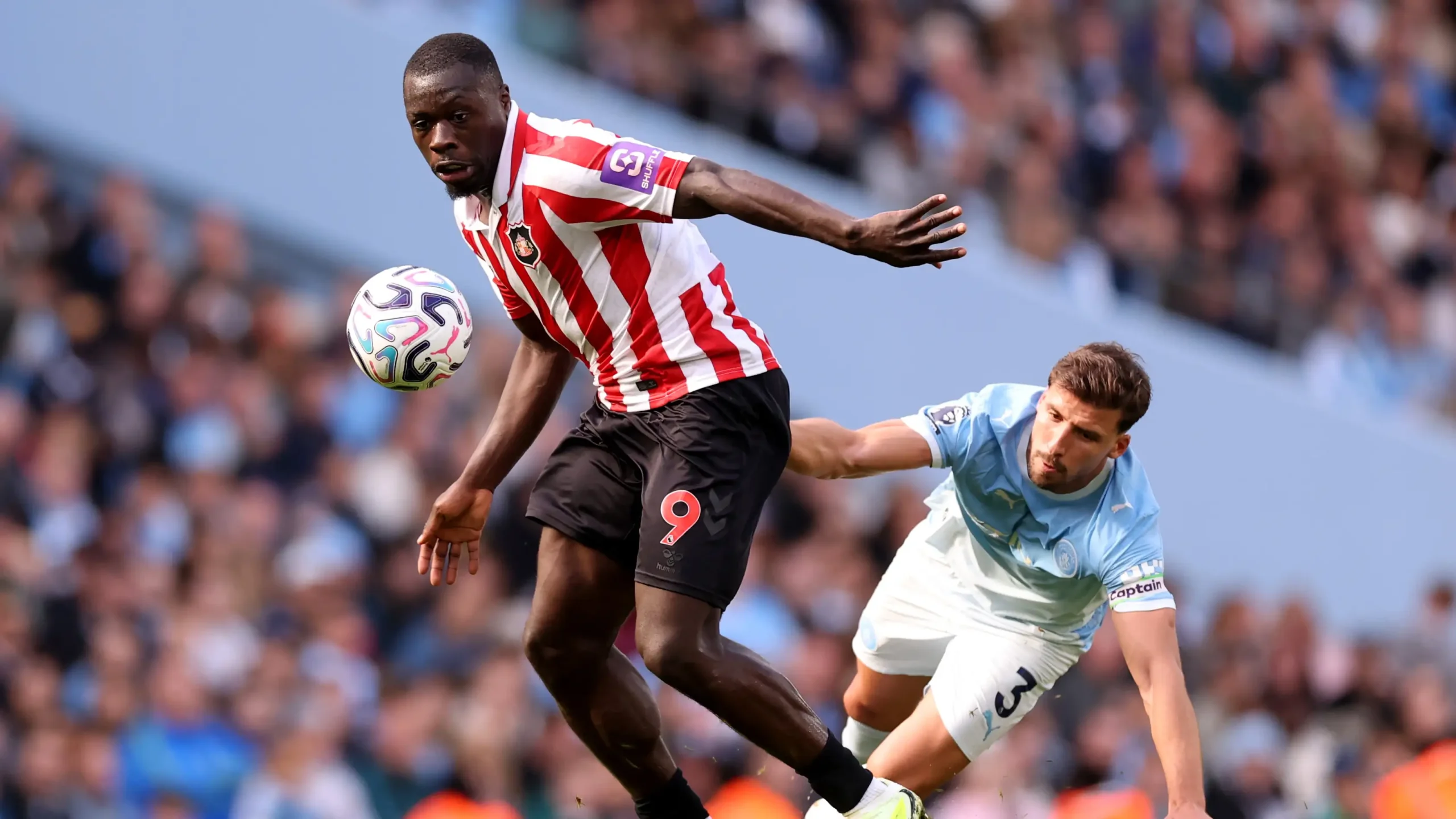 Ironically, Sunderland may have provided Maresca with exactly the type of test he needed.
They did not simply sit back.
They pressed.
They attacked.
They played with courage.
And they repeatedly challenged City’s defensive structure.
That forced Maresca’s team to solve several different problems during the same match.
City had to:
- break a high press;
- attack a compact defensive block;
- defend transitions;
- protect a two-goal advantage;
- respond after conceding;
- manage late pressure;
- and eventually close the match.
They succeeded—but not comfortably.
That matters.
A team that wants to challenge for major trophies cannot rely on scoring five every week.
Eventually, there will be Champions League knockout matches where one defensive mistake can decide an entire tie.
Is This Actually a New Manchester City?
The early evidence suggests yes—but with an important qualification.
This is not a complete rejection of Guardiola’s football.
Instead, Maresca appears to be building on the same positional principles while introducing greater directness and more aggressive pressing.
The Premier League’s pre-season tactical analysis noted that Maresca’s attacking structure could feature high and wide wingers, with players such as Doku and Semenyo particularly suited to that approach.
That is significant.
Guardiola’s later City teams had already become more direct, with increased emphasis on through-balls, fast breaks and take-ons.
Maresca therefore did not inherit a completely static system.
He inherited a team already evolving.
His task is to push that evolution further.
Five Wins From Five: The Numbers Are Impossible to Ignore
The result against Sunderland preserved City’s 100% Premier League record after five matches.
Maresca has therefore become only the sixth manager to win his first five Premier League matches in charge of a new club.
City also went into the international break three points clear at the top of the table.
That makes the attacking transformation particularly interesting.
The results are not being achieved despite the new system.
They are being achieved through it.
The question now is whether the defensive problems are simply early-season imperfections or a structural consequence of Maresca’s approach.
The Real Test Comes After the International Break
The Sunderland victory was entertaining.
But it was not definitive.
The next stage of Maresca’s project will be judged against stronger opponents who can punish the spaces Sunderland found.
City’s next Premier League fixture after the international break is against Liverpool on October 11.
SEE ALSO: Manchester City vs Sunderland: The Tactical Test That Could Reveal Maresca’s New Blueprint
That match could provide a much clearer indication of where this team stands.
Liverpool will test:
- City’s rest defence;
- their ability to stop counterattacks;
- their midfield spacing;
- their defensive transitions;
- their ability to maintain pressure;
- and whether their attacking freedom survives against elite opposition.
If City can maintain the attacking explosiveness while reducing the defensive exposure, Maresca’s project becomes considerably more interesting.
What Manchester City Must Fix
 The answer is not to abandon the attacking football.
That would defeat the purpose of Maresca’s evolution.
Instead, City need better control within the chaos.
The priorities should be:
1. Protect the centre.
Opponents should not be allowed to repeatedly find runners through the middle.
2. Improve rest defence.
When City attack with numbers, enough structure must remain behind the ball.
3. Know when to slow the game down.
After making it 4–2, City allowed Sunderland back into the contest almost immediately.
4. Make pressing more coordinated.
Aggression is valuable only when the second line is prepared for the first line being bypassed.
5. Keep exploiting attacking width.
Semenyo and Doku give City the ability to stretch defensive blocks before Haaland attacks the centre.
Final Verdict: A Machine Still Under Construction
 Calling Manchester City an attacking machine after five matches would be premature.
But the ingredients are unmistakable.
Five Premier League wins.
Fifteen points.
Five goals against Sunderland.
A forward line containing Haaland, Semenyo, Cherki, Doku and other elite attacking options.
And a manager prepared to combine Guardiola’s positional principles with a more aggressive, vertical interpretation.
The Sunderland match therefore offered both a warning and a promise.
The warning: three goals conceded against a newly promoted side cannot become a recurring pattern.
The promise: City can now hurt opponents in more ways than simply dominating possession.
Maresca does not need to build another Guardiola team.
He needs to build his Manchester City.
And if he can retain the attacking explosiveness displayed in the 5–3 Sunderland thriller while restoring defensive control, this could become one of the most fascinating tactical transformations in the Premier League.
The real question is no longer whether Maresca can make Manchester City entertaining.
It is whether he can make them devastating without making them vulnerable.
What did you make of Manchester City’s new attacking approach? Share your view in the comments.
Would you like the next piece to focus more on Maresca’s pressing structure or on how Haaland, Semenyo and Cherki combine in the final third?