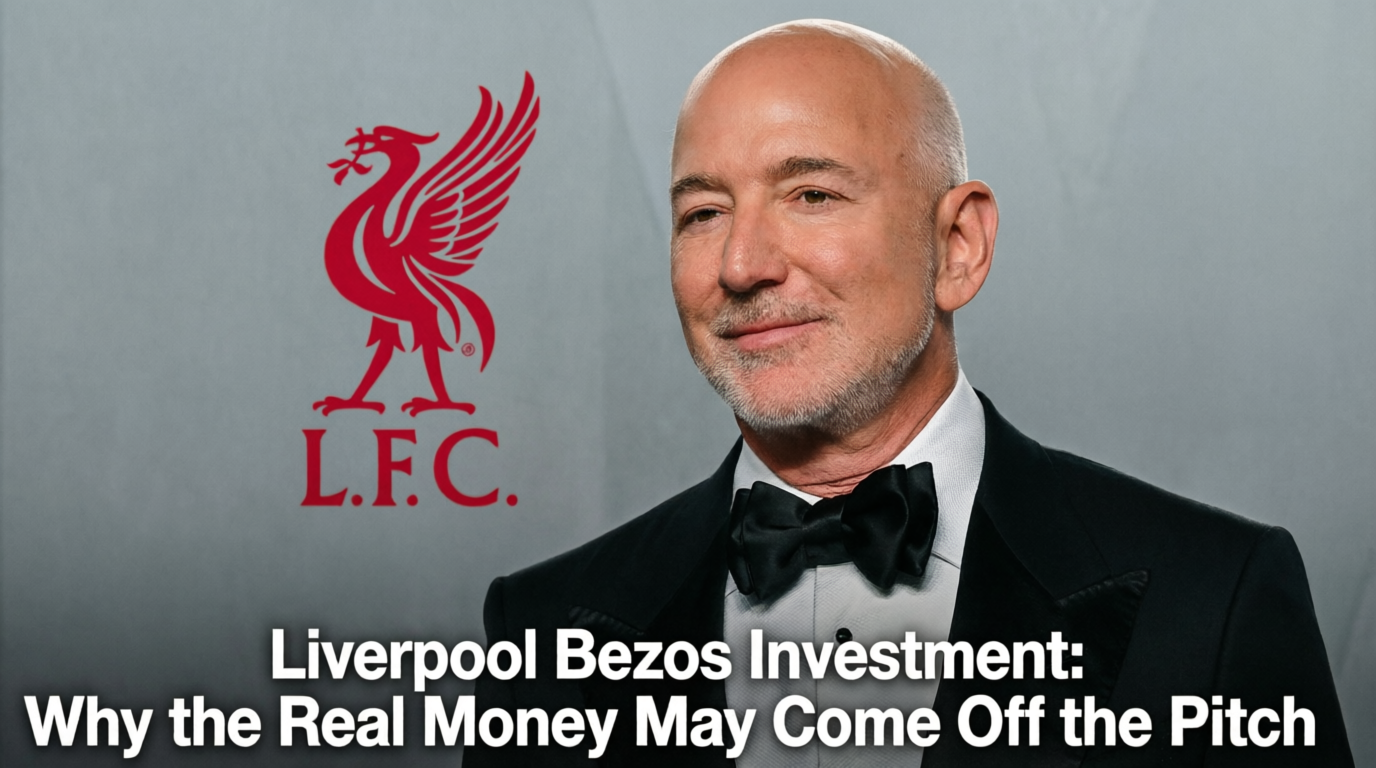
Liverpool Bezos investment is not really a story about how much money could arrive at Anfield for transfers. It could be something far more powerful: a commercial opportunity capable of reshaping Liverpool’s global business, brand value and long-term financial ambitions.
The arrival of Amazon founder Jeff Bezos into Liverpool’s ownership structure has immediately created the obvious question.
How much more can Liverpool spend?
It is understandable. Bezos is one of the world’s wealthiest businessmen, and his name is now attached to one of football’s most valuable clubs.
But that question may actually miss the bigger story.
Liverpool does not suddenly have an unlimited transfer budget because Bezos has become an investor.
The club remains controlled by Fenway Sports Group (FSG), Premier League and UEFA financial regulations still apply, and Bezos himself is expected to remain a passive investor without a board seat.
The more important opportunity lies elsewhere.
Liverpool already generates hundreds of millions of pounds every year. The Bezos investment could help the club become significantly better at turning its global popularity into commercial revenue.
That is where this deal becomes genuinely fascinating.
What Has Jeff Bezos Actually Bought?
The first clarification is essential.
Jeff Bezos has not bought Liverpool Football Club outright.
FSG has agreed to sell a roughly 30% minority stake to 1892 Holdings, a consortium involving Bezos, Eduardo Saverin and Amit Bhatia. FSG remains the majority owner and retains operational control.
The reported transaction values the 30% stake at approximately £1.65 billion, implying a club valuation of around £5.5bn. Other reports have placed the implied valuation above $7bn, illustrating how currency movements and valuation calculations can produce different headline numbers.
That valuation itself is a statement.
It tells us that elite football clubs are no longer being valued purely according to what happens over 90 minutes on a pitch.
They are increasingly being valued as global entertainment, media and commercial businesses.
And Liverpool is one of the strongest examples.
Liverpool Bezos Investment: Why Commercial Growth Matters More Than Transfers
The obvious question surrounding a potential Jeff Bezos investment in Liverpool is how much money could be made available for transfers. But that may be the least interesting part of the story. The bigger opportunity could be what Bezos brings to Liverpool’s commercial machine — and how that could strengthen the club’s financial power for years to come.
Liverpool already possesses one of football’s most recognisable global brands. Its worldwide fanbase, Premier League exposure and historic identity give the club a commercial platform that extends far beyond matchday revenue. The real challenge is finding smarter and more scalable ways to turn that global following into sustainable income.
That is where the **Liverpool Bezos investment** angle becomes particularly interesting.
Bezos’ business background is built around scale, technology, digital commerce and creating ecosystems that connect millions of consumers. If that expertise were ever applied to Liverpool’s commercial strategy, the potential impact could go well beyond writing a larger cheque for the next transfer window.
A stronger digital strategy could create new ways for Liverpool to engage supporters across international markets. E-commerce could become more deeply integrated into the fan experience, while data-driven marketing could help the club build more personalised relationships with supporters around the world.
The same principle applies to sponsorship. Liverpool’s global audience gives the club enormous commercial reach, but the next stage of growth could involve finding new categories, markets and digital partnerships capable of increasing the value of that audience.
That matters because transfer spending is ultimately a cost, while commercial growth can become a recurring source of revenue.
A major signing might generate excitement for a season or two. A stronger commercial operation can continue producing value year after year, potentially giving the club greater flexibility to invest in players, infrastructure, technology and other areas of the football operation.
This is why the most interesting question may not be how much Bezos could spend on Liverpool’s squad. It is whether his involvement could help Liverpool build a more powerful business model around one of football’s biggest global brands.
If that happens, the biggest impact of the investment may never appear on a transfer receipt. It could instead be seen in Liverpool’s sponsorship portfolio, international expansion, digital platforms, fan engagement and long-term revenue growth.
Liverpool Was Already a £700m Football Business
Before Bezos arrived, Liverpool had already built an enormous revenue machine.
The club’s financial results for the year ending 31 May 2025 showed record revenue of £703m, an increase of £89m from the previous year.
The breakdown is even more revealing.
Liverpool generated:
- £264m from media revenue
- £116m from matchday revenue
- £323m from commercial revenue
The commercial figure is particularly important for understanding why investors such as Bezos are interested in elite football.
Liverpool are not simply selling tickets.
They are selling:
- sponsorship rights;
- global brand exposure;
- merchandise;
- digital content;
- hospitality;
- international partnerships;
- broadcast value;
- access to a huge global audience.
That is a business model with significant room for expansion.
And this is where Bezos’ background becomes relevant.
The Amazon Question Is Bigger Than Amazon
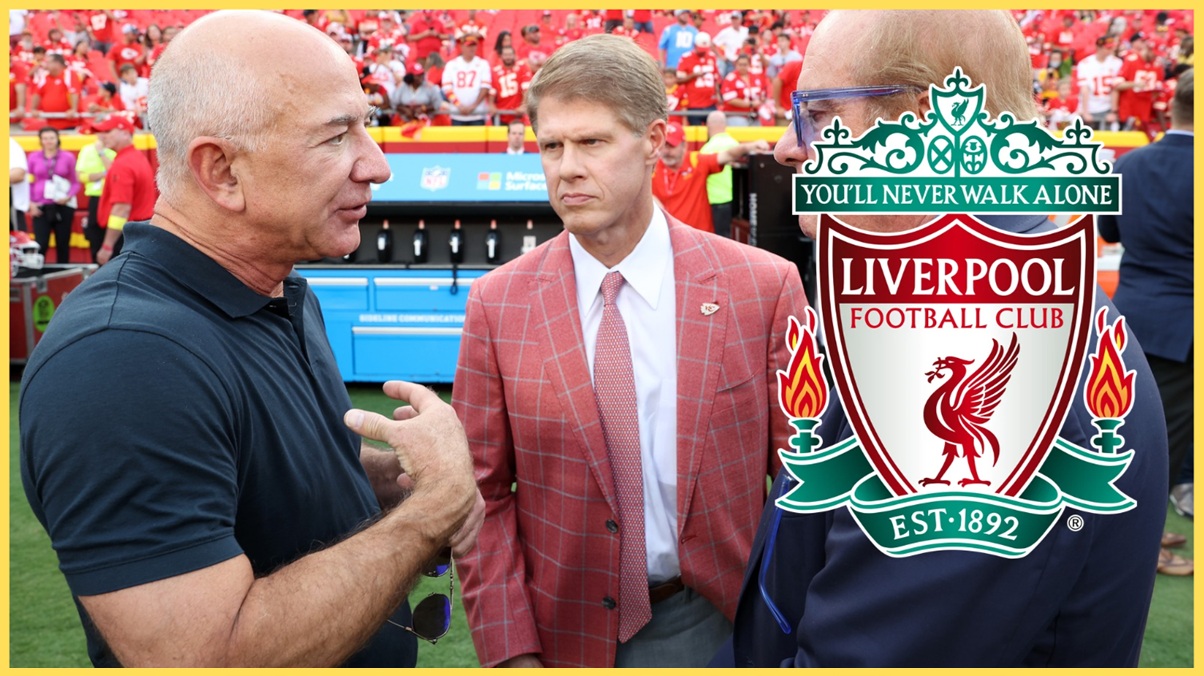 It would be too simplistic to assume Bezos’ Liverpool investment automatically means an Amazon-Liverpool commercial partnership.
The available reporting does not establish that.
The more interesting point is the type of commercial expertise Bezos represents.
Amazon built one of the world’s most sophisticated digital businesses by understanding something fundamental:
A global audience is only valuable if you can build systems that repeatedly monetise its attention.
Liverpool already has the audience.
The club now has to keep increasing the value generated from that audience.
That could mean better digital products.
More sophisticated international commercial partnerships.
More targeted regional sponsorships.
Greater use of data.
Improved direct-to-consumer engagement.
And stronger connections between football content and global consumer markets.
None of those automatically happens because Bezos owns part of Liverpool.
But his presence makes the commercial dimension of the investment impossible to ignore.
The £323m Commercial Number Is the Real Starting Point
Liverpool’s £323m commercial revenue in 2024/25 is already enormous.
But it also provides the baseline against which future growth can be judged.
Imagine, purely as a business scenario, that Liverpool could increase commercial revenue substantially over time.
The benefit would not necessarily be a single massive transfer window.
It could be recurring revenue.
And recurring revenue is one of the most valuable things any sports organisation can create.
A transfer fee is spent once.
A global sponsorship agreement can generate income year after year.
A successful digital subscription product can generate recurring income.
A stronger international retail operation can continue producing revenue across multiple seasons.
That is the difference between buying footballers and building a football business.
Why Bezos’ Billions Do Not Mean Unlimited Transfers
This is where many football headlines will probably go wrong.
Bezos is extraordinarily wealthy.
But Liverpool cannot simply treat his personal wealth as club revenue.
Premier League financial rules and UEFA regulations constrain how clubs can spend relative to their football revenues and costs. AP specifically notes that the new investors’ financial strength does not simply translate into unlimited transfer spending.
That means the Bezos investment should not be interpreted as:
“Liverpool can now buy anyone.”
It is better understood as:
“Liverpool may have access to investors who can help the club strengthen its long-term business infrastructure.”
That distinction is critical.
The FSG Model Makes This Deal Even More Interesting
There is another side to the story.
Bezos’ arrival is impressive.
But the real financial success story began before him.
FSG bought Liverpool in 2010 for approximately £300m/$400m.
The reported new transaction values Liverpool at roughly £5.5bn.
That represents an extraordinary increase in the club’s implied value.
It also demonstrates the economics of owning a successful elite football institution.
FSG did not simply inherit a valuable asset and wait.
Liverpool developed into a more commercially powerful organisation while also achieving major sporting success.
The club won the Premier League in 2020 and 2024/25 and won the Champions League under Jürgen Klopp during FSG’s ownership.
The result is a football organisation that now sits among the most valuable sports properties in the world.
Bezos is entering a machine that has already been built.
His challenge is to help make that machine more powerful.
The Most Important Number Could Be £323m
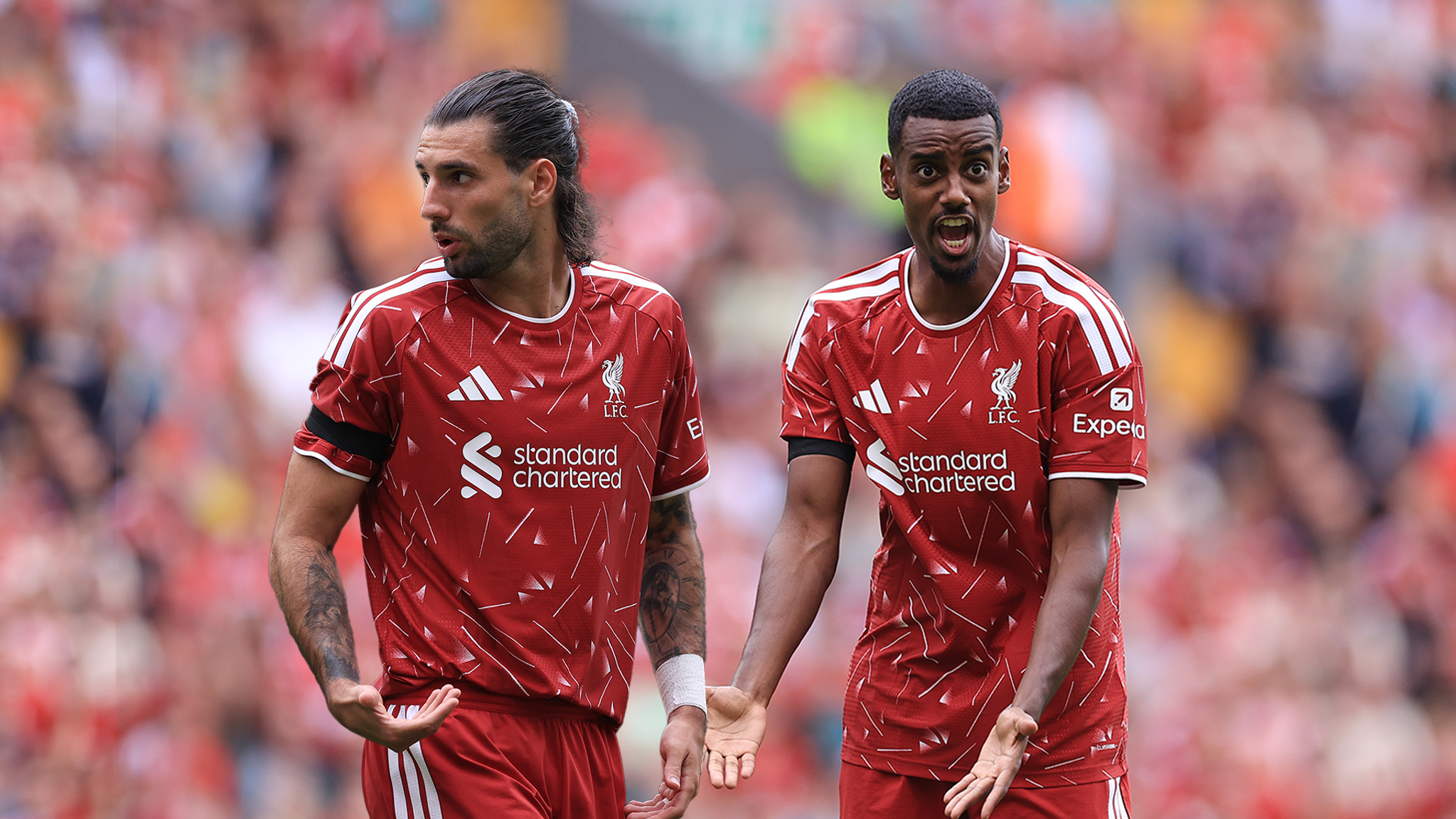 Liverpool’s £703m total revenue attracts attention.
But from a commercial-growth perspective, the £323m commercial figure may be more important.
Why?
Because commercial revenue offers one of the clearest opportunities for international expansion.
Media revenue is heavily influenced by broadcasting structures.
Matchday revenue is constrained by stadium capacity and ticket economics.
Commercial revenue can potentially expand across borders.
A Liverpool supporter does not have to live in Merseyside for the club to generate economic value from them.
That supporter can live in:
- New York;
- Mumbai;
- Singapore;
- Lagos;
- Nairobi;
- Dar es Salaam;
- Tokyo;
- São Paulo.
The club’s challenge is converting global passion into sustainable commercial relationships.
That is where international investment becomes particularly relevant.
Asia Could Become a Major Battleground
Reports around the deal have highlighted Asia as an important potential area for Liverpool’s global commercial expansion.
This is significant because football’s biggest clubs are competing aggressively for supporters and commercial partners in international markets.
Liverpool does not need to convince people to become football fans.
Millions already are.
The opportunity is to build deeper relationships with those fans.
That could involve regional sponsorships, retail, content, partnerships, events and digital experiences.
The investment consortium’s international business networks could potentially help Liverpool develop those relationships.
Again, that is a potential commercial opportunity, not a guaranteed outcome.
But it explains why the Bezos story is much bigger than a billionaire putting his name into a football club.
Liverpool’s £428m Staff Bill Shows Why Revenue Growth Matters
 There is another number that should not be ignored.
Liverpool’s staff costs reached £428m in the 2024/25 financial year. Administrative costs reached £657m.
The club still reported £8m profit after tax, but those numbers demonstrate the scale of operating a modern elite football institution.
This is an expensive business.
World-class players cost money.
Coaching staff cost money.
Scouting costs money.
Stadium operations cost money.
Technology costs money.
Travel, administration and infrastructure all cost money.
That means sustainable growth cannot rely solely on an owner’s willingness to invest.
The club needs to keep growing its own earning power.
That is precisely why commercial expansion could be more important than Bezos funding a single transfer.
What Liverpool Should Not Do With Bezos’ Arrival
Liverpool’s biggest mistake would be to treat Bezos as a shortcut.
If the investment creates pressure to chase expensive players simply because the club now has billionaire backing, it could undermine the financial discipline that helped create Liverpool’s current position.
The better strategy would be to use the investment as a catalyst.
Build the commercial operation.
Expand internationally.
Improve digital engagement.
Strengthen global partnerships.
Protect sporting competitiveness.
Increase recurring revenue.
Then use the additional revenue capacity to support the football operation.
That model is considerably more sustainable than simply injecting money into transfers.
The Bezos Investment Could Change How Liverpool Thinks About Fans
This may ultimately be the most important long-term consequence.
Liverpool’s supporters are not only match-going fans.
They are also consumers, viewers, subscribers, travellers and members of a global digital community.
The modern football club therefore has two products.
The first is obvious:
the football team.
The second is the ecosystem surrounding the team.
That includes media, merchandise, sponsorship, hospitality, content and experiences.
The bigger that ecosystem becomes, the more valuable the football club becomes.
Liverpool’s record £703m revenue demonstrates how far the club has already travelled down this road.
The Bezos investment could accelerate that evolution.
Why This Is Not Yet a Full Takeover Story
There has been speculation that the minority investment could eventually become something larger.
But that should be treated carefully.
The current agreement leaves FSG in majority control, and reporting indicates there are no immediate obligations for the new investors to purchase additional shares. Regulatory approval is also still required.
Therefore, the immediate reality is straightforward:
FSG remains in charge. Bezos is an investor. Liverpool’s operational structure remains intact.
Anything beyond that is future speculation.
And The Football Xtra should distinguish between the two.
The Timing Is Also Significant
Liverpool are entering the 2026/27 season with a new manager, Andoni Iraola, while the club prepares for its Premier League opener away to Newcastle United on 23 August.
That creates an interesting sporting backdrop.
The ownership investment arrives just as Liverpool are attempting to build the next phase of their football project.
But the new ownership structure should not be confused with a new sporting strategy overnight.
The football department still has to deliver.
The manager still has to build the team.
Players still have to perform.
And the club still has to compete within financial regulations.
Bezos can invest in the business. He cannot buy Liverpool a trophy.
That remains the responsibility of the football operation.
What Happens Next?
The immediate next step is regulatory approval.
Until that process is completed, the transaction should not be described as an unrestricted transfer of ownership.
After that, the real test begins.
Not with a £150m transfer.
Not with a headline signing.
But with the growth of Liverpool as a global football business.
Can the club turn its worldwide popularity into greater commercial revenue?
Can it expand its presence in Asia and other international markets?
Can it build stronger digital relationships with supporters?
Can it increase commercial revenue without damaging the identity that made Liverpool commercially powerful in the first place?
Those questions matter more than how much money Jeff Bezos has in the bank.
Liverpool already generated £323m in commercial revenue and £703m overall revenue in its latest published accounts.
The opportunity now is to make those numbers bigger.
And that is why the most important part of the Liverpool Bezos investment may never be seen on the transfer market.
The real prize is not buying more footballers. It is making Liverpool worth even more.
Do you think Jeff Bezos’ involvement will transform Liverpool’s commercial power, or will supporters ultimately judge the investment by what happens on the pitch? Share your view in the comments.