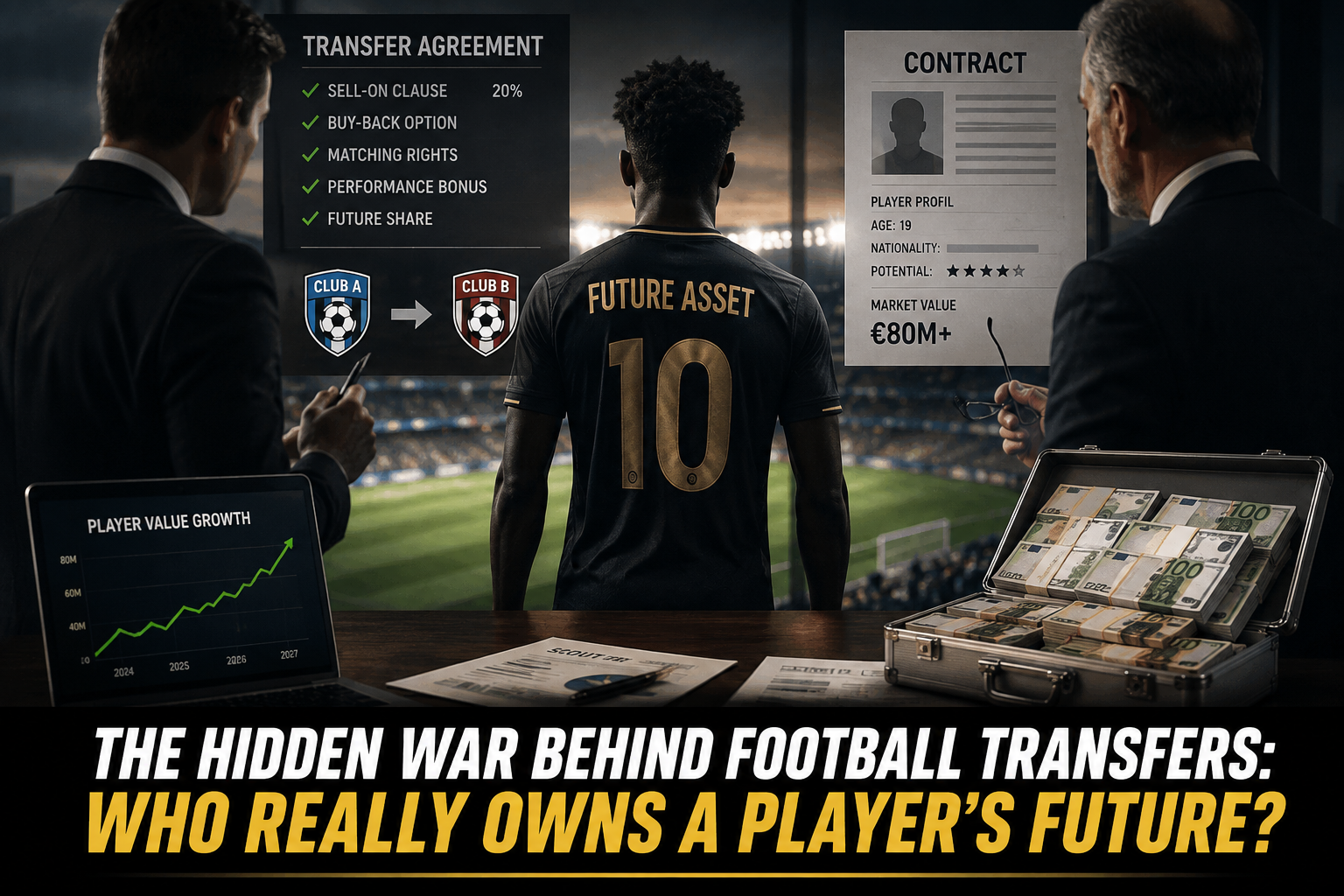
The Player Moves — But His Money May Not
A football transfer looks simple from the outside.
One club announces a signing. Another announces a departure. A fee is reported. The player holds up a shirt, signs a contract and starts training with his new teammates.
But behind that photograph can sit an entirely different agreement.
A club can sell a player and still retain a financial interest in what happens to him years later.
That hidden layer is becoming one of the most important features of modern football transfers.
Djed Spence’s move from Tottenham to Inter, for example, included a reported 10% sell-on clause, meaning Tottenham retained a financial interest in a future transfer. Cristian Romero’s move from Spurs to Atlético Madrid also reportedly included a 15% sell-on clause. Meanwhile, Chelsea are expected to benefit from a sell-on arrangement after Diego Moreira’s reported £56 million move from Strasbourg to AC Milan.
These are not isolated contractual curiosities.
They reveal a broader transformation.
The modern transfer is no longer necessarily:
Club A → Player → Club B.
Increasingly, it looks more like:
Club A → Player → Club B → Future value → Club C → Financial return to Club A.
So who really owns a player’s future?
The answer is more complicated than the word “ownership” suggests.
The First Thing to Understand: Clubs Do Not Own the Human Being
This distinction is critical.
A football club does not own a player as property.
What the club acquires is the player’s registration, together with the contractual rights that allow him to represent that club.
UEFA’s current regulations explicitly describe the acquisition of a player’s registration as an accounting asset. Where clubs capitalise registration costs, those costs are treated as an intangible asset and amortised over the original contract period, up to a maximum of five years under UEFA’s rules.
That means when a club pays a transfer fee, it is not purchasing the person.
It is acquiring the contractual and registration rights associated with the player’s services.
That distinction becomes extremely important when analysing what happens next.
Because the club can transfer those registration rights to another club — and can negotiate conditions that continue beyond the original transfer.
The Hidden Asset Inside a Transfer Agreement
Imagine Club A signs a 19-year-old for £20 million.
Three years later, he becomes a star and Club B offers £80 million.
If Club A sells him without any additional protections, the original club may simply receive the agreed transfer proceeds.
But suppose Club A negotiated a 20% sell-on clause when the player left.
Suddenly, the player’s future remains financially connected to Club A.
If Club B sells the player for £80 million, Club A could be entitled to a share of that future transfer under the terms of the agreement.
The exact calculation depends on the wording of the clause — some agreements are based on the gross future fee, while others calculate a percentage of the profit — but the principle is straightforward.
The first club has sold the player without completely surrendering its economic interest in his future.
That is why sell-on clauses have become such a powerful negotiating tool.
Tottenham’s Transfer Strategy Shows How It Works
 Tottenham’s recent business provides a particularly useful snapshot of this strategy.
When Djed Spence moved to Inter in a deal reported at £30 million, Spurs retained a 10% sell-on clause.
The significance is not the percentage alone.
It is the philosophy behind it.
Tottenham accepted that Spence was leaving, but the club did not necessarily view the transfer as the end of its financial relationship with the player.
Instead, Spurs effectively kept a ticket to his next valuation increase.
If Spence develops into an elite wing-back and Inter eventually sells him for a significantly higher fee, Tottenham could benefit again.
That is a fundamentally different way of thinking about player trading.
The first transfer becomes only one chapter in the asset’s life cycle.
The Ashley Phillips Model Is Even More Interesting
 Another Tottenham deal illustrates the same principle from a younger-player perspective.
Ashley Phillips is reportedly moving to Middlesbrough for an initial £7 million, potentially rising to £20 million with add-ons, while Spurs have reportedly retained a 20% sell-on clause and matching rights on future bids.
Phillips never made a senior appearance for Tottenham.
Yet the club can potentially continue benefiting from his career after he leaves.
That is precisely where the modern transfer market becomes fascinating.
A player does not have to become a first-team star for the original club to have made a successful investment.
The club can:
- Develop him.
- Loan him.
- Increase his market exposure.
- Sell him.
- Retain a sell-on percentage.
- Potentially benefit again if his value rises.
The footballer has moved on.
The financial relationship has not necessarily ended.
The Multi-Layered Transfer: More Than One Club Can Benefit
This has created a new type of transfer economy.
A player’s career can potentially generate value for several clubs.
Consider a simplified example:
Club A develops a young player.
Club B buys him for £10 million.
He becomes a star.
Club C buys him for £60 million.
If Club A negotiated a 20% sell-on clause, it could receive £12 million from the second transfer, depending on the clause’s exact structure.
Club A therefore receives value from the player twice:
First transfer: £10m
Future transfer: potential £12m
And Club B may still make money if it sells the player for more than it paid.
The player has effectively become part of a chain of financial interests.
That is why today’s sporting directors are increasingly thinking beyond the next season.
They are thinking about the next three transfers.
This Is Not the Same as Third-Party Ownership
There is an important legal distinction that often gets lost in football coverage.
A sell-on clause does not automatically mean that another party owns part of the player’s economic rights.
FIFA has long distinguished between third-party influence (TPI) and third-party ownership (TPO).
FIFA’s regulations prohibit arrangements in which third parties can acquire rights that allow them to influence a club’s independence or hold economic rights in a player’s future transfer in the prohibited manner. FIFA’s framework was specifically created to protect contractual stability and the integrity of the transfer system.
That is very different from a former club negotiating a contractual sell-on provision with the player’s new club.
The former club does not suddenly control the player.
It simply retains a contractual right to receive money if a specified future event occurs.
That distinction matters.
Financial interest is not necessarily ownership.
So Who Actually Controls the Player’s Future?
The answer depends on which part of the future we are discussing.
Sporting future
The player and his current club are central.
The player has an employment contract, while the club controls his registration during that contractual period.
Transfer future
The current club generally controls whether it will agree to transfer the player’s registration, subject to the player’s contractual and legal rights.
Financial future
Multiple parties can potentially have interests.
A former club might have a sell-on clause.
Another club might have a buy-back provision.
A future transfer might contain performance-related bonuses.
The player may have contractual compensation linked to a future move.
Agents and intermediaries can also have contractual remuneration arrangements.
Suddenly, the player’s “future” is not one thing.
It is a collection of different rights, obligations and financial possibilities.
The Player Can Also Have a Financial Interest in His Own Future
 This is another important distinction.
FIFA has previously clarified that players themselves are not treated as “third parties” under the third-party ownership rules when agreements provide them with compensation connected to their own future transfer.
In cases reviewed by FIFA, players had agreements entitling them to receive a lump sum or percentage if they moved to another club. FIFA’s Disciplinary Committee treated those payments as part of the player’s remuneration rather than prohibited third-party ownership.
So the financial architecture can include the player himself.
That creates an interesting dynamic.
A footballer can have:
- A salary.
- Bonuses.
- Signing-on payments.
- Performance incentives.
- Contractual compensation.
- Potential transfer-related remuneration.
Meanwhile, clubs can hold registration rights and negotiate future-transfer clauses.
The result is an increasingly sophisticated network surrounding a single footballer.
The Rise of the “Future Value” Transfer
This is where football economics enters the conversation.
Clubs increasingly recruit players not only because of what they can contribute today, but because of what they could become tomorrow.
A young player can provide three forms of value:
1. Sporting value
He improves the squad.
2. Development value
The club can develop his technical, tactical and physical profile.
3. Financial value
His transfer value may increase.
That third category is becoming particularly important under modern financial regulations.
UEFA’s accounting rules require clubs that capitalise player-registration costs to amortise them over the contract period, up to five years, and require annual impairment reviews. UEFA also recognises that profits or losses on player disposals are connected to the registration’s net book value.
In other words, a player registration has a financial life inside the club.
The longer he stays, the more the accounting value changes.
The moment he is sold, the club compares the proceeds with the remaining carrying value to calculate the accounting result.
That makes player trading much more sophisticated than simply asking:
“How much did we buy him for?”
Why Sell-On Clauses Are Becoming So Valuable
The logic is particularly powerful for clubs operating below Europe’s financial elite.
A smaller club may know that keeping a young star forever is unrealistic.
So instead of demanding an enormous fee that a buyer may refuse to pay, it can negotiate:
Lower upfront fee + future percentage.
This creates a form of risk-sharing.
The buying club gets the player for a potentially more manageable initial cost.
The selling club keeps exposure to the player’s future success.
The player gets his career move.
Everybody has a reason to accept the arrangement.
And if the player becomes a superstar, the original club can receive a second financial windfall.
This is why sell-on clauses are particularly valuable in development markets.
They allow smaller clubs to participate in the future upside of players they can no longer afford to keep.
Diego Moreira Shows How the Chain Can Come Full Circle
 The current Diego Moreira story provides one of the clearest examples of this hidden economy.
Chelsea signed Moreira from Benfica on a free transfer in 2023.
He subsequently moved to Strasbourg for a reported £1.7 million in 2024.
After developing significantly in France, he has now completed a reported £56 million move to AC Milan, with Chelsea expected to benefit because of a sell-on clause negotiated when Moreira left Stamford Bridge. The precise percentage has not been publicly disclosed.
Think about what happened.
Chelsea did not need to keep Moreira in London for his career to generate future value.
The player developed elsewhere.
Strasbourg benefited from his performances.
AC Milan paid a substantial fee.
And Chelsea can potentially receive another financial return.
This is the modern transfer ecosystem in miniature.
A player can leave a club and still remain part of that club’s financial future.
Multi-Club Ownership Takes the Idea Even Further
The evolution becomes even more complex when the same ownership group controls multiple clubs.
Instead of one club developing a player and another independent club buying him, a multi-club network can provide different competitive environments within the same broader ownership structure.
That can mean:
Academy → Development club → First-team environment → Elite club.
But this model also creates regulatory challenges.
UEFA’s 2026/27 competition regulations impose strict multi-club ownership requirements designed to prevent one individual or entity from exercising control or decisive influence over more than one club participating in the same UEFA competition.
That tells us something important.
European football’s regulators recognise that club networks are no longer merely a side issue.
They can influence the structure of competition itself.
The more interconnected football clubs become, the more important it becomes to understand who controls what, and at which stage of a player’s career.
football transfers: The Hidden War Is Really About Leverage
This is ultimately what modern transfer negotiations are about.
Leverage.
A selling club wants maximum value today.
A buying club wants manageable cost and maximum control tomorrow.
A former club wants to preserve upside.
A player wants control over his career.
An agent wants to protect contractual interests.
Regulators want competitive integrity and financial sustainability.
Every clause exists because someone is trying to protect leverage.
That’s why modern transfer announcements increasingly contain language that casual fans might ignore:
- Sell-on percentage
- Buy-back option
- Matching rights
- Performance bonuses
- Appearance clauses
- Future-transfer compensation
- Conditional payments
- Contract extensions
The headline may say “Player joins Club B.”
But the actual agreement can determine what happens if he becomes a £100 million superstar.
SEE ALSO; How European Football Transfers Work: A Simple Guide for Fans
And that is where the real negotiation often takes place.
The Future of Transfers May Be About Controlling Optionality
The smartest clubs may not always be the clubs that get the highest transfer fee.
They may be the clubs that preserve the most future options.
A sell-on clause is an option.
A buy-back clause is an option.
A performance bonus is an option.
A long-term contract is an option.
A multi-club development pathway is an option.
The objective is to ensure that when circumstances change, the club still has a way to benefit.
That is an increasingly sophisticated way of constructing a football squad.
And it explains why some transfer agreements look complicated even when the headline fee appears straightforward.
What’s Next: The Player’s Career Is Becoming a Financial Timeline
 The football transfer market is moving away from the old idea that a transfer is a single transaction.
It is increasingly becoming a financial timeline.
A player can be signed for £5 million.
Developed for two seasons.
Sold for £25 million.
Generate a sell-on payment five years later.
Trigger bonuses.
Move again for £80 million.
And potentially continue generating value for several clubs throughout his career.
The player is still the centre of the story.
But surrounding him is an increasingly sophisticated network of contracts, registrations, clauses, accounting rules and financial interests.
And that brings us back to the original question:
Who really owns a player’s future?
No club owns the player.
But clubs can own the registration rights while a player is under contract. Former clubs can retain contractual claims on future transfer income. New clubs can secure long-term control. Players can negotiate their own financial protections. Regulators can restrict how third parties influence the process.
The result is not ownership of a human being.
It is something much more modern:
ownership of contractual possibilities.
And perhaps that is the hidden war behind football transfers.
The biggest battle is no longer only over where a player goes next.
It is over who gets to benefit when his value explodes after he gets there.
That is why the next generation of transfer negotiations may be decided not by the biggest headline fee, but by the smallest clause buried deep inside the contract.
Because in modern football, selling the player may not mean selling the future.
What do you think: are sell-on clauses and future-transfer rights making football smarter financially, or are they turning players into increasingly complicated financial assets? Share your view in the comments.