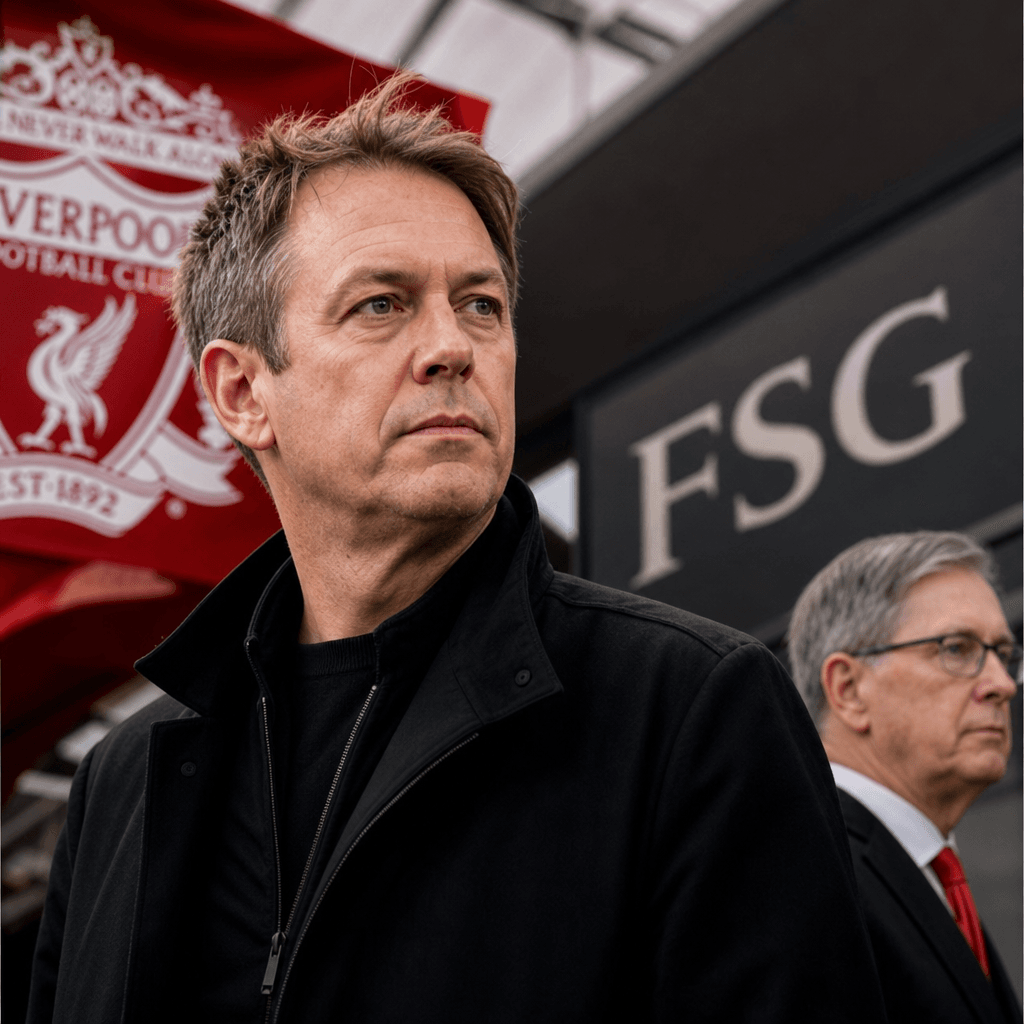
Michael Edwards leaves Liverpool and FSG has left his role as chief executive officer of football for Fenway Sports Group, the owners of Liverpool, in a development that will shape the club’s next phase ahead of the 2026/27 season. According to Sky Sports, the move marks another significant change in the power structure around one of Europe’s most closely watched football operations, with Liverpool now facing a major transition at senior executive level.
The departure of Edwards matters because his name has long been associated with Liverpool’s modern football strategy, recruitment structure and long-term planning. His exit from FSG’s football leadership comes at a time when elite clubs are under intense pressure to combine sporting success with sound governance, strong recruitment, and financial control. For Liverpool, the timing adds extra intrigue because the club is already planning for future seasons while remaining in the middle of a highly competitive era domestically and in Europe.
Table of Contents
What happened
Michael Edwards leaves Liverpool and FSG has left his position as CEO of football for Fenway Sports Group. FSG, of course, are the ownership group behind Liverpool, and the decision means that one of the key football figures linked to the club’s modern era is stepping away before the 2026/27 season.
The information, as reported by Sky Sports, is straightforward but significant. Edwards has not merely changed internal responsibilities; he has moved out of a senior football role that connected the ownership group’s overall sporting strategy with Liverpool’s day-to-day football direction.
That distinction is important. In modern football, ownership structures are often complex, and the role of a football executive is not limited to transfers alone. It can encompass recruitment philosophy, squad planning, management of football departments, alignment with coaching staff, and broader sporting oversight. Edwards’ departure therefore represents more than a routine personnel update. It is a change at the top of the football decision-making chain.
For Liverpool supporters, the name Michael Edwards leaves Liverpool and FSG will already carry strong associations. His return to a major role at FSG was viewed by many as a statement of intent from the ownership group, underlining the importance they place on coherent football leadership. His exit, then, is likely to be seen as a major development not just because of the title he held, but because of what that title represented in the club’s overall structure.
To understand why this matters, it is useful to compare Liverpool’s situation with other clubs that operate under a more formal football architecture. For example, readers who want a broader look at how elite clubs build and manage their sporting departments can explore our guide to Champions League Explained: Format, Money and Why It Defines European Football, which shows how the modern game rewards strong planning at every level.
Why Michael Edwards leaves Liverpool and FSG matters
Liverpool are one of the biggest clubs in world football, and decisions made at ownership level can affect the sporting direction for years. When a senior executive with football responsibilities leaves, it can alter how a club approaches player recruitment, contract planning, and long-term strategy.
That is especially true for a club such as Liverpool, where the relationship between ownership, recruitment, and coaching has been central to modern success. In the Premier League, where margins are tight and the difference between winning titles and finishing outside the top spots can be small, the stability of the executive team is often just as important as the quality of the squad.
Michael Edwards leaves Liverpool and FSG at a moment when continuity matters. Edwards’ departure matters on several levels:
1. Leadership continuity
A football club’s leadership structure is most effective when there is continuity. If a key executive leaves, the club may need to adjust how decisions are taken and who holds final responsibility for major football matters. That can affect everything from transfer timing to succession planning.
2. Recruitment direction
Elite clubs do not buy players randomly. They build systems to identify targets, assess value, and fit players into a wider strategic plan. A change in executive leadership can influence how those systems work, even if the broader philosophy remains in place.
3. Long-term planning
Football at the top level is increasingly planned in multi-year cycles. Clubs look ahead to future windows, contract renewals, and squad evolution well before those moments arrive. Michael Edwards leaves Liverpool and FSG ahead of the 2026/27 season, which suggests Liverpool and FSG now face another period in which future planning must be managed carefully.
4. Governance and accountability
Modern football governance places heavy importance on clarity of roles. Who decides? Who approves? Who oversees the sporting model? A senior exit creates a need for clarity so that the club’s football operation continues without disruption.
For an international audience, this is a reminder that football clubs are not just teams on the pitch. They are large sporting businesses in which leadership changes can have as much impact as a manager arriving or leaving.
The football business angle
Edwards’ role at FSG sat at the intersection of football performance and business discipline. That is a crucial area for clubs operating at the top end of the sport, where commercial power, wage structures, transfer spending and squad efficiency all need to be balanced.
Liverpool’s ownership model under FSG has often been discussed in the context of sustainability and strategy. In that environment, a CEO of football is not simply a figurehead. The position can influence how resources are allocated across the football side of the organisation.
Michael Edwards leaves Liverpool and FSG with that wider business context in mind, and the timing matters because elite clubs plan across several seasons rather than one transfer window.
As part of that wider context, Liverpool’s executive structure has always been tied to the broader conversation about how a modern top club operates. That is why stories about leadership change often sit alongside other football-business debates, from recruitment to commercial performance and the role of ownership in shaping sporting outcomes.
Recruitment efficiency and squad value
Top clubs try to maximise value in the transfer market. That means identifying players who can contribute on the pitch while also fitting the club’s longer-term financial and sporting plan. When a football executive leaves, one question is whether the club’s decision-making process changes or whether the framework already in place remains strong enough to absorb the transition.
Planning ahead of key seasons
Liverpool’s mention of the 2026/27 season gives the exit a future-facing dimension. Football departments often work far beyond the current campaign, mapping out squad needs and structural changes well in advance. Leaving before that season allows FSG time to reconsider who leads football operations into the next cycle.
Organisational control
At the elite level, clubs are under constant scrutiny from fans, media, regulators and commercial partners. A leadership change can also affect how the outside world views stability inside the club. Investors and commercial stakeholders often like clarity, and a clean executive structure can be important in maintaining confidence.
In that sense, the departure is not just a Liverpool story. It is also a case study in how modern football clubs are run. For readers interested in the commercial side of the sport, our article on Why Transfer Rumours Attract Millions of Football Fans explains how football decisions can influence attention, behaviour and market interest across the game.
Edwards and Liverpool’s modern identity
Michael Edwards leaves Liverpool and FSG has long been linked with Liverpool’s recent football identity, even before this latest development. His name has often been associated with the kind of strategic thinking that has helped the club operate as a serious force in elite football.
That is one reason his exit stands out. When a senior football executive becomes strongly associated with a club’s successful period, their departure carries symbolic weight. It can feel like the end of an era, even when the team itself continues with other leaders in place.
Liverpool’s rise in the modern game has depended on different parts of the structure working together: ownership, recruitment, coaching, data, finance and sporting performance. Edwards’ role at FSG was part of that wider architecture. He was not a public-facing manager on matchdays, but his influence would have been felt in many decisions around the football operation.
This is where governance in football becomes especially important. Clubs today need people who understand both the sport and the business behind it. If a senior executive leaves, the club must not only replace a name on an organisational chart. It must preserve knowledge, relationships and process.
That wider identity also helps explain why Liverpool remain such a reference point in conversations about the Premier League. The league’s global reach is tied not only to match quality but also to the way leading clubs build their institutions. For more on that broader context, see our piece on Premier League Explained: Why It Remains the World’s Most-Watched Football League.
What this could mean for Liverpool
It would be premature to draw dramatic conclusions about Liverpool’s immediate football future solely from this announcement. The source material confirms Edwards’ departure from FSG’s football leadership, but it does not provide detail about the full internal response or any named successor. Still, even without those specifics, there are several likely areas of focus.
Michael Edwards leaves Liverpool and FSG at a point where the club will want calm, clarity and continuity across key sporting decisions.
Squad planning
Liverpool will want to ensure that transfer planning remains efficient and aligned with the club’s football priorities. The timing of an executive exit can affect how a club approaches future windows, especially if key decisions were already being mapped out by the existing structure.
Internal roles and responsibility
With a high-profile football executive leaving, there may need to be clarity on who now carries which responsibilities. That matters for communication with the manager, recruitment staff and other departments. Smooth internal alignment is vital if the club is to avoid any disruption.
Fan perception
Supporters often interpret executive changes through the lens of results, trust and ambition. For a club like Liverpool, where expectations are always high, fans will be keen to know how the exit fits into FSG’s wider football plan. Even when a change is part of routine restructuring, the perception of stability is important.
Wider strategic alignment
FSG have historically been associated with methodical planning. If one of their key football leaders is leaving, the group will likely need to reinforce how the Liverpool operation remains aligned with the broader ownership strategy. That includes the balance between sporting ambition and financial discipline.
The governance perspective
From a governance standpoint, this is a notable reminder of how clubs operate behind the scenes. Football is often judged only through results, but the executive layer can shape those results by creating the conditions for success.
A CEO of football role at a multi-club or ownership-wide level is especially significant because it can link the strategic aims of the owners to the needs of individual clubs. When that figure changes, the club’s leadership model may evolve too.
For Liverpool, a club with global reach and strong commercial standing, governance clarity will be essential. Changes at the top need to be communicated internally and managed in a way that maintains focus on football performance. Even when the public details are limited, the importance of the role itself is clear.
There is also a broader lesson here for football as a whole. The game has become more corporate, more data-driven and more structurally complex than ever. Clubs that manage transitions well tend to protect their competitive edge. Clubs that do not can find themselves moving between phases of uncertainty.
This is one reason leadership changes are monitored so closely across the sport. A club’s success depends on the links between the boardroom and the training ground, and those links are strongest when the football department has clear direction. The departure of a senior figure such as Edwards will therefore be read not only as a staffing change, but also as a test of the club’s broader structure.
The timing ahead of 2026/27
The reference to Liverpool leaving ahead of the 2026/27 season gives this development a long-range edge. That does not necessarily imply an immediate crisis. Instead, it suggests a transition that is being considered in a forward-looking way.
In football, the best-run organisations rarely wait until a deadline is upon them before making structural decisions. Planning for the next cycle can begin years in advance, particularly when it involves major leadership roles. If Edwards is departing before that season, FSG have a meaningful window to assess what comes next.
That timeframe also matters because clubs are always balancing short-term sporting goals with longer-term structural decisions. Liverpool will want continuity on the pitch while ensuring their off-pitch framework remains strong enough to support the next stage of development.
The key point is not only who leaves, but how the club prepares for the following cycle. That is where the phrase Michael Edwards leaves Liverpool and FSG becomes more than a headline: it becomes a sign that the next stage of planning has already started, even if the public details are limited.
How the market will view the move
In the football business world, senior exits are often monitored closely because they can signal more than a simple personnel change. They can indicate a shift in governance style, a new strategic phase, or a reorganisation of power within a club or ownership group.
Because Liverpool are such a prominent club, Edwards’ exit is likely to attract attention across the sport. Rivals, analysts and supporters will all be watching to see whether FSG follow this decision with another internal adjustment or a broader reshaping of football leadership.
From a market perspective, consistency matters. Clubs with clear structures tend to be viewed more favourably by those studying long-term football operations. A departure at senior level does not automatically mean instability, but it does create a moment when that stability must be demonstrated.
That market view is also shaped by the wider football environment. In an era when clubs compete for elite talent, efficient structures often help teams remain competitive even when the landscape changes. The executive layer can be less visible than the first team, but it still affects recruitment, planning and confidence.
What comes next
The immediate next step will be for FSG and Liverpool to manage the transition around Edwards’ departure. In practical terms, that means ensuring the football operation remains organised and that any responsibilities tied to his role are clearly accounted for.
For the club, the main priorities will be continuity, communication and strategic clarity. Those are the foundations that matter most when a senior football executive leaves.
For supporters, the headline is simple: another major change has arrived in the Liverpool structure. For the wider football world, it is a reminder that leadership moves at the top of the game can be just as consequential as changes on the bench or in the transfer market.
There will also be attention on whether the departure leads to a subtle reorganisation or a more visible adjustment in the club’s football hierarchy. At this stage, the available information does not confirm those answers, but it does make clear that Liverpool’s long-term structure is once again in focus.
Conclusion
Michael Edwards’ departure from his role as CEO of football for FSG is a major development for Liverpool’s ownership structure and future planning. It does not by itself define the club’s next era, but it does signal a change in the architecture that supports the team’s football strategy.
In a sport where success depends on much more than the 11 players on the pitch, the loss of a senior executive can be significant. Liverpool now enter another period of adjustment, and the way FSG handle this transition will be closely watched.
The broader lesson is that football leadership matters at every level. When Michael Edwards leaves Liverpool and FSG, the impact goes beyond one person and one title; it reaches into recruitment, governance, planning and the club’s wider identity.
Editor Notes:
– Source Credit: Sky Sports, reporting that Michael Edwards has left his role as chief executive officer of football for Fenway Sports Group, leaving Liverpool ahead of the 2026/27 season.
– Names used: Michael Edwards, Fenway Sports Group, Liverpool, Sky Sports
– Numbers/values used: 2026/27 season
– Claims that need human verification: Exact date of departure; whether a successor has been appointed; internal reasons for the exit; any quotes or statements beyond the source summary; full details of Edwards’ responsibilities and whether the structure changes further
– Suggested Image Prompt: A professional football executive in a modern stadium executive suite with Liverpool-themed red tones, blurred pitch in the background, editorial news style, realistic lighting
– Publish Risk: Medium
For readers following the wider football landscape, this kind of leadership change also fits into the bigger story of how top clubs build their identities, much like the strategic planning behind the Premier League and the European game’s elite competitions.
Michael Edwards leaves Liverpool and FSG with questions about continuity, but it also reinforces how much modern football depends on stable executive planning. Michael Edwards leaves Liverpool and FSG at a time when the club will want every part of its structure aligned for the next cycle. Michael Edwards leaves Liverpool and FSG may be the headline, yet the real story is how Liverpool respond. Michael Edwards leaves Liverpool and FSG is now a key reference point for discussions about governance, recruitment and long-term football direction. Michael Edwards leaves Liverpool and FSG will continue to be monitored closely as the 2026/27 season approaches.