Chelsea defensive flaw is the question that should be asked after Xabi Alonso’s impressive start at Stamford Bridge. Chelsea are scoring goals, winning matches and beginning to look more dangerous in attack — but one defensive statistic is creating a warning that cannot be ignored.
Chelsea have gone 18 consecutive Premier League matches without a clean sheet, while their first two league games of the new season have produced seven goals scored but five conceded.
The problem is not simply that Chelsea are conceding goals.
The bigger question is whether they can keep winning when the level of opposition rises.
Because a team chasing the Premier League, major European honours and the biggest trophies cannot rely on scoring more goals than its opponents every week.
That is where the Chelsea defensive flaw becomes a problem for their ambitions.
Chelsea Defensive Flaw: The Number Alonso Cannot Ignore
 The beginning of the Alonso era has been encouraging.
Chelsea beat Fulham 3–2 before defeating Brighton 4–3. That means two Premier League games, six points and seven goals.
But the other side of those numbers tells a very different story.
Five goals conceded in two league matches.
And that comes after Chelsea had already reached a run of 18 consecutive Premier League matches without a clean sheet.
This means the issue did not suddenly appear against Brighton.
It is a problem Alonso inherited and now has to solve.
However, simply saying “Chelsea concede too many goals” misses the bigger tactical issue.
The real concern is defensive control.
Brighton Exposed the Problem Hidden Behind the 4–3 Victory
 Look beyond the final score.
Chelsea were 3–0 ahead after just 32 minutes against Brighton.
For a team with title ambitions, that should be the moment when the match moves into control mode.
Instead, Brighton found a way back.
Malick Yalcouyé reduced the deficit before half-time. João Pedro’s own goal made it 3–2, and although Cole Palmer restored Chelsea’s two-goal cushion, Pascal Groß scored again late in the match.
Chelsea won 4–3.
But The Football Xtra sees a different question:
Why did a match that looked effectively finished at 3–0 become dangerous again?
That is where the Chelsea defensive flaw becomes visible.
It is not only about the goals conceded.
It is about Chelsea’s inability to kill the momentum of an opponent once the game starts moving against them.
The Biggest Problem Is Not Conceding — It Is Losing Control
 Every team concedes goals.
That alone does not make a defence dysfunctional.
Elite teams can concede and still remain structurally dominant.
They can concede and continue controlling territory.
They can concede and prevent the opponent from building momentum.
Chelsea did not consistently do that against Brighton.
Once Brighton began to believe they could come back, the match became much more open.
That creates a series of tactical questions Alonso must answer.
When Chelsea lose possession, who closes the first passing lane?
Who protects the space in front of the centre-backs?
Who stops the opposition transition?
Are the full-backs positioned to recover quickly?
Are the midfield lines compact enough to prevent opponents receiving between the lines?
These questions are far more important than simply counting tackles or interceptions.
Alonso Must Not Sacrifice Attack — He Must Add Control
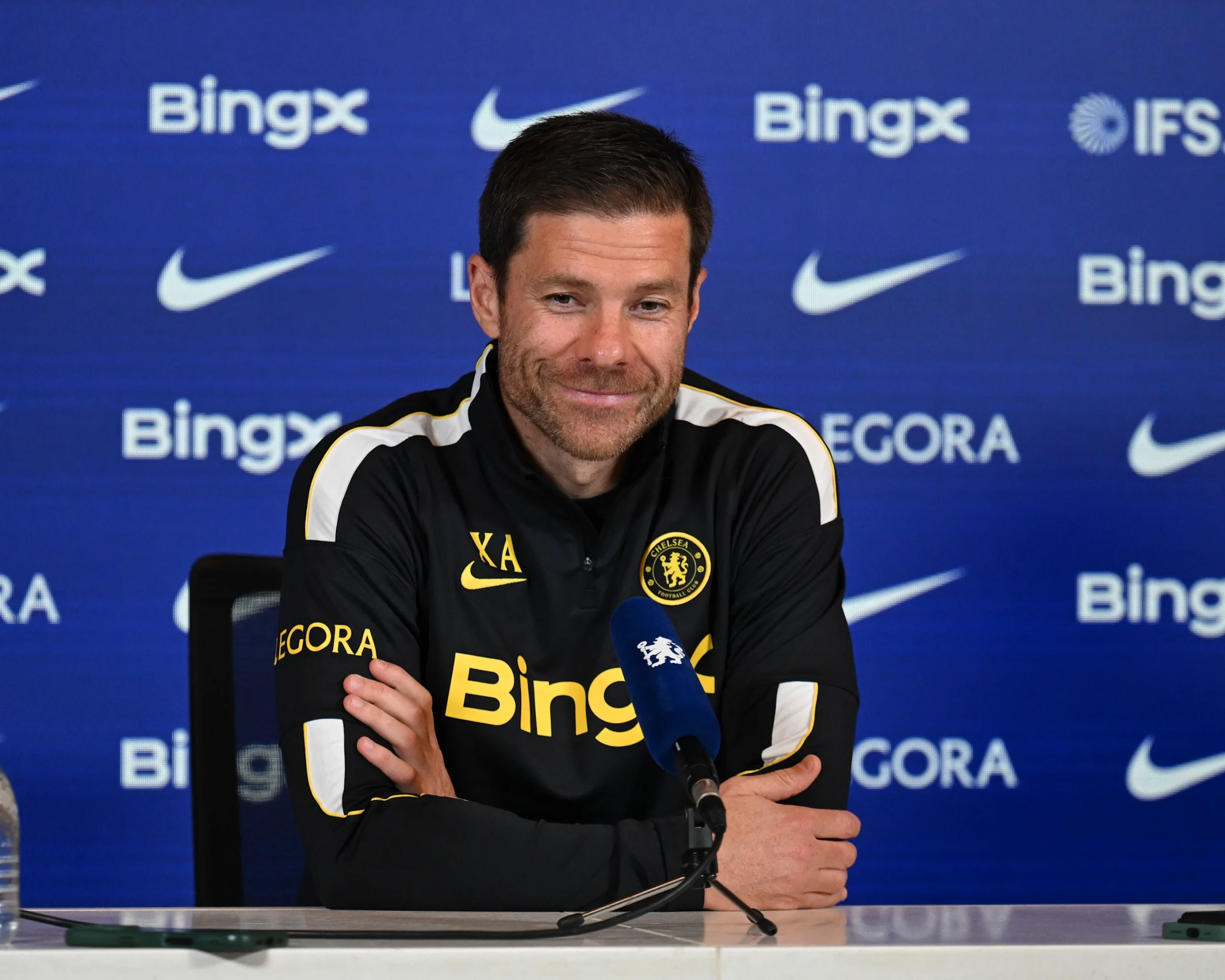 This is where the tactical discussion becomes particularly interesting.
Xabi Alonso did not build his reputation at Bayer Leverkusen by asking his teams to sit deep and defend.
His football was based on possession, pressing, positional flexibility and aggressive reactions after losing the ball.
Leverkusen’s 2023/24 Bundesliga campaign is the clearest evidence. They finished unbeaten and conceded only 24 league goals in 34 matches.
That is crucial context.
Alonso does not need to turn Chelsea into a defensive team.
He needs to make Chelsea’s attacking football more secure behind the ball.
That is the evolution required.
Why Chelsea Defensive Flaw Could Become a European Problem
This is where the story becomes bigger than Brighton.
Chelsea are not competing in the Champions League in the 2026/27 season, but the long-term ambition at Stamford Bridge is obviously much greater than simply winning attractive Premier League matches.
Eventually, Chelsea want to return to the stage where they face Europe’s best teams.
And European knockout football punishes defensive instability in a different way.
In a league match, conceding two goals but scoring three can still give you three points.
In a knockout tie, one bad defensive transition can change everything.
Imagine Chelsea dominate a first leg.
They lead 2–0.
Then they lose the ball in a dangerous area.
The opponent scores on the counter.
Suddenly it is 2–1.
The opponent believes again.
The second leg changes.
The pressure changes.
The tactical plan changes.
The atmosphere changes.
This is why elite European knockout football is often decided by small margins and defensive concentration.
The best attack does not always win.
The team that makes fewer costly mistakes often does.
Chelsea therefore need to evolve from a team that can win chaotic matches into one that can also control chaotic matches before they become dangerous.
Chelsea Defensive Flaw Is Also a Title-Race Problem
The same issue applies to the Premier League.
A title is not won because you produce one spectacular performance.
It is won through consistency over an entire season.
Chelsea cannot continually turn matches into:
4–3.
3–2.
3–2.
2–1.
They may still win plenty of games.
But every match becomes more dependent on finishing quality, individual brilliance and moments of fortune.
That creates pressure.
At some stage, even a brilliant attack cannot compensate for repeated defensive instability.
The elite teams understand something Chelsea are still learning:
Sometimes controlling the match is more valuable than dominating it.
Alonso Has to Build a Stronger Rest-Defence
One of the most important solutions is improving Chelsea’s rest-defence structure.
Rest-defence refers to how a team positions players behind the ball while attacking so it is protected against the opposition counterattack.
That is especially important for Alonso.
Chelsea want to attack with numbers.
That naturally means players will move forward.
But when possession is lost, someone has to immediately protect the team.
The structure should make sure that Chelsea always have enough players in useful positions to stop the first counter.
Without that protection, an aggressive attacking system can quickly become vulnerable.
The answer is not fewer attacks.
It is better preparation for the moment immediately after the attack breaks down.
Midfield Protection Could Decide Chelsea’s Ceiling
This is why Moisés Caicedo could become one of Alonso’s most important players.
Caicedo’s importance is not limited to making tackles.
His real value is what happens before a defensive emergency begins.
Can he close passing lanes?
Can he win second balls?
Can he cover for an advancing full-back?
Can he protect the centre-backs?
Can he stop a transition in its first few seconds?
Those are the details that turn an aggressive side into a balanced side.
Chelsea need midfielders capable of giving the attacking players freedom without leaving the defenders exposed.
Chelsea Need to Learn How to Change Gear
 This could be the single biggest development Alonso must introduce.
Chelsea do not need to play at maximum attacking intensity for 90 minutes.
At 3–0, the game should have a different rhythm.
Possession can become a defensive weapon.
Shorter passing sequences can slow the opposition down.
Chelsea can force the opponent to chase.
The midfield can become more compact.
The full-backs can become more selective about when they attack.
That is not negative football.
That is game management.
The best teams in Europe know how to switch between attacking and controlling modes without losing their identity.
Chelsea still need to master that switch.
The Football Xtra Recommendation: Three Defensive Fixes
1. Protect the space in front of the centre-backs
Chelsea cannot allow opponents to receive centrally with time and space to turn.
The midfield has to provide stronger protection.
2. Improve defensive transitions
Once possession is lost, the reaction must be immediate and coordinated.
One player pressing while everyone else retreats is not enough.
The entire structure has to react together.
3. Introduce a clearer game-management plan
After Chelsea take a significant lead, they need to understand when to continue attacking and when to reduce unnecessary risk.
That balance will be essential if Alonso wants to compete for major trophies.
Arsenal Could Provide the First Real Examination
Chelsea’s next major Premier League test is Arsenal on 5 September 2026.
That match could reveal far more about Alonso’s team than another high-scoring victory.
Brighton demonstrated Chelsea’s attacking power.
Arsenal can test their defensive control.
They can test Chelsea’s ability to protect central spaces.
They can test the midfield’s defensive positioning.
They can test what happens immediately after possession is lost.
And, perhaps most importantly, they can test whether Chelsea can protect a lead without allowing the match to become chaotic.
That is why the Arsenal fixture should be viewed as more than another early-season game.
It is a test of Chelsea’s control.
The Biggest Trophy Problem Is Not Simply Conceding Three Goals
This distinction matters.
The problem is not that Brighton scored three.
The problem is that Chelsea allowed the game to reach a point where another Brighton goal could have turned a 4–2 lead into a completely different situation.
SEE ALSO; Chelsea Sign Emiliano Martínez: Why £7.5m Could Transform Chelsea’s Winning Mentality
That is dangerous.
Against Brighton, Chelsea survived because their attack created enough decisive moments.
Against an elite opponent in a European knockout tie, there may be no room for that kind of recovery.
That is why the 18-game clean-sheet drought deserves serious attention.
It is not simply an ugly statistic.
It is a question of repeatability and reliability.
A trophy-winning team has to reproduce its level under pressure.
What Alonso Must Build Next
There is plenty to like about Chelsea’s start.
The attack looks more dynamic.
The players appear more confident.
The football is more aggressive.
The Stamford Bridge atmosphere has changed.
And Alonso has quickly introduced a clearer attacking identity.
But the next stage of the project is harder.
He must make Chelsea comfortable without the ball as well as dangerous with it.
He needs to improve the team’s defensive transitions.
He needs to establish stronger rest-defence principles.
He needs midfield protection in front of his centre-backs.
And he needs his players to understand that controlling a match can sometimes be more valuable than continuing to attack relentlessly.
The Football Xtra Verdict
Chelsea do not need to become defensive under Xabi Alonso. They need to become defensively intelligent.
That means keeping the creativity, movement and attacking ambition that have made the opening weeks so exciting while adding a defensive framework capable of surviving the moments when possession disappears.
Because the difference between Chelsea winning 4–3 and Chelsea winning 1–0 is not simply entertainment.
Sometimes it is the difference between a team that is exciting to watch and a team capable of lifting the biggest trophies.
Attack can take you to a final. Defensive control can win it.
For Chelsea, that is the next evolution of the Alonso project.
The manager has restored the belief.
Now he has to build the control.
And that could ultimately determine whether this Chelsea revival becomes another exciting chapter — or the beginning of a genuine trophy-winning era.
What do you think Chelsea must fix first: their defensive structure, midfield protection, or game management when they take the lead?